
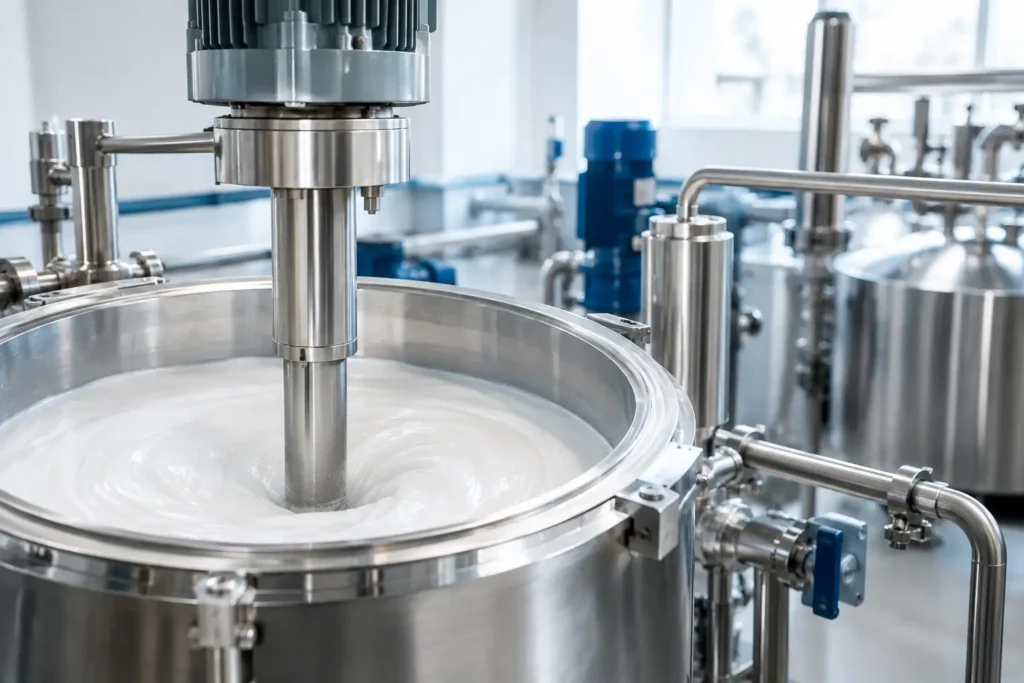
A dressing that looks smooth at the end of a pilot batch can still separate after thermal processing, lose viscosity during filling, or show unacceptable droplet-size variation at production volume. The difference is rarely a single mixer setting. A reliable industrial emulsification process guide begins with the conditions that govern energy transfer, interfacial stabilization, residence time, and air management across the entire process.
Emulsification is not simply blending oil and water. It is the controlled creation and stabilization of droplets in an immiscible phase. The process must apply enough mechanical or hydraulic energy to break droplets to the required size range, then give emulsifiers, proteins, hydrocolloids, or surfactants the time and conditions needed to stabilize the newly created interface. If either requirement is missed, the batch may appear acceptable initially but fail in storage, transport, heating, or downstream filling.
What an Industrial Emulsification Process Must Control
Product quality is determined by more than average droplet size. The full droplet-size distribution matters because a small population of oversized droplets can drive creaming, coalescence, oiling off, or visual defects. For suspensions and semi-solids, particle-size distribution, viscosity profile, yield stress, and entrained-air content may be equally important.
The processing zone must deliver energy where it produces useful deformation. In an inline rotor-stator mixer, high tip speed, tight rotor-stator clearance, turbulence, and localized pressure changes accelerate fluid through engineered shear zones. In a high-pressure homogenizer, hydraulic energy is released as product passes through a precisely controlled valve assembly, creating intense velocity gradients, impact, and cavitation effects. Each route can reduce droplet size, but they do not produce identical process outcomes.
Formulation sets the operating window. Oil-phase viscosity, dispersed-phase volume, temperature, interfacial tension, emulsifier selection, and the hydration state of stabilizers all influence the energy required. A 70% oil mayonnaise-like system requires a different processing strategy than a low-viscosity beverage emulsion or a silicone-based personal-care lotion. Higher viscosity can improve stability after processing, yet it can also limit flow through an inline device and raise pumping demands.
Begin With the Required Product Structure
Define the output before selecting equipment. A meaningful process target includes droplet or particle-size range, distribution width, viscosity at a stated temperature and shear rate, density or air content, shelf-life criteria, batch size, throughput, and cleaning requirements. For regulated applications, the target should also address sanitary construction, material traceability, CIP/SIP compatibility, and documentation requirements.
Bench formulations are useful, but small-scale agitation is not a direct model for commercial equipment. A lab vessel may achieve an acceptable result through long mixing times and favorable wall effects that disappear at scale. Commercial scale-up must preserve the relevant energy mechanism, not merely the RPM or the mixing time. Matching tip speed alone can be misleading when rotor diameter, flow rate, recirculation path, and hydraulic losses change.
A process assessment should therefore identify whether the product needs a single-pass result, controlled recirculation, or multiple high-energy passes. It should also establish the maximum acceptable temperature rise. Energy that reduces droplet size also becomes heat, and temperature can change viscosity, destabilize proteins, damage actives, or alter volatile flavor components.
Match the Equipment to the Energy Requirement
Inline high-shear mixers and emulsifiers are often the right choice when a product requires rapid incorporation, moderate-to-high shear, and predictable recirculation through a sanitary process loop. They are particularly effective for sauces, dressings, creams, polymer dispersions, and many liquid formulations where the desired result can be reached with rotor-stator processing.
High-pressure homogenizers are typically selected when very fine, narrow droplet distributions are required or when formulation performance depends on more intense hydraulic energy transfer. They are common in dairy, beverages, pharmaceutical emulsions, nutraceuticals, and advanced materials. The trade-off is higher pressure, increased capital complexity, and greater attention to feed consistency, valve wear, and pressure-rated system design.
Colloid mills can provide controlled grinding and shearing for viscous products, pastes, and systems containing soft agglomerates. They are valuable when gap adjustment and milling action are central to the result. However, a colloid mill is not automatically the best solution for every stable fine emulsion. If the product requires submicron-scale control or exceptionally narrow distribution, high-pressure processing may be more appropriate.
Vacuum emulsifying systems are often justified when air removal is part of product quality. Cosmetics, ointments, creams, gels, and viscous personal-care products can trap air during powder addition and high-shear mixing. Vacuum reduces foam, improves density control, supports faster deaeration, and can improve finished-product appearance. It also adds process complexity, so the vacuum level, vessel design, condenser arrangement, and product volatility must be evaluated together.
Build the Process Around Flow, Not Just the Mixer
An inline device performs only on the material that passes through its processing zone. For recirculated batch production, the actual result depends on flow rate, tank turnover, number of passes, and how effectively the return line prevents bypassing or stagnant regions. A powerful mixer installed in a poorly designed loop can produce a wide distribution because part of the batch receives repeated processing while another portion receives too little.
Tank geometry and agitation still matter. A sweep agitator or anchor may be needed to move high-viscosity material toward the inline loop. A properly designed tank impeller can maintain bulk uniformity while the high-shear device creates the required droplet reduction. This division of labor is often more efficient than asking one conventional agitator to perform both functions.
Pump selection also deserves attention. Positive-displacement pumps can handle viscous products and provide consistent transfer, but excessive slip, pulsation, or shear-sensitive pumping can affect process behavior. Centrifugal pumps suit lower-viscosity recirculation duties but may lose performance as viscosity rises. The best choice depends on rheology, required flow, pressure drop, sanitary requirements, and allowable shear before the product reaches the primary processing zone.
Control Powder Addition and Entrained Air
Many emulsification failures start before the emulsion is formed. Powders added through an open vessel can float, form fisheyes, agglomerate, or introduce substantial air. Once stabilizers are partially hydrated on the surface of an agglomerate, breaking that structure can require much more energy than dispersing the powder correctly at the outset.
Powder induction systems use vacuum and controlled liquid flow to draw powders into a wetting and dispersion zone. This approach can shorten hydration cycles, improve operator safety, reduce dust, and create more repeatable addition rates. The right sequence remains formulation-specific. Some hydrocolloids should be predispersed in oil, some require controlled pH, and others need a defined hydration hold before high-shear processing.
Air should be treated as a process variable, not a cosmetic issue. Entrained air can distort density measurements, cause fill-weight variation, accelerate oxidation, interfere with heat transfer, and create foam during downstream pumping. Inline deaeration or vessel vacuum may be warranted when low-air specifications, high-viscosity processing, or sensitive finished-product appearance is required.
Validate Scale-Up With Measurable Evidence
Scale-up should be confirmed through process data rather than visual inspection alone. Collect droplet or particle-size measurements at defined passes or residence times. Track temperature rise, pressure, flow, motor load, viscosity, density, and product samples before and after thermal treatment where applicable. Stability testing should reflect real exposure conditions, including storage temperature, freeze-thaw cycling, centrifugation where relevant, and packaging interaction.
This data establishes a defensible operating range. Instead of instructing operators to mix until smooth, the batch record can specify flow, recirculation time, rotor-stator speed, homogenization pressure, temperature limits, and endpoint criteria. That is the difference between a process dependent on operator judgment and one engineered for repeatability.
Automation strengthens this control. A PLC/HMI platform can manage recipe parameters, valve sequencing, pump interlocks, temperature alarms, vacuum control, and data capture. For engineered turnkey skids, integrating tanks, pumps, inline processing equipment, instrumentation, and CIP circuits from the outset reduces the risk of mismatched components and unvalidated transfer conditions.
Design for Cleaning and Production Reality
A system that produces a stable emulsion but cannot be cleaned reliably is not a complete industrial solution. Hygienic design requires drainable piping, appropriate surface finish, sanitary seals, cleanable dead-leg management, and CIP coverage of every product-contact zone. High-viscosity products may require special attention to return-line velocity and cleaning chemistry because residue can remain in low-flow areas.
Maintenance access matters as well. Rotor-stator heads, homogenizer valves, seals, and mill components are wear items in demanding service. Designing for inspection and predictable replacement protects product consistency and reduces unplanned downtime. EmulXion evaluates these mechanical realities alongside the fluid-processing objective, because documented performance must remain achievable after installation.
The most effective next step is to process a representative formulation under controlled conditions, measure the outcome, and use that evidence to define the commercial operating window. When energy, flow, formulation, and cleaning are engineered as one system, product quality becomes a controlled result rather than a favorable batch outcome.


