
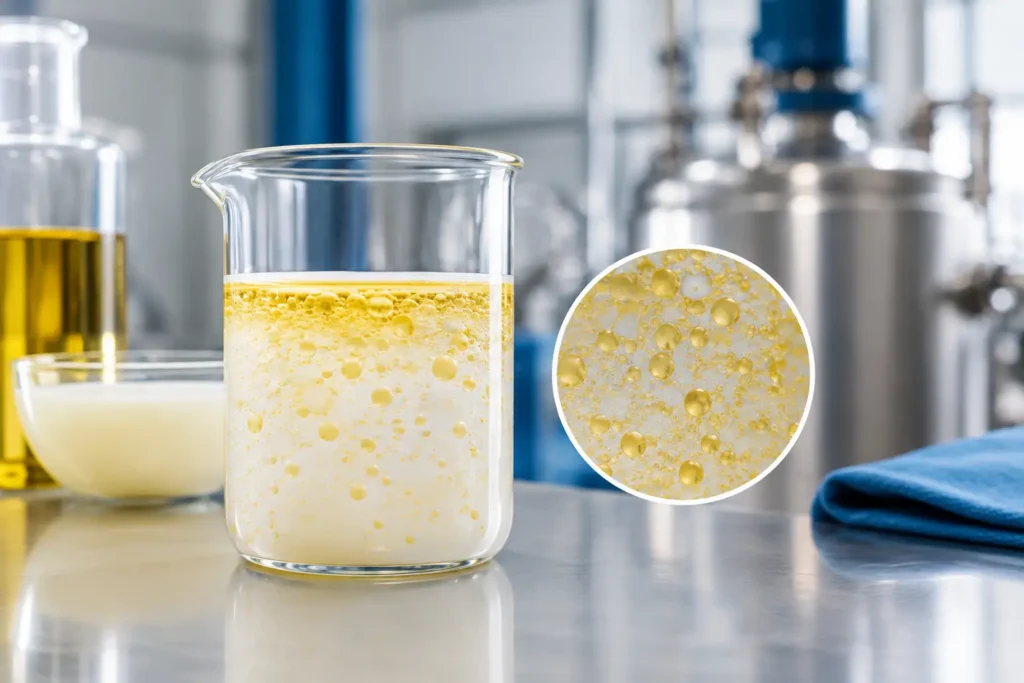
An emulsion that looks uniform at the discharge point can still fail in a tote, on a retail shelf, or during downstream filling. Creaming, coalescence, oiling off, viscosity drift, and phase inversion are rarely isolated formulation problems. They are usually evidence that interfacial chemistry and process energy are not working together. Knowing how to stabilize oil emulsions means controlling both – the formulation that protects droplets and the processing conditions that create a repeatable droplet-size distribution.
For manufacturers, stability is not simply a visual target. It is a measurable production outcome tied to shelf life, batch-to-batch consistency, sensory performance, pumpability, and yield. A stable dressing, cream, coating, nutraceutical suspension, or chemical emulsion must remain within specification after thermal cycling, storage, transport, and normal production variation.
How to Stabilize Oil Emulsions: Start With the Failure Mode
Oil-in-water emulsions contain dispersed oil droplets surrounded by a continuous water phase. Water-in-oil emulsions reverse that structure. In either case, the goal is to create small droplets, cover their interfaces with the right emulsifier system, and prevent those droplets from moving together or merging over time.
The first engineering question is not which mixer to buy. It is why the existing emulsion is destabilizing. Different failure modes point to different corrective actions.
Creaming or sedimentation occurs when density differences cause droplets to migrate through the continuous phase. The droplets may remain intact, but the product becomes nonuniform. Increasing continuous-phase viscosity, reducing droplet diameter, or lowering the density difference can slow this migration.
Flocculation occurs when droplets cluster without fully merging. It can precede more serious instability and may alter appearance or rheology. Coalescence is the permanent merger of droplets into larger droplets, often followed by visible oil separation. This usually indicates insufficient interfacial coverage, poor emulsifier selection, inadequate droplet-size control, or damaging temperature and shear conditions.
Phase inversion is a separate problem. It can occur when the internal phase volume becomes too high, when the order of ingredient addition is wrong, or when temperature changes alter emulsifier behavior. A product designed as oil-in-water can suddenly convert to water-in-oil, often with a dramatic viscosity shift.
Build Interfacial Protection Before Applying More Energy
Mechanical energy creates new interfacial area by breaking large oil droplets into smaller ones. But every new surface must be rapidly protected. If emulsifier molecules cannot reach and cover that surface quickly enough, freshly formed droplets can collide and coalesce almost immediately.
Emulsifier selection should match the required emulsion type, oil phase, aqueous phase, pH, ionic strength, processing temperature, and finished-product requirements. In food systems, this may involve proteins, lecithin, modified starches, mono- and diglycerides, or gum-supported systems. Personal care and pharmaceutical formulations may use nonionic surfactants, polymeric emulsifiers, phospholipids, or specialized co-emulsifier packages.
Hydrophilic-lipophilic balance is useful as an initial screening tool, but it is not a complete formulation answer. Two emulsifiers with similar HLB values can perform differently because of adsorption rate, film strength, electrolyte tolerance, and interaction with other ingredients. Protein-stabilized systems, for example, are strongly affected by pH relative to the protein’s isoelectric point.
The emulsifier must also be fully dispersed or hydrated before intense droplet breakup begins. Poor powder wetting can leave undissolved agglomerates, create localized concentration gradients, and reduce the amount of active emulsifier available at the oil-water interface. Powder induction and controlled hydration are often as important as the final homogenization pass.
Control Droplet Size, Not Just Mixer Speed
Smaller droplets generally cream more slowly and can improve emulsion stability. However, simply increasing mixer RPM does not guarantee smaller, more uniform droplets. The relevant variables are local shear rate, energy dissipation, rotor-stator gap, residence time in the high-energy zone, viscosity ratio, interfacial tension, and recirculation pattern.
Conventional tank agitators are effective for bulk turnover and ingredient blending, but they distribute energy broadly through the vessel. That can leave a wide droplet-size distribution, especially in viscous systems or batches with variable addition rates. A few large droplets can dominate stability performance even when the average droplet size appears acceptable.
Inline rotor-stator mixers concentrate mechanical and hydraulic energy in a controlled processing zone. Fluid is accelerated through precisely engineered rotor-stator openings, where intense shear and turbulence reduce droplets before the product returns to the loop or moves downstream. For many emulsions, multiple controlled passes through an inline high-shear mixer produce tighter results than extending tank mixing time.
High-pressure homogenizers apply a different mechanism. Product is forced through a narrow valve or interaction zone, generating high velocity, pressure drop, turbulence, and controlled cavitation. This approach is especially valuable when very fine droplet sizes, narrow distributions, or high stability are required in dairy, beverages, pharmaceuticals, biotechnology, and demanding personal-care formulations.
More energy is not always better. Overprocessing can raise product temperature, damage shear-sensitive ingredients, alter viscosity modifiers, introduce excess air, or destabilize protein systems. The correct target is the minimum specific energy that consistently achieves the required droplet-size distribution and shelf-life performance.
Manage Temperature, Viscosity, and Phase Ratio Together
Temperature affects viscosity, interfacial tension, emulsifier solubility, and crystallization behavior. In many systems, heating the oil and water phases to compatible temperatures improves emulsifier performance and reduces viscosity enough for efficient droplet breakup. But thermal mismatch during addition can cause waxes or fats to solidify prematurely, leading to coarse droplets and unstable structure.
For fat-containing products, cooling profile matters after homogenization. If crystallization occurs too quickly or under poorly controlled agitation, crystals may disrupt interfacial films and promote partial coalescence. That can be desirable in certain structured products, but it is a defect in others. The process must be designed around the intended finished microstructure, not only the hot-process appearance.
Viscosity can help control creaming by slowing droplet movement, but high viscosity also makes mixing and pumping more difficult. Thickening the aqueous phase may mask an underlying droplet-size problem rather than solve it. A practical approach is to establish droplet-size control first, then use rheology modifiers to achieve the required texture, suspension behavior, and processing characteristics.
Phase ratio deserves the same discipline. As the dispersed-phase volume increases, droplet collisions become more frequent and the likelihood of phase inversion rises. Equipment selection, feed sequence, and recirculation flow must account for the viscosity and volume fraction encountered at peak loading, not just the final average batch condition.
Design the Addition Sequence for Repeatability
Ingredient order can determine whether an emulsion forms cleanly or becomes difficult to recover. The continuous phase should generally contain fully hydrated stabilizers and dissolved water-soluble ingredients before oil addition begins. The oil phase should be prepared separately when it contains oil-soluble emulsifiers, waxes, flavors, actives, or solids that require temperature control.
Adding oil too quickly can overwhelm the available emulsifier and create large droplets that persist through the process. Metered oil addition into an active high-shear zone provides better control than dumping oil into a tank and relying on extended agitation. The optimum feed rate depends on formulation viscosity, emulsifier adsorption kinetics, recirculation rate, and available processing energy.
Air management also matters. Entrained air changes apparent volume, creates oxidation risk, complicates density-based filling, and can reduce effective homogenization performance. Vacuum emulsifying systems or inline deaeration are particularly useful where appearance, oxidation stability, filling accuracy, or high-viscosity processing make air removal difficult.
Validate Stability With Process Data
A stable emulsion should be verified with more than a visual check after one shift. Establish measurable acceptance criteria for droplet-size distribution, viscosity, density, pH, conductivity where relevant, and retained sample performance. Accelerated testing may include centrifugation, heat-cool cycling, freeze-thaw testing, elevated-temperature storage, and real-time shelf-life evaluation.
Track the process conditions that produced the accepted material: phase temperatures, addition rates, recirculation flow, mixer speed, pressure, number of passes, batch time, and vacuum level. This data turns emulsion quality from operator judgment into a controllable process window.
Scale-up should preserve energy exposure and residence-time logic rather than simply increasing tank volume or motor horsepower. A pilot result achieved with a lab rotor-stator device may require an inline recirculation skid, a high-pressure homogenizer, or a staged process at production scale. EmulXion process systems are engineered around these application-specific variables, including sanitary piping, instrumentation, CIP requirements, and automation needed to reproduce validated conditions.
Choose Equipment Around the Product, Not the Catalog
An inline high-shear mixer is often the right starting point for moderate-viscosity emulsions that need efficient droplet reduction and fast batch turnover. A colloid mill can be effective for certain viscous products, though its shear profile and heat generation must fit the formulation. High-pressure homogenization is suited to finer dispersions and demanding stability requirements. Vacuum systems add value when deaeration, powder wetting, and closed-process control are central to product quality.
The best configuration may combine technologies. A powder induction system can hydrate gums and emulsifiers without agglomerates, an inline rotor-stator stage can form the pre-emulsion, and a high-pressure homogenizer can set the final droplet distribution. This is not equipment stacking for its own sake. Each stage should address a defined fluid-mechanics requirement.
The most reliable emulsions are engineered as a controlled relationship between formulation, energy input, temperature profile, and production sequence. When those variables are defined and measured, stability stops being an accident observed after packaging and becomes a performance target built into the process.


