
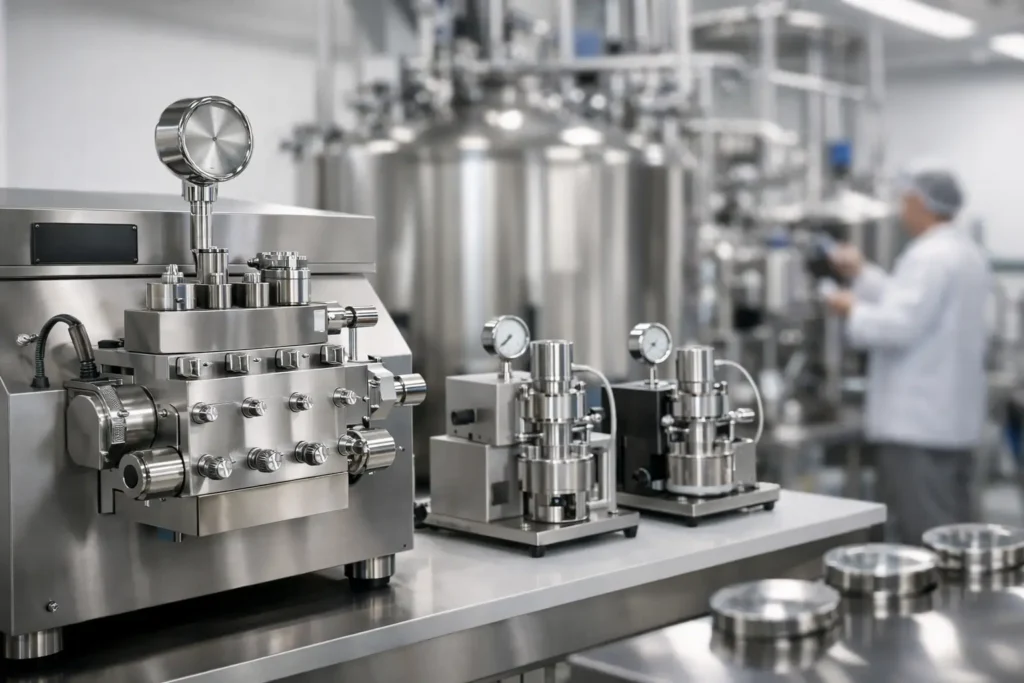
A high pressure homogenizer is not simply a pump that operates at elevated pressure. It is a controlled energy-transfer system that determines whether an emulsion remains stable, a suspension stays uniform, a cell stream reaches the intended disruption level, or a nanoparticle dispersion meets its specification. For manufacturers working with demanding liquid and semi-solid formulations, the difference between acceptable and repeatable performance is often determined inside a few millimeters of the homogenizing valve.
Traditional batch agitation can blend ingredients and distribute bulk solids, but it does not consistently produce the intense hydraulic forces needed to reduce droplets, deagglomerate fine particles, or disrupt biological cells. High-pressure processing addresses that gap by converting pump pressure into fluid acceleration, turbulence, shear, impact, and controlled cavitation at the valve. The result is not merely a smoother product. When the process is specified correctly, it is a tighter particle-size distribution, more predictable viscosity, improved stability, and a production method that can be validated from development through commercial scale.
How a High Pressure Homogenizer Creates Process Control
A high-pressure homogenizer uses a positive-displacement pump to force product through a narrow, engineered restriction. As the fluid enters the valve gap, velocity rises sharply and local pressure drops. The resulting hydraulic events subject dispersed droplets, particles, or cells to multiple reduction mechanisms at once: high shear gradients, turbulence, impingement, and cavitation.
The valve is therefore the process zone, not a passive outlet. Valve geometry, gap adjustment, seat material, impact-ring design, and the relationship between first- and second-stage pressure all influence the finished product. Two machines operating at the same indicated pressure can produce materially different results if their valve assemblies and flow paths are different.
For oil-in-water emulsions, these forces reduce oil droplets and create greater interfacial area for emulsifier coverage. In suspensions, they can break soft agglomerates and improve solids distribution. In biotech applications, they can rupture cells while minimizing unnecessary heat exposure or overprocessing. The target is application-specific: smaller is not always better. Excessive energy can alter protein functionality, increase viscosity, damage sensitive actives, or create a distribution that behaves poorly during storage.
Pressure Alone Is Not a Selection Criterion
Pressure is a meaningful specification, but it is not the entire specification. Selecting equipment only by its maximum PSI rating is one of the fastest ways to overbuy a machine that does not solve the product problem, or underbuy one that cannot meet a defined particle-size target at production flow.
A useful selection process starts with the product outcome. Define the desired particle or droplet size, acceptable distribution width, viscosity range, batch volume, throughput, temperature limit, and expected number of passes. Then assess the material itself: solids loading, abrasive content, product compressibility, sensitivity to heat, tendency to foam, and cleanability requirements.
Pressure establishes available energy, while flow rate establishes production capacity. The number of passes determines total exposure to the valve zone. A process that requires two passes at 8,000 PSI is operationally different from one pass at 15,000 PSI, even when both approaches appear capable of reaching a similar average particle size. The better choice depends on throughput, thermal management, product sensitivity, and how the process fits into the complete line.
For multiphase products, the upstream condition matters as much as the homogenizer setting. A poorly pre-emulsified product may demand excessive pressure and repeated passes simply to compensate for large initial droplets. An inline high shear mixer or emulsifier upstream can establish a controlled feed condition, reducing the pressure duty needed downstream and improving consistency lot to lot.
Critical Inputs for High Pressure Homogenizer Design
The right high-pressure homogenizer is engineered around a process window, not a nameplate number. During application assessment, the following inputs have the greatest effect on machine configuration and operating strategy:
- Product viscosity at both processing temperature and final temperature
- Required throughput, including peak demand rather than average production rate
- Solids concentration, particle hardness, and potential valve wear
- Particle-size or droplet-size target, including the allowable distribution range
- Number of passes and recirculation strategy
- Inlet conditions, feed pump capability, and available net positive suction head
- Product temperature rise and the need for interstage or downstream cooling
- Sanitary, CIP, SIP, GMP, and documentation requirements
These variables are interconnected. Raising pressure may improve droplet reduction, but it also increases heat generation and mechanical demand. Increasing flow can improve throughput, yet the pump and valve must still maintain the intended pressure under real product viscosity. Processing abrasive mineral suspensions may require hardened valve materials and planned maintenance intervals that would be unnecessary for a dairy beverage or cosmetic emulsion.
Second-stage homogenization also deserves attention. In many emulsion applications, the first stage performs the primary droplet reduction, while a lower-pressure second stage breaks clusters that can form downstream of the first valve. Without that second-stage control, a product may show an acceptable average droplet size but still exhibit instability caused by flocculation or a broad distribution.
Where High-Pressure Processing Delivers the Most Value
High-pressure homogenization is especially effective when product quality depends on controlled microscopic structure. Dairy products and plant-based beverages use it to stabilize fat or oil phases and improve mouthfeel. Sauce, dressing, and beverage manufacturers use it to control emulsion stability and reduce visible separation during shelf life.
In pharmaceutical, vaccine, and biotechnology processing, high-pressure systems can support cell disruption, liposomal dispersions, nanoparticle preparation, and fine suspension control. These applications require particular attention to temperature, hold-up volume, cleanability, and documented repeatability. A process that produces acceptable laboratory data but cannot be cleaned, validated, or scaled predictably is not production-ready.
Personal care manufacturers use high pressure to refine lotions, creams, and active dispersions where sensory properties and stability are directly tied to droplet distribution. Chemical, coating, battery, ceramic, and advanced-materials producers use the same core hydraulic principles for deagglomeration and dispersion, but often place greater emphasis on abrasion resistance, solids handling, and downstream filtration compatibility.
The technology is not automatically the best answer for every formulation. High-viscosity products, large discrete solids, fibrous materials, or formulations that require only bulk blending may be better suited to an inline high shear mixer, colloid mill, vacuum emulsifying system, or another process configuration. Good equipment selection begins by matching the mechanism to the material rather than forcing every product through a high-pressure valve.
Scale-Up Requires More Than a Larger Machine
Laboratory results are valuable, but scale-up cannot be based on batch volume alone. A pilot unit may process a few gallons with short recirculation loops, while a production line must manage feed variability, line losses, heat transfer, cleaning cycles, and sustained run time. The objective is to preserve the relevant processing conditions as capacity increases.
That means documenting actual pressure, flow rate, pass count, inlet temperature, outlet temperature, valve configuration, and particle-size results during development. It also means identifying whether the pilot process depends on recirculation. In commercial production, a single-pass continuous arrangement may be preferable for consistency and throughput, but it must deliver equivalent energy exposure and product quality.
Thermal control is frequently underestimated. Nearly all homogenization energy ultimately becomes heat. If the product leaves the valve hotter than its stability window permits, a heat exchanger may be required immediately downstream, and sometimes between passes. This is particularly relevant for heat-sensitive proteins, volatile flavors, live cultures, biologics, and formulations with temperature-dependent viscosity.
An integrated skid can simplify these scale-up variables by coordinating the feed system, homogenizer, heat exchanger, tanks, instrumentation, CIP circuits, and PLC/HMI controls. Instead of treating the homogenizer as an isolated asset, the line is engineered as a process system with defined flow paths, alarm logic, recipe control, and traceable operating data.
Operating Reliability Is a Product-Quality Issue
A high pressure homogenizer should be evaluated for maintainability as carefully as for its stated performance. Valve seats, impact rings, pump seals, plungers, and check valves are wear components. Their service life depends on pressure, duty cycle, product abrasiveness, cleaning chemistry, and operator practices. As wear progresses, process efficiency and particle-size control can drift before a catastrophic failure occurs.
A practical maintenance strategy tracks pressure stability, flow consistency, temperature rise, seal condition, and product test results. A rising need for additional pressure to meet the same product specification can signal valve wear or a shift in upstream feed condition. Process data makes those changes visible early enough to schedule service rather than react to lost production.
For sanitary applications, hygienic design must extend beyond product-contact materials. Dead-leg control, seal-flush arrangements, surface finish, drainability, access for inspection, and validated CIP coverage affect both food safety and changeover time. Where sterile processing is required, SIP capability and documentation must be evaluated as part of the complete system, not added as an afterthought.
Specify the Outcome Before You Specify the Machine
The most effective purchase specification states what the process must achieve: a target droplet size, suspension stability period, acceptable viscosity range, cell-disruption rate, throughput, temperature limit, and cleaning standard. It then defines the product range and operating conditions needed to achieve it. This gives engineering and procurement teams a common basis for comparing equipment proposals.
EmulXion approaches high-pressure processing as precision fluid engineering because valve pressure is only one lever in a larger system. When formulation data, hydraulic energy, thermal control, and line integration are designed together, the homogenizer becomes a repeatable production tool rather than a high-pressure variable waiting to create variation. Start with the product structure you need to protect, then engineer the process conditions that will produce it every shift.


