
A coarse slurry that looks acceptable in a development tank can become a costly failure at production scale. Settling, grittiness, weak color development, clogged filters, unstable viscosity, and inconsistent downstream performance often trace back to uncontrolled particle reduction. The objective is not simply to make particles smaller. It is to produce the required particle-size distribution, at the required throughput, without damaging the product or creating an unmanageable production process.
Traditional batch agitation rarely provides that level of control. An agitator may move material effectively through a vessel while leaving localized high-energy and low-energy regions that produce a broad, inconsistent result. Precision fluid processing concentrates energy where it can do useful work, then controls how often and how long the product experiences that processing zone.
What Particle Reduction Actually Controls
Particle reduction is the mechanical breakdown of solids, agglomerates, droplets, or soft dispersed structures within a liquid or semi-solid product. Depending on the application, the target may be a lower median particle size, a narrower distribution, elimination of oversized particles, or improved dispersion stability.
Those outcomes affect more than appearance. In foods and beverages, smaller and more uniform particles can improve mouthfeel, suspension stability, hydration, and flavor release. In coatings, inks, adhesives, and battery materials, particle-size distribution can influence viscosity, gloss, conductivity, film performance, and storage stability. In pharmaceutical, biotech, cosmetic, and nutraceutical production, particle control may determine bioavailability, dose uniformity, texture, filtration behavior, and regulatory consistency.
A specification such as an average particle size is useful, but it is incomplete by itself. A process can meet a D50 target while retaining an unacceptable coarse tail. For many manufacturers, D90, D99, maximum particle size, or microscopy-based defect counts are equally important. The right process is therefore designed around the full distribution and the product behavior it creates.
Why Conventional Mixing Produces Inconsistent Results
A vessel agitator is designed primarily for bulk circulation. It can blend ingredients, suspend solids, and support heat transfer, but it does not necessarily deliver sufficient localized shear or pressure differential to break strong agglomerates consistently. Increasing mixer speed may improve results, but it can also introduce air, increase heat load, create vortexing, and still leave material that has not passed through the highest-energy region.
The limitation is not motor horsepower alone. Particle breakage occurs when the local stress exceeds the cohesive strength of the particle or agglomerate. That stress may come from mechanical shear, hydraulic shear, turbulence, impact, cavitation, pressure drop, or a combination of mechanisms. If the process zone is poorly defined, the energy input varies from one portion of the batch to another.
Residence time creates another constraint. A product may need multiple passes through a high-energy zone to achieve the desired distribution. In a batch tank, pass frequency is often uncertain. In a properly engineered inline system, flow rate, recirculation rate, and processing time can be measured and controlled. That distinction is central to repeatable scale-up.
The Variables That Determine Particle Reduction
Equipment selection should begin with the material and the performance target, not with a generic mixer category. Particle hardness, friability, initial size, solids loading, viscosity, wetting behavior, temperature sensitivity, and susceptibility to air entrainment all influence the appropriate processing method.
The most consequential process variables include rotor-stator tip speed, rotor-stator clearance, pressure differential, flow rate, number of passes, and residence time in the active processing zone. Product temperature matters because viscosity and particle strength can change substantially during processing. A formulation that disperses efficiently at one temperature may resist breakup or thicken excessively at another.
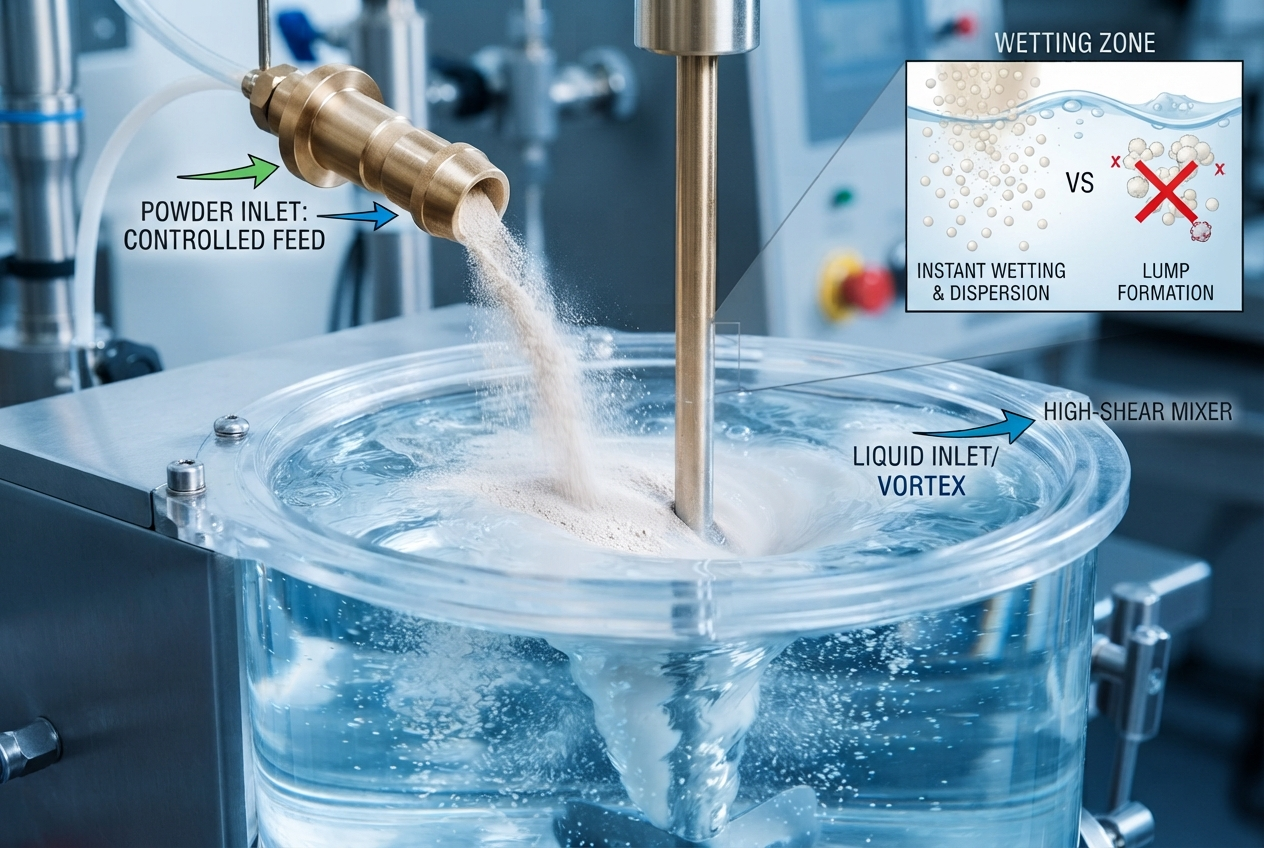
Feed quality also matters. Dry powders that enter a liquid as poorly wetted rafts can form persistent agglomerates before they ever reach a high-shear device. Powder induction and controlled wet-out may be required upstream of particle-size reduction. Likewise, entrained air can cushion hydraulic forces, disrupt pump performance, and complicate density, filling, and deaeration requirements.
There is also a practical lower limit. More energy does not always produce a better product. Excessive processing can generate heat, alter rheology, degrade sensitive active ingredients, damage crystal structure, overwork proteins, or create foam. The target is controlled energy transfer, not maximum energy input.
Choosing the Right Processing Technology
Inline high-shear mixers and rotor-stator homogenizers are effective when a process requires rapid wetting, deagglomeration, emulsification, or moderate particle reduction at continuous or recirculated flow. Their engineered rotor-stator geometry creates intense mechanical and hydraulic shear as product is accelerated through precisely controlled openings. They are often a strong fit for suspensions, sauces, personal-care products, polymer dispersions, and chemical formulations where process flexibility and sanitary design are priorities.
Colloid mills are commonly selected when tighter mechanical gaps and milling action are needed for viscous products, soft solids, pastes, and difficult dispersions. Gap adjustment enables operators to tune the process, but the material must be compatible with the mill’s feed requirements and heat generation profile. A colloid mill is not automatically the right answer for hard crystalline materials or applications requiring extremely fine, narrow distributions.
High-pressure homogenizers apply a different mechanism. Product is forced through a controlled high-pressure valve, where rapid acceleration, pressure release, turbulence, impact, and cavitation contribute to droplet disruption and particle-size reduction. This approach is often used when submicron emulsions, fine suspensions, or highly consistent dispersions are required. It can be especially valuable in dairy, beverages, pharmaceuticals, biotechnology, vaccines, and advanced-materials applications, but pressure capability alone does not guarantee performance. Valve geometry, feed condition, temperature control, and pass strategy remain decisive.
For demanding formulations, the best system may combine technologies. A powder induction system can wet and disperse difficult ingredients without airborne dust or manual bag dumping. An inline high-shear mixer can eliminate initial agglomerates. A high-pressure homogenizer can then refine the final distribution. Inline deaeration may follow to remove entrained air before filling or downstream processing. The sequence should reflect the physics of the formulation rather than the availability of individual machines.
Design for Distribution, Not Just a Single Number
A successful particle-reduction process begins with measurable acceptance criteria. Define the incoming material condition, required final distribution, sample method, analytical method, temperature range, throughput, and allowable cycle time. Without that information, an equipment quote may be based on assumptions that fail under actual production conditions.
Pilot trials should test the formulation at meaningful solids loading and viscosity. Water-based trials can help evaluate basic equipment function, but they rarely predict the behavior of a non-Newtonian gel, a high-solids slurry, or a temperature-sensitive emulsion. The trial should document pressure, flow, power draw, temperature rise, pass count, and particle-size data. These records become the basis for scaling the process with confidence.
Scale-up must preserve the conditions that matter most, rather than simply increasing tank volume or motor size. For a rotor-stator system, that may mean maintaining tip speed, shear-zone geometry, flow regime, and effective number of passes. For high-pressure homogenization, it may mean preserving pressure, valve configuration, feed consistency, and thermal management. A larger machine with different processing geometry can produce a different product even when its nameplate capacity appears comparable.
Build Repeatability Into the Production System
The machine is only one part of a controlled process. Tanks, feed pumps, recirculation loops, instrumentation, automation, and cleanability all affect the final result. A poorly sized feed pump can starve a high-pressure homogenizer. An uncontrolled recirculation loop can create variable pass counts. Inadequate cooling can shift viscosity and invalidate particle-size performance before the batch is complete.
For sanitary and regulated manufacturing, CIP/SIP compatibility, drainability, material traceability, surface finish, and GMP-ready documentation should be considered early. Retrofitting hygienic details after a system is installed is expensive and rarely ideal. A turnkey skid can integrate the processing equipment with automated valves, temperature control, flow measurement, pressure monitoring, and PLC/HMI recipe control so operators can repeat a validated process rather than rely on judgment at the vessel.
EmulXion approaches particle reduction as a process-engineering problem: define the product target, identify the governing energy mechanism, verify performance through trials, and build the controls required to hold that result at production scale.
The most useful next step is to compare your current particle-size data with the conditions that produced it. When the distribution, temperature, flow path, and pass history are visible, the path to a more predictable process becomes far clearer.


