
Every plant that hydrates gums, proteins, starches or thickeners knows the ritual: an operator up a ladder, pouring bags into a stirred tank, dust in the air, powder rafting on the surface — and an hour later, the batch still has lumps. This article explains why that happens and how modern lines fix it at the point of powder-liquid contact.
Why fine powders refuse to wet
Fine powders resist wetting for four physical reasons: electrostatic attraction holds particles together, surface tension keeps liquid from penetrating the powder bed, many functional powders have inherently poor wetting behavior, and hydrocolloids in particular have aggressive agglomeration tendencies — the outside of a clump hydrates instantly into a gel skin that seals the dry core inside. That sealed clump is the fish eye, and once formed, no amount of tank agitation dissolves it quickly.
Why top-loading makes it worse
Dumping powder onto the surface of a stirred vessel maximizes every one of those problems: the powder hits the liquid as a mass (instant rafting), the surface is the lowest-shear zone of the whole tank (gel skins form undisturbed), and the agitator’s job becomes breaking skins instead of dispersing particles. The visible symptoms are floating powders, excessive dusting, fish eyes, inconsistent hydration, poor dispersion and long process times — plus the invisible one: entrained air whipped in at the surface, which you then pay to remove downstream.
The fix: wet every particle individually, under shear
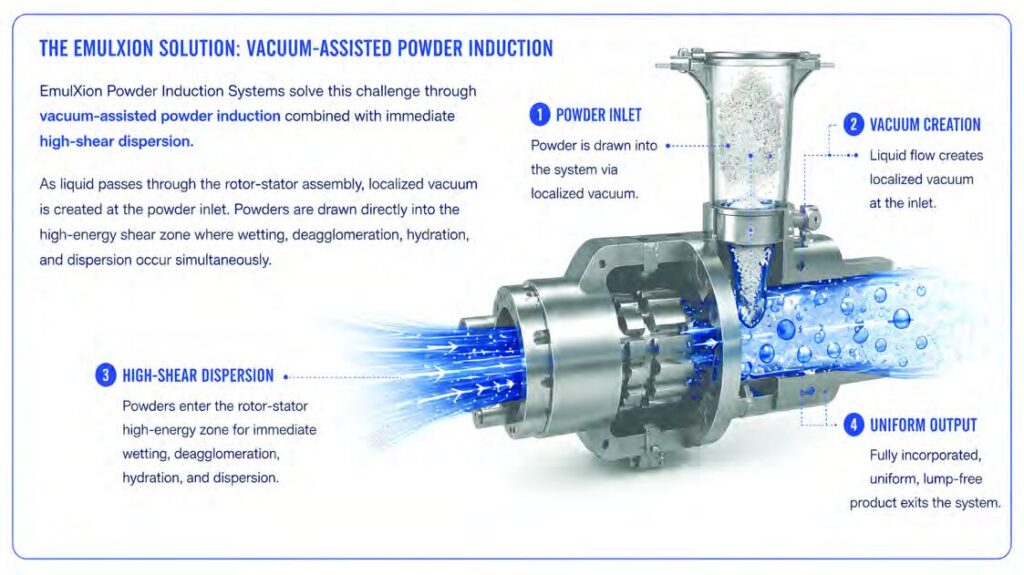
The engineering answer is to reverse the geometry — instead of bringing powder to a calm liquid surface, bring each powder particle into a high-energy liquid stream. Vacuum-assisted powder induction does exactly that:
- Powder inlet: as liquid passes through the rotor-stator assembly, localized vacuum is created at the powder inlet — powder is drawn in, not dumped.
- Straight into the shear zone: particles enter the high-energy zone individually, where wetting, de-agglomeration, hydration and dispersion occur simultaneously.
- No chance to clump: gel skins can’t form around a particle that is already dispersed when it meets the liquid.
- Uniform output: fully incorporated, lump-free product exits the system — continuously.
The practical result: hydration steps that took an hour of tank mixing typically finish in minutes, with no lumps to strain out, dramatically less dust in the room, and less air entrained in the batch — which also means better texture and more accurate filling downstream. Pair with an inline deaerator if air is still a quality driver.
Powders this works on
Xanthan, guar, CMC, carrageenan and pectin; proteins and caseinates; starches; carbomer and sodium polyacrylate; salts, sweeteners and flavors; pigments, fumed silica and ceramic powders. The harder the powder is to wet by hand, the bigger the improvement.
Retrofit or new line?
Powder induction installs as an inline loop on existing tanks — you keep your vessels and gain the incorporation performance. It also integrates into complete EmulXion engineered process systems with hopper or bag-dump stations, flow control and automation. Tell us your powder, liquid and batch size and we’ll size the system. Ask an engineer →