
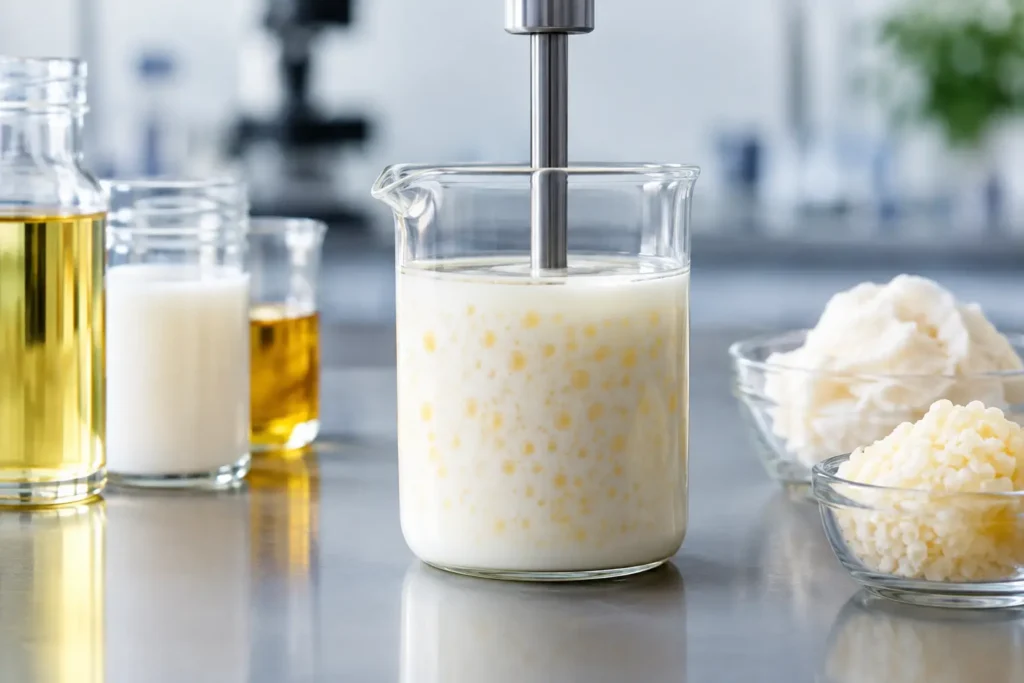
A dressing that breaks in a warehouse, a cosmetic cream that thins after filling, or a pharmaceutical emulsion that shifts outside specification rarely fails for one simple reason. Emulsion stability is the visible result of several interacting process and formulation variables: droplet size distribution, interfacial coverage, viscosity, temperature history, air content, and the energy applied during production. Control those variables together, and stable product structure becomes repeatable rather than dependent on operator judgment.
For manufacturers, the objective is not merely to create an emulsion that looks uniform at the discharge valve. It is to produce a defined dispersed-phase structure that remains within specification through pumping, thermal processing, filling, transport, and its intended shelf life.
What Emulsion Stability Actually Means
An emulsion is a dispersion of one immiscible liquid in another, commonly oil droplets dispersed in water or water droplets dispersed in oil. The two phases naturally seek to separate because the interface between them carries energy. An emulsifier, surfactant, protein, polymer, or finely divided solid can reduce interfacial tension and form a protective layer around droplets, but chemistry alone does not guarantee stability.
In production, stability means resistance to the mechanisms that change the emulsion over time. These include creaming or sedimentation, flocculation, coalescence, Ostwald ripening, and phase inversion. Each mechanism has a different cause and may require a different correction. Treating every failure with more mixing often creates a new problem while leaving the original mechanism untouched.
Creaming occurs when droplets migrate under gravity because of density differences between phases. Flocculation occurs when droplets cluster but remain individually intact. Coalescence is more severe: droplets merge, increasing the average droplet size and eventually producing a visible oil or water layer. Ostwald ripening occurs when material diffuses from smaller droplets to larger ones, particularly when the dispersed phase has some solubility in the continuous phase.
Droplet Size Is a Primary Control Variable
Smaller droplets generally cream more slowly and present a larger total interfacial area for stabilization. More important than a low average value is a controlled particle-size distribution. A process that produces a few large droplets alongside many fine droplets may meet an initial visual inspection yet fail during storage because the largest droplets coalesce first.
This is where conventional tank agitation reaches its limit. An agitator can circulate bulk liquid and blend ingredients, but its energy is distributed across a large vessel volume. It may not create the localized hydraulic stress required to consistently break droplets to the target range. The result is often batch-to-batch variation driven by fill level, viscosity, impeller position, operator timing, and raw-material condition.
Inline rotor-stator systems concentrate mechanical energy within a defined processing zone. Product is accelerated through precisely controlled rotor-stator clearances, where intense shear, turbulence, and pressure fluctuations divide droplets and disperse agglomerates. Because each pass experiences a known processing event, inline recirculation can provide far more consistent outcomes than relying on bulk vessel turnover alone.
High-pressure homogenization is often the better choice when formulations require very fine droplet sizes, narrow distributions, or high levels of long-term stability. The process forces product through an engineered valve at high velocity. Hydraulic energy is converted into intense shear, turbulence, impact, and controlled cavitation as pressure is released. The right technology depends on the required droplet distribution, viscosity, throughput, and sensitivity of the formulation.
Interfacial Chemistry Must Match the Process
Every new droplet surface created during emulsification must be covered quickly by the stabilizing system. If emulsifier concentration is insufficient, poorly hydrated, or incompatible with the phase conditions, newly formed droplets can recombine before the batch reaches the next process step.
The order of addition matters. Powdered emulsifiers, gums, proteins, and hydrocolloids may require controlled wetting and hydration before high-energy processing. Adding them directly into a vessel can create fisheyes or partially hydrated agglomerates that survive downstream shear. A powder induction system can draw powders into the liquid stream under vacuum, disperse them rapidly, and reduce airborne dust and manual handling variability.
pH, ionic strength, and temperature also influence interfacial behavior. Protein-stabilized emulsions can be especially sensitive near their isoelectric point, where electrostatic repulsion is reduced and flocculation becomes more likely. Salt levels may change hydration or charge interactions. In personal care and chemical formulations, electrolyte additions or solvent changes can alter surfactant packing at the interface. These are formulation issues, but the processing system must be designed to introduce and distribute ingredients in a controlled sequence.
Viscosity Helps, but It Is Not a Substitute for Droplet Control
Increasing continuous-phase viscosity can slow creaming and reduce droplet collisions. This is why hydrocolloids, starches, waxes, and polymers are common stabilizing tools. However, higher viscosity also changes pumping requirements, heat transfer, powder incorporation, and the actual shear delivered by a given machine.
A highly viscous product may appear stable simply because droplets move slowly, while still containing a broad and unstable droplet distribution. Conversely, a lower-viscosity emulsion can remain stable when droplet size, interfacial chemistry, and density balance are well controlled. The correct target is not maximum viscosity. It is the product structure required for performance, sensory properties, processing, and shelf life.
This distinction is especially relevant during scale-up. A lab batch mixed with a small rotor-stator head can behave differently in a production tank where the bulk fluid path, residence time, and recirculation rate are changed. Scale-up should be based on measurable process conditions such as flow rate, pressure, tip speed, number of passes, energy density, temperature rise, and resulting droplet-size data, not simply motor horsepower.
Temperature and Air Can Destabilize a Good Emulsion
Temperature affects viscosity, interfacial tension, solubility, and the physical state of fats, waxes, and crystallizing materials. If the dispersed phase is added at the wrong temperature, it may not divide efficiently. If a product cools too slowly or experiences temperature cycling, crystallization can damage the droplet interface and promote coalescence.
High-energy processing also generates heat. That can be beneficial when melting a fat phase or accelerating hydration, but it can damage heat-sensitive actives, alter flavor, or shift viscosity outside the desired range. Jacketed vessels, controlled recirculation, heat exchangers, and temperature instrumentation should be part of the process design rather than an afterthought.
Entrained air is another common but underestimated source of instability. Air can interfere with pumping, distort density measurements, promote oxidation, create fill-weight variation, and cause foaming downstream. Vacuum emulsifying systems and inline deaerators remove dispersed air and dissolved gases while supporting more consistent product density and appearance. For products that are filled under vacuum-sensitive conditions or require a smooth, glossy finish, deaeration is a process control step, not cosmetic refinement.
Selecting Equipment Around the Failure Mechanism
The equipment selection question should begin with what the product needs to resist, not with a generic request for a mixer. A sauce with visible oil separation may need improved droplet breakup, better emulsifier hydration, or both. A lotion with entrained air may require vacuum processing after emulsification. A high-solids coating may need a colloid mill for particle deagglomeration before or alongside inline high-shear processing.
A practical assessment should define the dispersed and continuous phases, viscosity profile, emulsifier system, powder additions, temperature limits, target throughput, cleaning requirements, and acceptable droplet-size range. It should also account for what happens after the processing zone: holding time, thermal treatment, transfer pumps, filtration, filling, and storage conditions can all modify the finished structure.
For sanitary food, dairy, pharmaceutical, and biotechnology applications, hygienic design matters as much as shear intensity. CIP/SIP capability, drainability, elastomer compatibility, surface finish, and documented materials of construction affect both product integrity and production uptime. For industrial chemicals and advanced materials, pressure rating, abrasion resistance, solvent compatibility, and automation integration may drive the design.
EmulXion Process Technologies approaches these decisions as precision fluid engineering. The goal is to establish a process window that delivers the required droplet distribution and product structure at production rate, with instrumentation and automation that make the result repeatable.
Measure Stability Before It Becomes a Complaint
Visual inspection is useful, but it is not enough for process qualification. Manufacturers should combine immediate measurements with accelerated and real-time stability testing. Depending on the product, that may include droplet-size analysis, microscopy, viscosity, density, centrifugation, thermal cycling, freeze-thaw testing, and retained shelf-life samples.
Trend process data alongside product data. If a stable product begins drifting, changes in pressure, flow, inlet temperature, recirculation time, vacuum level, or raw-material lot may reveal the cause before separation becomes visible. This is the difference between reacting to a failed batch and controlling what matters.
A stable emulsion is engineered at the interface, built in the processing zone, and protected through every downstream step. When the formulation and equipment are designed around the same measurable outcome, shelf life becomes a production capability rather than a hopeful prediction.


