
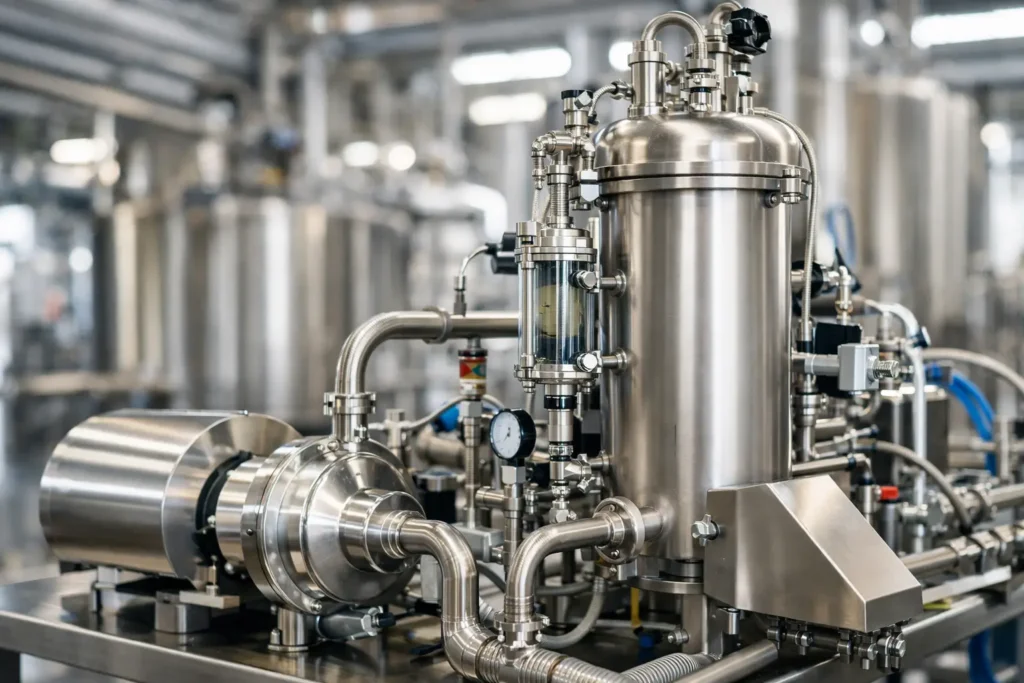
A product can meet viscosity, particle-size, and temperature targets yet still fail at the filler because it carries air. Entrained and dissolved gases can create foam, inconsistent net weights, false level readings, oxidation risk, and an unstable appearance. Inline deaeration equipment addresses that problem within a controlled process path, removing gas under vacuum before product reaches downstream filling, packaging, or finishing operations.
For manufacturers producing sauces, dairy products, cosmetics, pharmaceutical suspensions, coatings, adhesives, and other viscosity-sensitive formulations, deaeration is not simply a cosmetic improvement. It is a means of controlling density, rheology, volume, and product structure. The correct system must remove air without damaging a shear-sensitive formulation, stripping volatile components, or becoming the production bottleneck.
Why Air Persists After Mixing
Air enters a process in predictable ways. Powder addition can pull air into the liquid phase. Surface vortexing in a batch tank entrains headspace air. High-shear mixing, recirculation pumps, valve restrictions, and transfers can further disperse that air into fine bubbles that do not readily rise out under gravity.
The smaller the bubble, the harder it is to remove. Product viscosity compounds the problem because bubbles move slowly through a thick continuous phase. Yield-stress fluids, gels, creams, and filled suspensions may retain air long after mixing has stopped. Waiting for a batch to settle can consume valuable tank time without producing repeatable results.
Traditional open-tank agitation is especially limited here. An agitator may blend a batch effectively, but it does not provide a controlled low-pressure zone for expanding and releasing dissolved and entrained gas. In some cases, the agitation itself continues to fold air into the product. The result is a process that depends heavily on operator timing, batch hold time, and the variable condition of each formulation.
How Inline Deaeration Equipment Works
Inline deaeration equipment typically creates a controlled vacuum environment within a continuous or recirculating product stream. As pressure is reduced, entrained bubbles expand and dissolved gases become less soluble. The gas phase separates from the liquid and is evacuated through a vacuum connection, while conditioned product continues to the next stage of the process.
System design matters because vacuum alone is not the answer. The product must enter the separation zone in a manner that exposes sufficient surface area and residence time without excessive foaming or uncontrolled turbulence. Depending on the application, that may involve a vacuum chamber, distribution geometry, thin-film exposure, recirculation loop, sanitary transfer pump, level control, and automated vacuum regulation.
A properly engineered system balances several variables:
- Product viscosity and yield behavior determine flow resistance and bubble mobility.
- Feed rate and residence time determine whether gas has enough opportunity to separate.
- Vacuum level influences removal efficiency, foam formation, and potential loss of volatile components.
- Product temperature changes viscosity and gas solubility, affecting both processability and final quality.
- Upstream shear and pumping conditions determine the initial bubble-size distribution.
These variables explain why two products with similar apparent viscosity may require different deaeration strategies. A shear-thinning cosmetic cream, for example, may flow readily under pump shear but retain microbubbles at rest. A high-solids coating may require careful feed control to prevent vacuum-induced expansion from creating a foam layer that limits throughput.
Entrained Air Versus Dissolved Gas
Entrained air is present as visible or microscopic bubbles dispersed in the formulation. It can cause voids, density variation, surface defects, and erratic volumetric filling. Dissolved gas is held at a molecular level within the liquid and may come out of solution later as pressure or temperature changes.
An effective deaeration process considers both. Removing only larger visible bubbles may improve appearance but leave enough dissolved gas to create package swelling, bubbles at the nozzle, or instability during storage. The required degree of gas removal depends on the product, package format, and downstream process conditions.
Where Deaeration Belongs in the Process Line
Placement should follow the source of air and the sensitivity of the product. In many systems, deaeration occurs after powder wetting, high-shear dispersion, homogenization, or milling because these operations can introduce or subdivide air. It is then positioned before filling, vacuum drying, coating, extrusion, or any stage where bubbles would create defects.
For recirculating batch production, a vacuum deaeration module can be integrated with the process tank and transfer loop. This approach is useful when the formulation requires multiple passes through a rotor-stator mixer, colloid mill, or homogenization stage before final conditioning. Controls can hold vacuum level, monitor product temperature, and manage flow so the deaeration step remains repeatable from batch to batch.
For continuous production, inline operation can reduce batch hold time and minimize the need for a dedicated settling tank. The system must be sized for actual production flow, not merely nominal pump capacity. A deaerator that is undersized for peak demand can become a restriction, while excessive capacity may complicate low-flow control and reduce effective residence time.
Production Problems It Can Correct
The operational value of deaeration becomes most visible at the point where product meets the package or finished surface. In food and beverage applications, reduced air can improve fill-weight consistency, reduce oxidation exposure, and create a smoother visual finish. In dairy, sauces, and dressings, it can help maintain a more uniform texture and reduce foam during transfer and filling.
In cosmetics and personal care, removing air supports clean filling of creams, gels, lotions, and toothpaste-like products. Air pockets can distort package appearance, interfere with dosing, and create an inconsistent consumer experience. For pharmaceutical and nutraceutical products, controlled deaeration may support accurate filling, uniform suspension behavior, and process documentation requirements within GMP-oriented operations.
Coatings, inks, adhesives, and advanced-material slurries present another set of demands. Bubbles can cause pinholes, crater defects, weak bond lines, inaccurate coating thickness, and voids in cast or coated films. In battery, ceramic, and graphene processing, gas removal can be critical where internal voids affect material density, conductive pathways, or final component performance.
Deaeration does not correct every quality issue. If a suspension is poorly dispersed, if particle agglomerates remain, or if an emulsion has an unstable droplet-size distribution, vacuum treatment will not replace the required mixing or homogenization energy. It should be specified as one controlled unit operation within the broader process, not as a substitute for upstream formulation control.
Selecting the Right Deaeration Configuration
The first question is not which deaerator model to buy. It is what gas-removal result the process requires. That begins with product characterization: viscosity across the expected temperature range, solids loading, sensitivity to shear, vapor pressure, volatile ingredients, acceptable residence time, and target throughput.
Vacuum capability must be matched to the formulation. Higher vacuum can increase gas release, but it can also promote excessive foaming or pull off desirable volatile compounds such as flavor components, fragrance materials, solvents, or active carriers. Products containing volatile phases may need staged vacuum control, lower operating temperatures, condensate management, or a different process sequence.
Sanitary requirements are equally consequential. Food, dairy, pharmaceutical, and personal-care systems may require hygienic design, polished wetted surfaces, appropriate elastomers, drainability, CIP capability, and documentation aligned with the plant’s quality system. Equipment that removes air effectively but cannot be cleaned or validated efficiently creates a different production risk.
Integration should also be evaluated early. The deaerator must work with upstream pumps, mixers, tanks, pressure instruments, vacuum systems, and downstream fillers. Automation can coordinate flow, vessel level, vacuum setpoint, product temperature, and alarm conditions. That control architecture turns deaeration from an operator-dependent correction into a repeatable process parameter.
Measuring Whether the System Is Performing
Visual inspection is useful, but it is not sufficient for critical production. Performance can be evaluated through density measurements, fill-weight variation, foam height, dissolved oxygen where relevant, package appearance, coating-defect rates, and retained-air measurements. The right metric depends on the application and its failure mode.
During trials, measure the baseline product before treatment and compare it with deaerated output at defined flow, temperature, and vacuum conditions. This provides the data needed to establish an operating window rather than relying on a single successful run. It also reveals whether upstream mixing is creating more air than the deaeration stage can economically remove.
EmulXion approaches these systems as part of precision fluid engineering. The objective is not simply to pull vacuum. It is to control the hydraulic conditions, residence time, and process sequence that determine whether air leaves the product consistently at commercial throughput.
The most productive next step is to map where air enters your line, define the downstream defect it causes, and test the product under realistic flow and temperature conditions. That evidence gives engineering teams a clear basis for specifying equipment that controls what matters: product structure, production rate, and repeatable finished quality.


