
A stable emulsion can fail long after it leaves the mixer. A sauce may develop oil separation, a topical cream may lose texture, or a pigment suspension may settle because the processing zone did not deliver the required energy, residence time, or particle-size control. The rotor stator versus colloid mills decision is therefore not a simple choice between two high-shear machines. It is a process-design decision that affects product structure, throughput, sanitation, thermal load, and scale-up confidence.
Both technologies concentrate mechanical energy in a narrow working zone. Both can outperform conventional tank agitation when a formulation requires rapid wetting, emulsification, deagglomeration, or dispersion. Their geometry, flow behavior, and operating windows differ materially, however. Selecting the right machine begins with the product result that must be controlled, not with motor horsepower alone.
Rotor Stator Versus Colloid Mills: The Core Difference
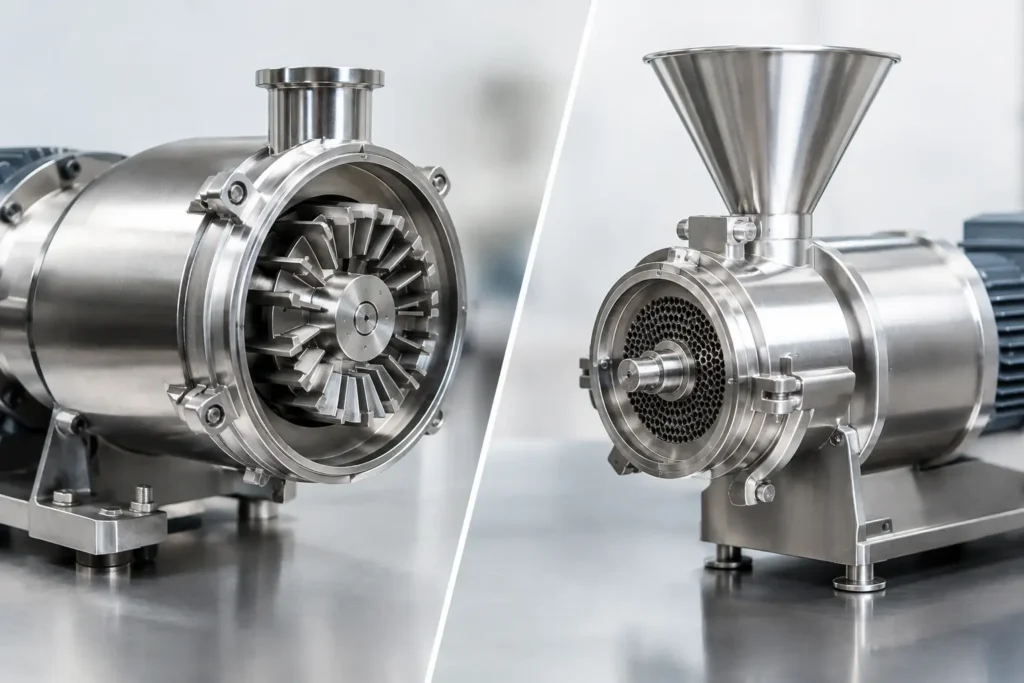
An inline rotor-stator mixer drives product through the close clearance between a high-speed rotor and a stationary stator. As fluid enters the rotor-stator workhead, it experiences intense acceleration, hydraulic shear, turbulence, pressure fluctuations, and, in certain conditions, controlled cavitation. Product is expelled through the stator openings and returned to the process stream. Single-stage and multistage designs allow engineers to tune the relationship between flow rate, shear exposure, pressure generation, and recirculation.
A colloid mill uses a precision-machined rotor and stator, commonly in a conical or ring-style configuration, with an adjustable milling gap. Product is forced through that restricted gap under high velocity. The result is high mechanical shear combined with compression and frictional effects. The tight, adjustable clearance makes colloid mills particularly effective where a formulation needs aggressive particle-size reduction, paste homogenization, or the breakdown of soft agglomerates.
The distinction is not that one technology creates shear and the other does not. Both do. The practical difference is how the product sees that shear. Rotor-stator systems generally emphasize high-volume hydraulic processing and controlled recirculation. Colloid mills emphasize passage through a highly restrictive, adjustable milling zone. A product that responds well to repeated hydraulic shear may favor a rotor-stator system. A viscous product that must be worked through a narrow gap may favor a colloid mill.
Start With the Required Product Outcome
Process equipment should be specified against measurable outcomes: target droplet-size distribution, maximum particle size, viscosity profile, batch time, temperature rise, and stability through the intended shelf life. The same formulation may require different equipment at lab scale and production scale if throughput, solids loading, or ingredient addition method changes.
For liquid emulsions, rotor-stator mixers are often selected to disperse an oil phase rapidly into an aqueous phase, reduce droplet size, and prevent localized concentration gradients. They are widely applied in dressings, beverages, liquid supplements, chemical emulsions, coatings, and personal-care formulations. An inline unit can process continuously or recirculate a batch until analytical targets are achieved.
For heavier products, colloid mills are often evaluated for sauces, nut butters, gels, ointments, toothpaste-style formulations, pigment concentrates, and other semi-solids. Their adjustable gap is valuable when the process needs a defined mechanical treatment rather than general agitation. Yet viscosity alone does not decide the application. Very high viscosity can limit feed into a mill, while heat-sensitive products can be damaged if restrictive milling creates excessive temperature rise.
Particle hardness also matters. A colloid mill can reduce soft particles and break down many agglomerates, but it is not automatically the correct answer for hard mineral grinding or nanometer-scale reduction. Those applications may require bead milling, high-pressure homogenization, or another specialized technology. Specifying a colloid mill for a duty outside its mechanical range can produce low throughput, premature wear, and disappointing size reduction.
How Flow Pattern Changes Processing Results
Rotor-stator mixers can be installed inline, in a recirculation loop, or as part of an engineered skid with feed tanks, transfer pumps, instruments, and PLC control. This architecture gives process teams considerable flexibility. They can control pass count, recirculation time, feed rates, and the point at which powders or secondary liquids enter the process. For production lines that require continuous output, a properly sized inline rotor-stator system can maintain high flow while applying repeatable hydraulic energy.
Colloid mills also operate inline, but their restricted gap creates a different hydraulic profile. Product flow is more dependent on the mill gap, viscosity, feed pressure, and rheology. Opening the gap increases capacity but may reduce the treatment intensity required for the product. Closing it increases shear and friction, but can restrict throughput and elevate temperature. This trade-off is central to colloid mill selection.
Neither machine should be judged by tip speed alone. Tip speed is useful, but it does not account for rotor-stator geometry, clearance, residence time, recirculation ratio, pumping characteristics, or the formulation’s yield stress. Two machines with similar tip speeds can deliver very different outcomes. The relevant question is whether the complete process delivers the required energy exposure without overprocessing the product.
Where Rotor-Stator Mixers Have an Advantage
Rotor-stator technology is often the stronger fit when fast incorporation and scalable liquid processing are the priorities. Powder induction systems can be paired with an inline high-shear mixer to pull powders directly into the liquid stream, minimizing fish eyes, floating powders, and long tank-side hydration cycles. For applications involving gums, proteins, thickeners, starches, or fine solids, the combination of controlled powder addition and immediate shear can substantially improve batch repeatability.
Multistage inline homogenizers are especially useful when a narrow emulsion droplet distribution is needed at meaningful production flow. Multiple processing stages expose the product to successive zones of acceleration and shear without relying solely on a single restrictive gap. For some formulations, this reduces the number of recirculation passes needed to achieve a stable result.
Rotor-stator equipment is also typically easier to integrate into sanitary continuous processes. Hygienic designs with appropriate surface finishes, elastomers, drainability, and CIP/SIP capability can support food, dairy, pharmaceutical, and personal-care operations. The correct sanitary standard still depends on the application, validation expectations, allergen controls, and cleaning chemistry.
Where Colloid Mills Have an Advantage
A colloid mill becomes compelling when an adjustable, high-intensity milling zone is central to the product specification. In a condiment or paste application, for example, the mill can break down soft solids and agglomerates while producing the smooth, uniform texture expected by the end user. In ointments and creams, it can help distribute waxes, active ingredients, and thickened phases that would remain coarse under lower-intensity mixing.
The adjustable gap also supports process development. Engineers can establish the relationship between gap setting, throughput, temperature, and measured particle size, then document a repeatable operating window. That capability is useful when formulation changes require controlled tuning rather than a complete equipment replacement.
The limitation is that a colloid mill can generate substantial heat. This is not automatically a defect. Some formulations benefit from thermal input or are processed hot by design. But temperature-sensitive actives, volatile flavors, proteins, and heat-sensitive emulsions may require a jacketed recirculation tank, heat exchanger, lower feed rate, a wider gap, or a different processing technology. Temperature must be treated as a controlled variable, not an afterthought.
Design Variables That Should Drive the Purchase Decision
A productive equipment review begins with representative samples and process data. Viscosity should be measured across the actual temperature range, not reported as a single room-temperature number. Particle size, density difference between phases, solids loading, pH, ingredient addition sequence, and hold time all influence equipment behavior.
The evaluation should also account for the production environment. A machine that produces an excellent sample but requires excessive manual intervention, long cleaning cycles, or frequent adjustment may not be the best production asset. For regulated operations, documentation, material traceability, CIP coverage, hygienic design, and automation strategy are part of the equipment requirement.
Ask the equipment supplier to define the expected process window rather than promise an undefined result. Useful acceptance criteria may include a specified droplet-size range, maximum retained particle size, viscosity after processing, batch cycle time, product temperature, and yield. For continuous systems, include flow rate and pressure stability. These metrics make factory testing and scale-up more accountable.
A Practical Selection Path
If the objective is rapid liquid emulsification, powder wetting, continuous dispersion, or flexible recirculation processing, evaluate an inline rotor-stator mixer first. If the objective is aggressive treatment of a viscous paste, soft-particle reduction, or processing through a tightly controlled adjustable gap, evaluate a colloid mill.
Some lines require both. A rotor-stator system may be used upstream to hydrate powders and form a pre-emulsion, followed by a colloid mill for final texture development. In other cases, an inline high-shear mixer followed by a high-pressure homogenizer is the better path when the specification demands finer droplet distribution than a colloid mill can efficiently achieve. Process sequencing matters as much as machine selection.
EmulXion Process Technologies approaches this decision as a fluid-engineering problem: define the required product structure, map the operating conditions, then configure the processing zone and system controls around measurable performance. The goal is not the most aggressive machine. It is the machine that delivers the required outcome consistently at production scale.
The best next step is to process the real formulation under representative conditions and measure what changes. When particle size, viscosity, temperature, throughput, and stability are visible, the correct technology becomes a defensible engineering choice rather than an equipment guess.


