
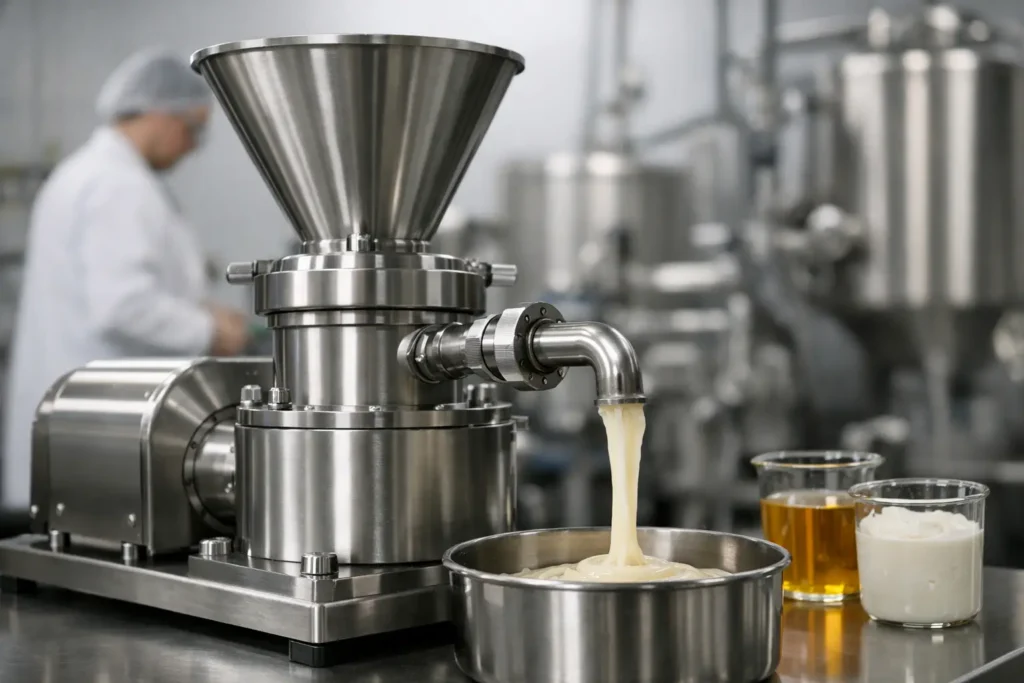
A colloid mill is often selected after a conventional agitator has already exposed its limits. The batch may look uniform in the tank, yet show oil separation after filling, gritty texture on the line, unstable viscosity, or an unacceptable particle-size distribution. In these colloid mill applications, the requirement is not simply more mixing. It is controlled mechanical shear at the point where product quality is established.
A properly specified colloid mill processes liquid and semi-solid materials through a narrow, adjustable gap between a high-speed rotor and a stationary stator. As material enters that processing zone, it experiences intense velocity gradients, hydraulic acceleration, turbulence, and localized shear. The result can be finer dispersions, more uniform emulsions, faster incorporation of soft solids, and improved product consistency. The outcome, however, depends on formulation, feed condition, mill geometry, flow rate, temperature sensitivity, and the target product structure.
Where Colloid Mill Applications Create Value
Colloid mills are most effective when a process needs a repeatable combination of size reduction, deagglomeration, and emulsification at moderate to high viscosity. They are not a universal replacement for every mixer, homogenizer, or grinding technology. Their value is strongest when the material can be pumped through a controlled rotor-stator gap and when the finished product benefits from a tight, repeatable structure.
Food, dairy, sauces, and dressings
Mayonnaise, salad dressings, sauces, condiments, nut-based spreads, cheese products, and dairy preparations frequently depend on stable oil droplet distribution and smooth texture. A colloid mill can reduce coarse particles, break down soft agglomerates, and distribute emulsified phases more uniformly than tank agitation alone.
For a dressing, the practical objective may be preventing oil separation while maintaining a specific viscosity and mouthfeel. For a chili sauce or condiment, it may be eliminating visible particles that compromise appearance without over-processing the product. Shear must be matched to the formulation. Excessive milling can heat the batch, alter hydrocolloid behavior, damage particulates that should remain intact, or produce a texture that is too thin after processing.
Sanitary construction is equally important in food applications. Product-contact materials, elastomer selection, cleanability, seal design, and CIP compatibility affect whether the mill supports reliable daily production rather than becoming a sanitation bottleneck.
Cosmetics and personal care
Creams, lotions, gels, sunscreens, foundations, toothpaste, ointments, and hair-care products require a balance of sensory performance, stability, and visual uniformity. A colloid mill helps process waxes, oils, thickeners, pigments, and soft solids into a consistent base before final finishing steps.
In an emulsion cream, reducing the size and distribution of dispersed droplets can improve stability and reduce the risk of separation during storage. In pigmented products, effective deagglomeration helps prevent color streaking, graininess, and uneven coverage. The mill must be selected with the product’s rheology in mind. Highly shear-sensitive emulsions may require a lower-intensity pass, recirculation control, cooling, or a different finishing technology.
Vacuum processing may be necessary when entrained air affects appearance, density, filling accuracy, or oxidation stability. In that case, the colloid mill is one element of a broader vacuum emulsifying system rather than a standalone answer.
Pharmaceutical, nutraceutical, and topical products
In regulated production, consistency is inseparable from documentation and cleanability. Colloid mills are used for oral suspensions, antacid preparations, topical creams, gels, syrups, nutraceutical slurries, and other pumpable formulations that require uniform particle distribution or smooth dispersion of insoluble ingredients.
A key distinction is that a colloid mill does not guarantee a specific micron-level particle size by itself. Its performance should be verified against the actual formulation, including feed particle size, solids loading, viscosity, recirculation time, and temperature rise. Where submicron droplet size, narrow distribution, or cell disruption is required, a high-pressure homogenizer may be the more appropriate process technology.
GMP-ready design considerations can include polished product-contact surfaces, drainability, validated CIP or SIP capability, material traceability, instrument selection, and batch records through PLC/HMI controls. These details protect both product quality and the plant’s ability to reproduce it at commercial scale.
Chemicals, coatings, adhesives, and advanced materials
Chemical manufacturers use colloid mills to disperse additives, reduce soft particle agglomerates, process resin systems, and improve uniformity in products such as coatings, inks, sealants, adhesives, chemical slurries, and specialty compounds. In these services, the quality target may be gloss, hiding power, suspension stability, application behavior, or controlled viscosity.
The mill can be particularly effective when powders have already been wetted into the liquid phase but still contain agglomerates. It is less effective when dry powder incorporation is the primary challenge. Powders that float, fisheye, or form persistent lumps often need a dedicated powder induction system upstream of the milling step. Better wetting at the start reduces the amount of downstream shear needed to achieve a stable dispersion.
For abrasive, hard, or highly filled materials, wear becomes a defining selection factor. Rotor-stator materials, gap setting, expected service life, and maintenance access should be evaluated early. A mill that performs well on a short trial can become an expensive choice if abrasive wear rapidly changes the processing gap and shifts product quality.
The Process Variables That Determine Mill Performance
A colloid mill should be specified as part of a process, not selected from motor horsepower alone. Rotor speed and gap setting influence shear intensity, but they do not tell the complete story. Product viscosity affects how efficiently material moves through the stator gap. Feed pressure, flow rate, and recirculation arrangement determine residence time and the number of effective processing passes.
Temperature is often the hidden constraint. Mechanical energy is converted partly to heat, which can be beneficial for melting fats or reducing viscosity, but damaging for heat-sensitive actives, volatile flavors, proteins, and certain emulsions. Jacketed tanks, heat exchangers, controlled recirculation, and temperature instrumentation may be necessary to hold the process window.
The initial condition of the feed also matters. A mill cannot reliably compensate for poor upstream preparation. Large unmelted wax pieces, inadequately hydrated gums, dry powder rafts, or uncontrolled addition rates can create variability that appears later as inconsistent mill performance. Controlled ingredient addition and proper pre-mixing make the rotor-stator zone more productive and predictable.
Colloid Mill vs. Other High-Energy Processing Options
The right equipment depends on the product target. A colloid mill is often a strong choice for continuous or recirculated processing of pumpable emulsions, dispersions, and soft solids where a configurable shear gap provides the needed result. It can be more direct and controllable than relying on prolonged tank agitation to force an unstable batch into specification.
An inline high-shear mixer may be preferable when rapid powder wetting, bulk recirculation, or high-throughput dispersion is the main requirement. High-pressure homogenization is generally better suited to demanding droplet or particle-size reduction, particularly where the process requires very fine emulsions. A vacuum emulsifying system is appropriate when deaeration, heating, cooling, and batch-level control are integral to producing creams, gels, or viscous emulsions.
There is also a scale-up consideration. A laboratory mill that produces an acceptable sample does not automatically translate to commercial capacity. The scale-up review should compare tip speed, rotor-stator geometry, gap range, flow regime, thermal load, number of passes, and the actual product quality data required at production rate. Engineered outcomes come from preserving the relevant process conditions, not from matching equipment size by volume alone.
Designing a Reliable Colloid Mill Process
The most effective projects start with measurable acceptance criteria. Define the required particle-size distribution or emulsion stability, finished viscosity, throughput, allowable temperature rise, cleaning standard, and maximum recirculation time. Then evaluate the feed materials and the upstream conditions that influence mill performance.
A production system may include a jacketed batch tank, positive-displacement feed pump, inline colloid mill, heat exchanger, instrumentation, recirculation piping, and automated controls. This arrangement gives operators control over flow, temperature, pressure, and processing time rather than relying on manual judgment. It also creates a clearer path for repeatable scale-up, commissioning, and troubleshooting.
For manufacturers replacing underperforming agitation equipment, the useful question is not, “What mill size do we need?” It is, “What product defect must the processing zone eliminate?” When that defect is defined in measurable terms, the equipment configuration can be engineered around the actual result the line must deliver.


