
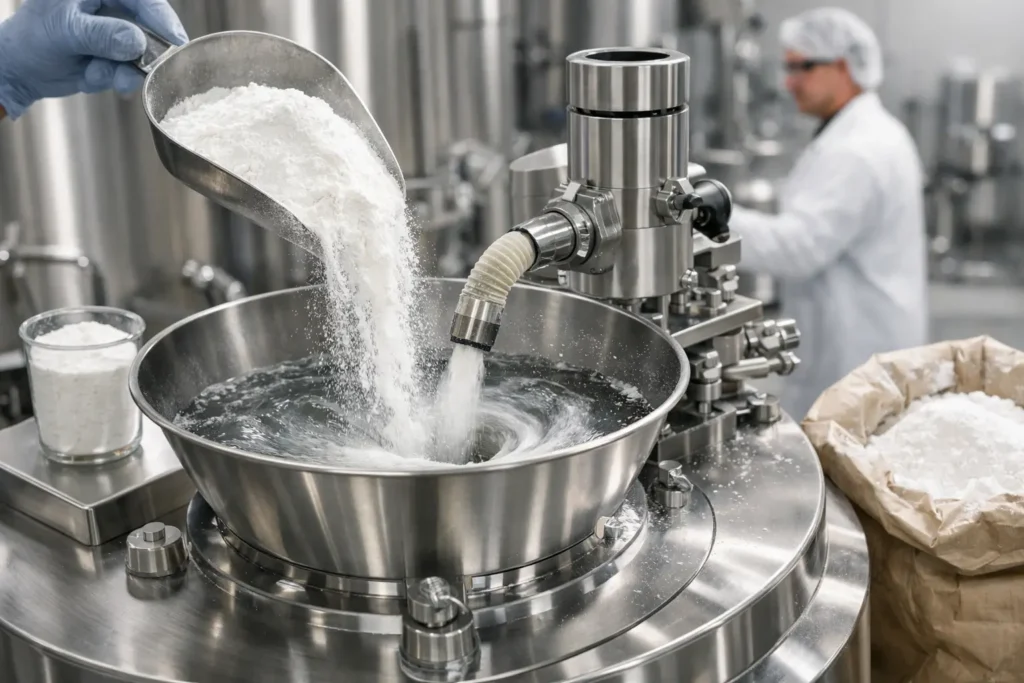
A powder that reaches the liquid surface is not necessarily wetted, dispersed, or hydrated. That distinction is where many production lines lose time. Effective powder induction methods control the moment powder enters the process stream, apply the right energy for wetting and deagglomeration, and prevent air from becoming part of the finished product.
For manufacturers processing gums, proteins, starches, sweeteners, carbomers, mineral solids, APIs, pigments, or battery materials, the target is not simply faster powder addition. It is repeatable incorporation: no fisheyes, no floating rafts, no wall buildup, and no extended recirculation cycle required to correct an unstable batch.
Why conventional powder addition creates process risk
In a conventional open tank, an operator often adds powder into the vortex created by an agitator. This can work for readily soluble, low-viscosity materials at modest throughput. It becomes unreliable when powders are fine, cohesive, hydrophobic, highly viscous after hydration, or prone to forming a gel layer at the liquid interface.
The problem is fluid mechanics. A tank agitator moves bulk liquid efficiently, but it does not always generate enough localized shear or pressure differential to pull individual particles below the surface and break apart dry agglomerates. Powders can hydrate on the outside first, trapping dry material in the center. These partially wetted agglomerates may remain in circulation long after the operator believes the batch is complete.
Open addition also introduces air, creates dust exposure, and makes addition rate dependent on operator technique. In sanitary applications, it can complicate containment and cleaning. For high-value formulations, the cost of one off-spec batch can exceed the added capital cost of a controlled induction system.
The principal powder induction methods
The correct method depends on powder behavior, batch size, required throughput, available headspace, viscosity progression, and whether the process must operate under sanitary, contained, or vacuum conditions. The following approaches are not interchangeable.
Venturi eductor induction
A venturi eductor uses a high-velocity liquid stream to create a vacuum at an induction port. Powder is drawn from a hopper or wand into the flowing liquid and carried into a recirculation loop. This approach is compact and can be effective for free-flowing powders that wet readily.
Its limitation is energy density. The venturi creates suction and transport, but it does not inherently provide the rotor-stator shear needed to disperse difficult agglomerates. An eductor system may therefore require a downstream inline mixer, colloid mill, or extended tank recirculation. It is a sound choice when the primary challenge is transferring powder into liquid, not reducing agglomerate size.
Vacuum hopper and closed transfer systems
Vacuum-assisted hoppers use negative pressure to draw powders into a closed process environment. They are valuable when dust control, operator protection, and material containment are the primary drivers. Pharmaceutical actives, fine pigments, and airborne food powders often benefit from this approach.
Vacuum transfer alone should not be treated as a hydration solution. Once the powder enters the liquid, it still needs sufficient wetting energy and residence time. In many systems, vacuum transfer is paired with an inline rotor-stator device that immediately draws, wets, and disperses the incoming solids. This division of labor is effective: the transfer system manages containment, while the mixer controls product structure.
Rotor-stator powder induction systems
A purpose-built powder induction system combines vacuum draw with an engineered high-shear zone. Liquid is recirculated from the process vessel through an inline rotor-stator mixer. The hydraulic pressure drop at the induction point pulls powder into the liquid stream, where it is accelerated through tight rotor-stator clearances.
This is often the most capable option for powders that clump, float, or rapidly increase viscosity. The powder does not sit at the surface waiting for the bulk tank flow to capture it. It enters a controlled high-velocity zone, where turbulence, shear, and localized pressure changes promote immediate wetting and agglomerate breakdown.
Performance depends on rotor-stator geometry, tip speed, stator design, recirculation rate, and the solids loading being introduced. More shear is not automatically better. Excessive mechanical energy can damage fragile particles, alter protein functionality, heat temperature-sensitive formulations, or incorporate unwanted air if the feed system is poorly configured. The objective is controlled energy input, not maximum energy input.
Direct-to-tank induction with high-shear recirculation
Some processes require operators to stage ingredients in a tank but need better control than top-entry agitation can provide. A recirculation loop equipped with a high-shear inline mixer can pull powder from a hopper positioned at the tank return or suction side, then return the processed stream below the liquid surface.
This arrangement offers flexibility for multi-ingredient batches and can be integrated into existing vessels. It is particularly useful where formulations vary frequently or where a plant needs to upgrade a conventional batch process without replacing the entire tank farm. The trade-off is that piping layout, pump selection, and return-point design become critical. Poorly designed recirculation loops can create dead zones, inconsistent turnover, or insufficient suction at the hopper.
Powder properties determine the equipment decision
The phrase “powder” covers materials with very different flow and wetting characteristics. A free-flowing crystalline sweetener behaves differently from a low-bulk-density gum, a hydrophobic silica, or a hygroscopic protein isolate. Equipment selection should begin with the powder, not with a preferred mixer category.
Particle size distribution affects surface area and the tendency to form airborne dust or cohesive bridges. Bulk density influences feeder and hopper design. Angle of repose, moisture sensitivity, electrostatic behavior, and compressibility determine whether powder will discharge consistently. Most importantly, the rate at which a material hydrates determines whether surface wetting will create a protective gel shell around dry material.
For example, hydrocolloids may require controlled addition rates to prevent fisheyes, even when substantial shear is available. Starches may need dispersion before a thermal step. Dairy and plant proteins may require gentle wetting to protect functional properties, followed by homogenization at a separate stage if droplet-size control is required. Pigments and ceramic powders may demand more intensive dispersion and extended residence time to meet particle-size targets.
Design the full process, not only the induction point
A powder induction unit cannot compensate for an undersized tank, an unsuitable feed hopper, or a process sequence that creates viscosity too early. The system must be engineered around the full production path.
Start with the required addition rate and final solids concentration. A system capable of inducting 500 pounds per hour may be inadequate if the formulation requires that rate at the highest point in the viscosity curve. Next, evaluate the liquid temperature, since viscosity, solubility, and hydration kinetics are often temperature-dependent. Then define what must happen after wetting: simple dissolution, deagglomeration, emulsification, milling, deaeration, heating, cooling, or high-pressure homogenization.
Air management deserves equal attention. Powder induction naturally creates conditions where air can enter with solids. If the finished product is sensitive to oxidation, density variation, fill-weight inconsistency, or foam, the line may require a covered vessel, controlled hopper geometry, deaeration, or vacuum processing. A system that hydrates powders quickly but leaves entrained air in a cosmetic cream, sauce, coating, or pharmaceutical suspension has not solved the complete process problem.
Sanitary design also changes the equipment specification. Food, dairy, personal care, and pharmaceutical lines may require polished product-contact surfaces, drainable piping, CIP capability, appropriate elastomers, documented materials of construction, and GMP-ready documentation. A powder hopper that is difficult to clean can become the limiting point in a hygienic production line, regardless of mixer performance.
Selecting powder induction methods by application goal
When the goal is rapid transfer of a readily soluble powder, an eductor-based approach may provide adequate performance with a lower level of mechanical complexity. When containment is the dominant requirement, a vacuum transfer system paired with downstream processing may be appropriate. When wetting, deagglomeration, and batch-time reduction must occur together, an inline rotor-stator powder induction system is usually the stronger technical fit.
The decision becomes more nuanced for shear-sensitive products. A low-shear induction arrangement may protect product integrity, while a separate downstream homogenizer handles emulsification only when needed. Conversely, highly structured dispersions may need staged processing: induction for initial wetting, a colloid mill or high-shear mixer for deagglomeration, and deaeration before filling.
This is why scale-up should be based on measurable process conditions rather than mixer horsepower alone. Track powder feed rate, recirculation flow, differential pressure, batch temperature, viscosity progression, particle-size distribution, and air content. These data create a process window that can be reproduced from pilot trials through commercial production.
EmulXion Process Technologies approaches powder handling as part of precision fluid engineering, integrating induction, high shear, deaeration, sanitary process design, and automation when the application demands a complete solution.
The best powder induction method is the one that gives operators control at the exact point where variability begins: the interface between dry solids and liquid. Engineer that moment correctly, and downstream processing becomes faster, cleaner, and far more predictable.


