
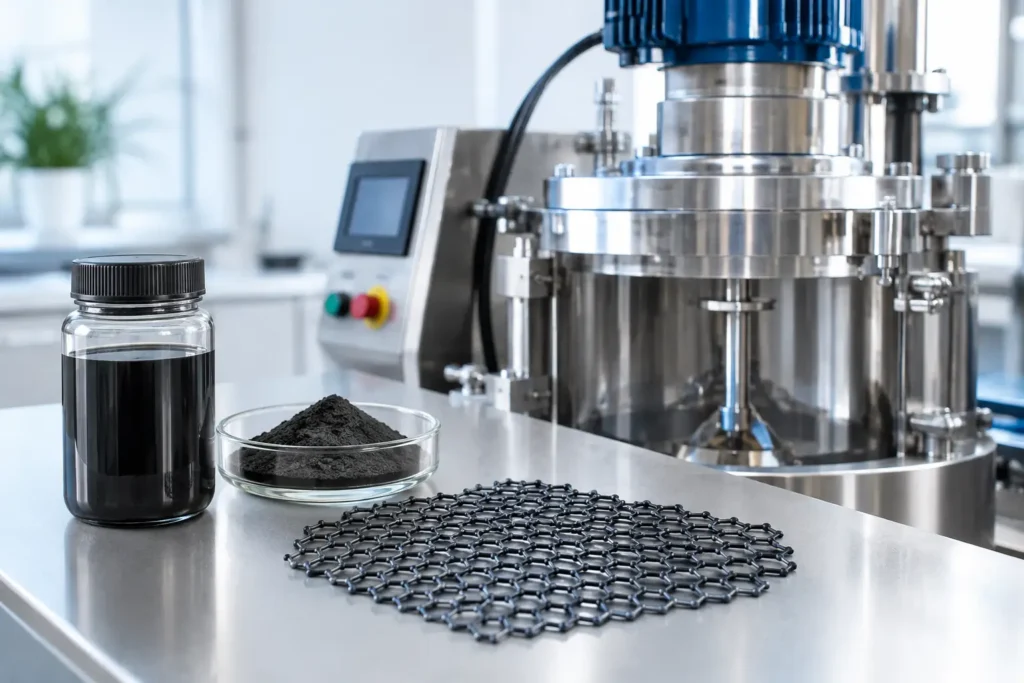
A graphene slurry can look uniform in a tank while still containing poorly wetted powder, dense agglomerates, entrained air, and a particle-size distribution that will compromise downstream coating, compounding, printing, or electrochemical performance. Graphene dispersion processing equipment must therefore do more than circulate fluid. It must deliver controlled energy where agglomerates are present, create repeatable wetting conditions, and preserve the material characteristics the formulation depends on.
For process engineers, the central question is not simply which mixer produces the highest shear rate. The right selection depends on the incoming graphene form, carrier liquid, solids loading, target flake size, viscosity profile, and the required production rate. A system that quickly disperses graphene nanoplatelets in a low-viscosity coating may be poorly suited to a high-solids conductive paste or a sensitive exfoliation process.
Why Conventional Agitation Leaves Graphene Agglomerates Behind
Graphene materials bring an unusual combination of high surface area, low bulk density, and strong particle-particle attraction. Dry powders can resist wetting, float at the liquid surface, form fisheyes, or enter the batch as partially hydrated clumps. Once agglomerates form, a conventional propeller or anchor agitator often moves them around the vessel rather than applying enough localized stress to break them down.
Tank agitation remains valuable for bulk turnover, temperature control, and maintaining suspension. It is not usually the primary particle-processing step. Energy density falls rapidly outside the impeller zone, and batch-to-batch results can vary with liquid level, powder addition rate, operator technique, and recirculation time.
The consequence is often hidden until later in the process. Large agglomerates can produce inconsistent electrical pathways in conductive inks, surface defects in coatings, unstable rheology in composites, or filtration and nozzle-clogging issues. In applications where graphene contributes barrier properties, thermal conductivity, or strength, incomplete dispersion can prevent the formulation from delivering its intended performance.
Graphene Dispersion Processing Equipment: Match Energy to the Mechanism
The equipment architecture should match the actual processing mechanism required. That distinction matters because deagglomeration, powder wetting, exfoliation, particle reduction, and deaeration are related operations, but they are not interchangeable.
Inline High-Shear Rotor-Stator Systems
An inline high-shear mixer concentrates mechanical and hydraulic energy in a close-tolerance rotor-stator workhead. As product passes through the processing zone, it is accelerated through openings in the stator and subjected to intense velocity gradients, turbulence, and controlled hydraulic shear. This makes rotor-stator processing effective for wetting graphene powders, breaking soft agglomerates, and recirculating a batch until the suspension reaches a defined state.
For many waterborne coatings, resin systems, inks, and chemical formulations, an inline high-shear system provides the practical balance of throughput, cleanability, and control. The process can be configured as batch recirculation or continuous inline processing. Recirculation provides more residence time for challenging powders, while continuous processing is advantageous when the feed condition and flow rate are tightly controlled.
Rotor-stator geometry matters. Fine-hole or multi-stage stators increase processing intensity, but they also increase pressure drop and can raise product temperature. The goal is not maximum shear by default. It is sufficient, repeatable shear to achieve the target particle-size distribution without damaging flakes, destabilizing the formulation, or creating unnecessary heat load.
High-Pressure Homogenizers for Fine, Controlled Dispersion
When graphene agglomerates are more persistent or the target dispersion demands a narrower particle-size distribution, high-pressure homogenization may be the better process route. Product is pressurized and forced through a purpose-designed valve or interaction zone, where hydraulic energy transfer, extreme fluid acceleration, turbulence, and cavitation contribute to particle disruption and dispersion.
High-pressure systems can deliver highly repeatable results when feed viscosity, pressure, pass count, and temperature are controlled. They are especially relevant where fine dispersion quality directly affects conductive performance, film uniformity, stability, or surface finish.
There is a trade-off. Excessive pressure or too many passes may shorten flakes, alter aspect ratio, or change rheology in ways that reduce the value of the graphene material. Formulation development should therefore establish an operating window rather than assume that more pressure produces a better result. Particle-size analysis, microscopy, viscosity measurements, conductivity testing, and coating evaluation should guide the final pressure and pass-count specification.
Colloid Mills and High-Viscosity Processing
Colloid mills can be useful when the process involves viscous binders, pastes, or semi-solid concentrates that do not flow easily through a conventional inline mixer. Their adjustable rotor-stator gap provides a controlled mechanical processing zone for dispersing agglomerates and refining texture in high-viscosity systems.
A mill is not automatically the best choice for every graphene application. Its suitability depends on the material’s sensitivity to mechanical stress, the required throughput, and whether the formulation contains solids that could accelerate wear. For abrasive or highly filled systems, wear materials, gap control, and maintenance access deserve early attention during equipment selection.
Control the Variables That Determine Dispersion Quality
Equipment selection is only one part of the process design. Graphene dispersion is highly sensitive to the interaction among powder properties, liquid chemistry, and processing conditions.
The first variable is wetting. Surfactants, dispersants, resin chemistry, pH, solvent selection, and order of addition influence whether liquid can penetrate powder agglomerates before high-energy processing begins. A poorly designed addition sequence can create hard lumps that require far more energy to disperse than the original powder.
Solids concentration is equally important. Higher loading improves production efficiency and reduces shipping water or solvent, but it raises viscosity and can restrict flow through fine processing zones. Some formulations process best as a lower-viscosity master dispersion that is later let down with additional resin, solvent, or carrier. Others require final-solids processing to avoid changing the material structure during dilution.
Temperature must also be controlled. Shear and high-pressure processing convert energy into heat. In waterborne systems, moderate temperature rise may be manageable. In solvent-based, thermally sensitive, or reactive formulations, a heat exchanger and temperature instrumentation may be necessary to protect product quality and maintain safe operation.
Air is another overlooked variable. Dry powder induction, high-speed recirculation, and viscosity changes can entrain bubbles that interfere with density measurement, coating appearance, conductivity, and filling accuracy. Inline deaeration or vacuum processing can remove entrained air before downstream filtration, coating, or packaging.
Build the Processing Line Around Powder Introduction
The powder-addition step frequently determines whether a graphene dispersion process is efficient or frustrating. Open-vessel charging can expose operators to airborne powder, extend batch time, and allow dry material to sit on the surface before it is drawn into the liquid.
A powder induction system creates vacuum at the powder inlet and draws material directly into a flowing liquid stream. When paired with an inline high-shear mixer, it can wet and disperse powder in a controlled circuit while reducing operator handling and dust generation. For higher production rates, automated loss-in-weight feeding, sealed transfer, and recipe-based control can make the addition rate repeatable from batch to batch.
An engineered process skid can combine the processing device, recirculation tank, feed pumps, heat exchanger, filtration connections, inline deaerator, valves, instrumentation, and PLC/HMI controls into one defined system. This approach is particularly valuable when the customer needs documented operating parameters, CIP capability, and a practical path from pilot work to commercial production.
Scale Up by Preserving Process Conditions, Not Tank Size
A larger vessel with a proportionally larger agitator rarely reproduces lab-scale graphene dispersion quality. Scale-up must preserve the processing conditions that created the target material: energy input in the active processing zone, flow rate, residence time, pressure where applicable, temperature, and number of effective passes.
A disciplined development program starts with the incoming powder specification and a measurable definition of success. That may include maximum agglomerate size, viscosity range, sedimentation behavior, conductivity, optical appearance, or coating performance. The process is then tested across realistic ranges of solids loading and production flow, not only under ideal laboratory conditions.
Before specifying capital equipment, engineering teams should establish the following process data:
- Feed and finished-product viscosity across the expected temperature range
- Graphene form, bulk density, particle morphology, and agglomerate behavior
- Target solids loading and acceptable particle-size distribution
- Required throughput, batch cycle time, and allowable recirculation passes
- Materials of construction, containment requirements, cleanability, and automation needs
These inputs determine pump sizing, workhead or valve selection, line diameters, heat-transfer requirements, and instrumentation. They also prevent a common capital mistake: purchasing a machine based on motor horsepower instead of demonstrated process performance.
Specify for Repeatable Manufacturing
For graphene applications moving from development to commercial production, repeatability should be designed into the system. Variable-frequency drive control allows defined rotor speed or pump speed. Flowmeters, pressure transmitters, and temperature sensors show whether the product is seeing the intended processing conditions. Recipe controls can hold addition rates and recirculation times within validated limits.
Sanitary construction may be essential for certain biomedical, pharmaceutical, nutraceutical, or specialty applications, while chemical compatibility and containment may take priority in industrial coatings or battery-material processing. The correct specification reflects the product, cleaning method, safety requirements, and plant operating model.
EmulXion approaches this work as precision fluid engineering: identify the material behavior, define the required process outcome, and engineer the energy transfer around it. The most effective graphene dispersion system is the one that gives the production team a measurable operating window, not a machine that relies on trial-and-error adjustments after installation.
The next useful step is to test representative material under production-relevant conditions. When dispersion quality, temperature rise, viscosity, and throughput are measured together, equipment selection becomes an engineering decision with a clear path to predictable scale-up.


