
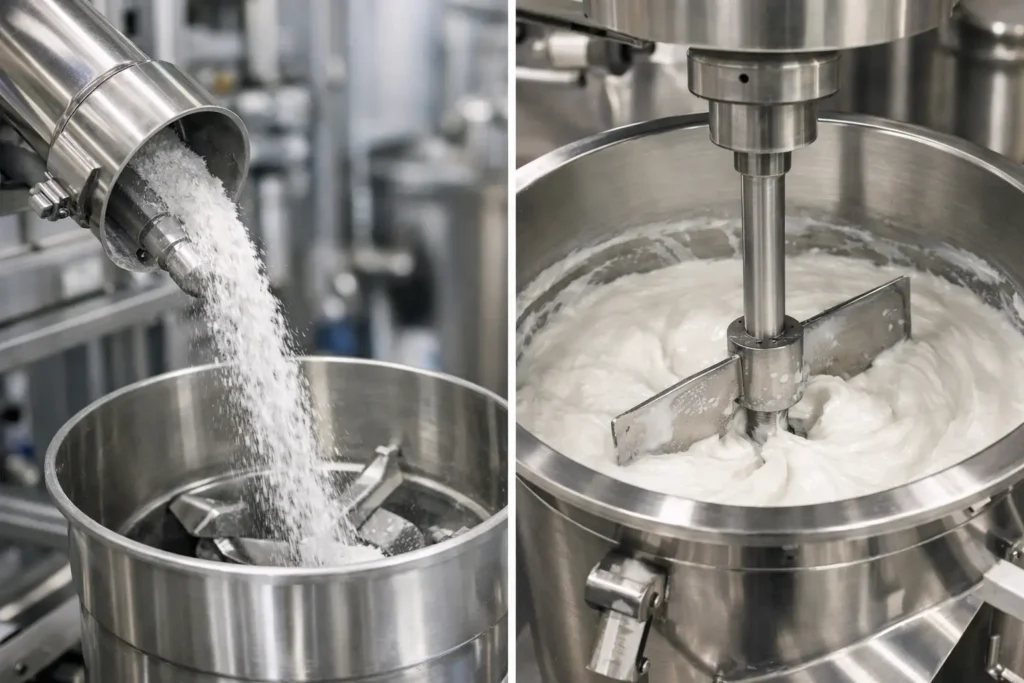
A conventional batch tank can produce an acceptable product at pilot scale, then become the limiting factor at commercial volume. Longer turnover times, uneven powder incorporation, inconsistent droplet size, and difficult cleaning often appear only after production demand rises. The decision between continuous versus batch mixing is therefore not simply about output rate. It is a decision about how mechanical energy reaches the product, how quality is verified, and how reliably a process can be repeated.
What Separates Continuous and Batch Mixing
Batch mixing processes a defined quantity of material in a vessel. Ingredients are charged, agitated, heated or cooled as required, recirculated through an inline device when needed, tested, discharged, and the cycle begins again. It is familiar, flexible, and well suited to formulations that change frequently or require extended residence time.
Continuous mixing processes ingredients as a controlled flow. Liquid streams, powders, concentrates, and additives enter at metered rates and move through a defined processing path. Inline high-shear mixers, homogenizers, colloid mills, powder induction systems, deaerators, heat exchangers, and holding sections can be arranged so the product receives a repeatable energy input before it exits the system.
The practical distinction is residence time and control. In a batch vessel, residence time is broad: some fluid elements pass near the agitator repeatedly while others remain in lower-energy regions. In a continuous system, flow rate and process-zone volume establish a more defined residence-time profile. That does not automatically make continuous processing better, but it can make critical variables easier to control.
Where Batch Mixing Performs Well
Batch processing remains the right choice for many operations. It accommodates frequent product changes, variable batch sizes, and formulas that need staged ingredient additions. A cosmetic cream may require wax melting, temperature holds, vacuum application, and slow addition of sensitive actives. A specialty chemical may need a reaction hold before final dispersion. These are valid reasons to retain a batch architecture.
A properly engineered batch system can also deliver excellent results when it combines vessel agitation with a recirculating rotor-stator mixer or high-pressure homogenizer. The tank provides working volume and dwell time; the inline device supplies the localized hydraulic and mechanical energy that a conventional impeller cannot produce consistently.
The limitation is that batch quality depends on more variables than many teams expect. Tank geometry, impeller position, baffle design, liquid level, viscosity, recirculation rate, feed sequence, and operator timing all influence the result. As viscosity rises, bulk turnover can slow substantially. A high-shear head installed on the tank may treat material near the processing zone effectively while leaving a larger vessel volume dependent on circulation patterns.
Batch systems also carry nonproductive time. Charging, heating, cooling, sampling, discharge, cleaning, and setup occur around every lot. For high-volume products, those steps can constrain output even when the actual mixing time is relatively short.
Why Continuous Mixing Changes the Control Strategy
Continuous processing replaces batch-by-batch adjustment with controlled operating conditions. Flow meters establish ingredient ratios. Pumps maintain pressure and flow. A rotor-stator head applies defined shear, while a high-pressure homogenizer can generate intense hydraulic energy transfer through an engineered valve. Instrumentation records temperature, pressure, flow, and other critical process parameters in real time.
That architecture is especially valuable when product quality is tied to a narrow particle-size distribution, droplet-size distribution, or degree of powder hydration. In mayonnaise, dressings, beverage emulsions, and nutraceutical suspensions, small shifts in dispersed-phase size can affect viscosity, appearance, shelf stability, and sensory performance. In coatings, adhesives, battery slurries, and advanced materials, inadequate dispersion can compromise functional performance downstream.
Continuous systems do not eliminate formulation risk. They make process conditions more visible and more repeatable. If a product requires a specific rotor tip speed, flow rate, pressure drop, temperature range, and number of passes, those conditions can be engineered into the line rather than managed through variable tank circulation.
Energy Density Matters More Than Motor Size
Comparing mixers by horsepower alone leads to poor equipment decisions. Product transformation occurs where energy is concentrated: inside the rotor-stator clearance, across a homogenizing valve, at the colloid mill gap, or within another engineered processing zone. Rotor-stator geometry governs fluid acceleration, turbulence, impact, and shear. High-pressure homogenization adds controlled pressure release, velocity change, and cavitation effects that can reduce droplets or particles beyond the capability of standard inline mixing.
A continuous line must be sized around the required energy per unit mass, not only the desired gallons per minute. Increasing flow through an undersized inline mixer may raise throughput while reducing residence time and shear exposure. Conversely, excessive energy can overprocess sensitive emulsions, elevate temperature, or alter product structure. Engineered outcomes require a balance between flow, viscosity, solids loading, temperature, and the target particle or droplet distribution.
Continuous Versus Batch Mixing for Scale-Up
Scale-up is where the difference becomes most apparent. A batch formula that works in a 50-gallon vessel does not necessarily transfer directly to a 2,000-gallon tank. Tank diameter changes, liquid height changes, impeller pumping changes, and the distance from the energy source increases. Matching tip speed alone rarely preserves the same fluid dynamics.
Continuous systems can simplify this transition because processing is based on a defined flow path. Once the correct inline processing conditions are established, capacity can often be expanded by increasing operating hours, adding parallel capacity, or selecting a larger unit designed to deliver equivalent energy intensity. Validation is still required, particularly for non-Newtonian products and formulations with broad particle-size distributions, but the scale-up logic is more direct.
Batch systems can scale successfully when recirculation volume, turnover rate, and processing passes are specified rather than assumed. The key is to define what the product must experience. For example, stating that a batch is mixed for 30 minutes is not a process specification. Defining recirculation flow, rotor-stator configuration, total passes through the processing head, temperature profile, and endpoint particle size is.
Powder Wetting Is Often the Deciding Application
Powder incorporation exposes the weaknesses of low-energy batch agitation. Hydrocolloids, proteins, starches, gums, mineral powders, and fine functional additives can form fisheyes or agglomerates when they contact liquid too slowly or hydrate at the surface before dispersing. More tank mixing time may not solve the problem.
A continuous powder induction system can pull powder into a high-velocity liquid stream and immediately route it through a high-shear zone. This approach improves wetting, reduces airborne dust, and shortens hydration cycles. For products requiring a subsequent hold period, the powder induction stage can feed a batch vessel. For high-volume formulations with rapid hydration, it can become part of a fully continuous line.
The right answer depends on powder behavior. Materials that require long hydration, controlled swelling, or staged thermal treatment may still benefit from a batch hold. Materials that need rapid, repeatable wetting and dispersion often favor continuous induction and inline processing.
Sanitation, Changeover, and Risk Management
For food, dairy, pharmaceutical, biotech, and personal care manufacturers, cleaning requirements are part of process selection. A continuous skid can reduce product hold-up and provide a defined CIP path through pumps, mixers, valves, piping, and instrumentation. Automated recipes can support consistent startup, flush, cleaning, and shutdown sequences.
However, continuous systems demand disciplined design. Dead legs, seal selection, drainability, valve arrangement, and clean-in-place velocity must be addressed early. A line that is difficult to clean can lose the labor and uptime advantages that justified continuous operation. GMP-ready documentation, material traceability, and validated cleaning procedures may be as consequential as throughput.
Batch equipment also requires careful sanitary design, particularly around vessel outlets, agitator shafts, spray devices, and recirculation loops. Its advantage is accessibility when formulas change often or when manual intervention is genuinely required. Its disadvantage is the repeated time and variability associated with each turnover.
Selecting the Right Process Architecture
Choose batch mixing when product portfolios are broad, lot sizes vary, reactions or long holds are required, or formulation changes demand frequent intervention. Choose continuous mixing when demand is steady, quality depends on tightly controlled dispersion or emulsification, and cycle-time losses are materially limiting production.
Many facilities benefit from a hybrid approach. A batch vessel may handle thermal preparation, premixing, or long hydration, then feed an inline emulsifier, colloid mill, high-pressure homogenizer, vacuum deaerator, or finishing skid. This separates bulk handling from the precision processing zone and gives engineers control over the variables that most directly affect final product quality.
The strongest equipment decision begins with product data: viscosity across temperature, solids content, particle or droplet-size target, ingredient addition sequence, throughput requirement, allowable air content, sanitation standard, and acceptable process window. From there, the system can be designed around measurable performance rather than a familiar tank configuration. EmulXion approaches that decision as precision fluid engineering: control what matters, document the result, and build a process that performs the same way when production pressure is highest.


