
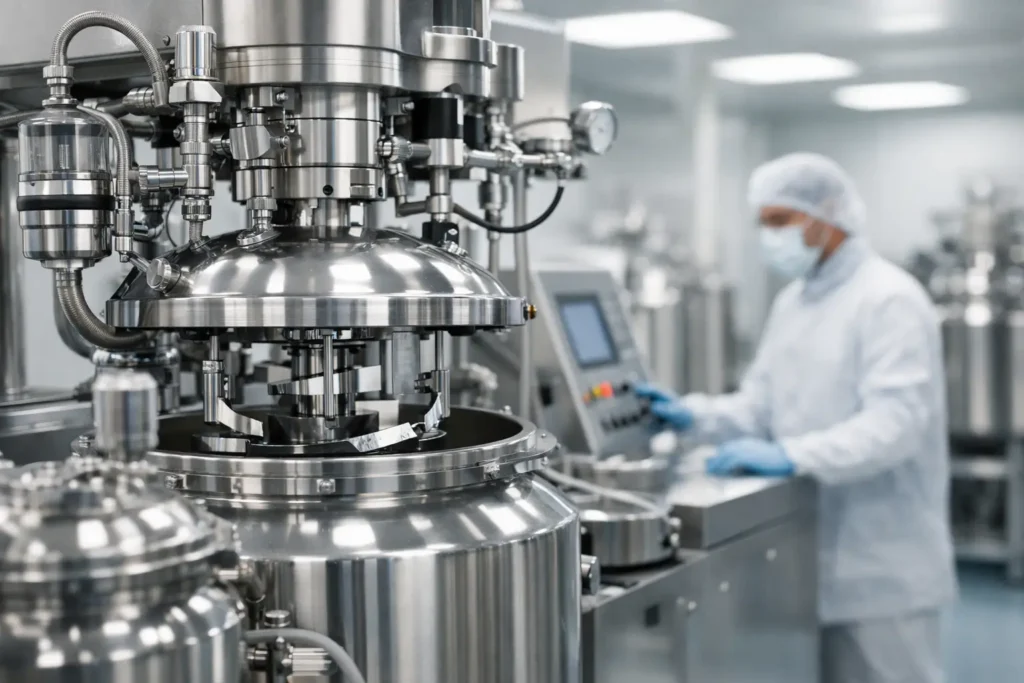
A cream that looks smooth in the vessel can still fail after filling. Entrained air may collapse under vacuum at the filler, a broad droplet-size distribution can weaken stability, and poorly wetted powders can surface as fisheyes days later. Vacuum emulsifying systems address these linked problems by combining controlled high shear, vacuum deaeration, thermal management, and recirculation in one engineered batch process.
For manufacturers of personal care products, pharmaceuticals, foods, nutraceuticals, and specialty chemicals, the value is not simply a vessel that operates under vacuum. It is the ability to control product structure from raw-material addition through final discharge. That control affects viscosity, appearance, density, shelf stability, filling accuracy, and batch-to-batch repeatability.
What Vacuum Emulsifying Systems Control
A conventional agitated tank moves bulk product, but it does not necessarily apply enough localized energy to create a fine, uniform emulsion. Large-scale circulation and localized droplet breakup are different process tasks. A properly configured vacuum emulsifying system separates and coordinates them.
The batch vessel typically combines an anchor or sweep agitator with a bottom- or side-mounted rotor-stator homogenizer. The agitator continuously renews material at the vessel wall, supports heat transfer, and prevents stagnant zones in viscous products. The rotor-stator head creates a high-velocity processing zone where liquid is accelerated, subjected to hydraulic shear, and forced through precisely defined openings. That action reduces droplet size, breaks soft agglomerates, and disperses ingredients into the continuous phase.
Vacuum adds a second critical control variable. Lowering vessel pressure removes entrained air and gases released during mixing, heating, or powder incorporation. The result can be a denser product, cleaner surface appearance, more accurate net-weight filling, and fewer oxidation-related quality issues. The exact benefit depends on product rheology and ingredients. A low-viscosity sauce may deaerate quickly, while a high-yield-stress cream may require controlled agitation, dwell time, and a staged vacuum profile to release trapped air without excessive foaming.
Why Air Removal Cannot Be an Afterthought
Air is often introduced before the batch reaches the emulsification step. Powders carry air between particles. Vortexing pulls air down from the surface. Pumps, valves, and poorly designed recirculation loops can contribute additional entrainment. In products with waxes, gums, proteins, surfactants, or high solids, those bubbles can be difficult to remove after viscosity rises.
Vacuum processing is most effective when it is designed into the batch sequence. Manufacturers may charge liquid under vacuum, induct powders below the liquid surface, apply shear during hydration, and hold the finished batch at a controlled vacuum level before discharge. The sequence should reflect the formulation rather than follow a fixed recipe borrowed from another product.
There is a trade-off. Applying high vacuum too aggressively to a surfactant-rich product can cause foaming or pull volatile components from the batch. Vacuum level, ramp rate, condenser capacity, and agitation speed must work together. Engineering the process means controlling vapor and foam behavior, not merely specifying the deepest available vacuum.
The Processing Zone Determines Emulsion Quality
Emulsions are defined by more than average droplet size. The width of the droplet-size distribution matters because oversized droplets can coalesce, separate, or compromise sensory properties. Rotor-stator geometry, tip speed, stator opening size, residence time, and product viscosity all influence that distribution.
The homogenizer must also be matched to the duty. A lotion, mayonnaise, ointment, gel, and polymer-thickened coating do not respond to shear in the same way. Some formulations need rapid droplet breakup at moderate viscosity. Others need long recirculation times to fully hydrate polymers before final emulsification. Shear that is too low leaves agglomerates and unstable droplets. Shear that is too high can damage shear-sensitive actives, alter rheology, or introduce unnecessary heat.
This is why horsepower alone is not a useful selection criterion. The relevant question is how much mechanical and hydraulic energy reaches the product in the intended processing window.
A Batch Sequence Built Around the Formulation
Effective vacuum emulsification begins with an application assessment: ingredient order, powder behavior, phase ratios, target viscosity, temperature profile, desired throughput, and quality attributes. From there, the process sequence can be engineered around known failure points.
For an oil-in-water cream, water-phase ingredients may be heated and mixed first while the anchor sweeps the jacketed vessel wall. Oil-phase components are prepared or charged at their required melt temperature. The phases are combined under controlled agitation, then processed through the rotor-stator head to establish the emulsion. Heat-sensitive ingredients, fragrances, preservatives, or active materials are commonly added during cool-down when the product can accept them without degradation. Vacuum deaeration is maintained or applied in stages as product viscosity develops.
A sauce or dressing may follow a different logic. Dry stabilizers and starches must be wetted before they form persistent agglomerates. Oil addition rate may control droplet formation and final texture. In some cases, an inline powder induction system or external recirculation loop improves charging speed and reduces operator exposure. The vacuum vessel remains the batch center, but the surrounding equipment determines whether the process is efficient at production scale.
Equipment Configuration Should Follow the Process
Vacuum emulsifying systems are available in many configurations, from compact pilot vessels to fully automated production skids. The correct design is defined by the product and operating requirements, not by a generic tank volume.
For sanitary applications, product-contact surfaces, elastomer selection, drainability, surface finish, and CIP coverage require the same attention as the homogenizer. Dead legs, poor spray-device placement, or incomplete drainage can undermine a well-designed mixing process by increasing cleaning time and contamination risk. Pharmaceutical and biotechnology applications may also require SIP capability, material traceability, validation support, and GMP-ready documentation.
Thermal design deserves equal scrutiny. Jacket area, heat-transfer media, scraper or sweep design, and product viscosity determine heating and cooling performance. If a batch cannot cool quickly enough, the homogenizer may be forced to run longer than necessary, reducing throughput and potentially stressing the formulation. If melting is uneven, waxes and structuring agents may not fully incorporate before emulsification begins.
Automation turns process knowledge into repeatable execution. A PLC/HMI system can manage recipe steps, temperature ramps, vacuum setpoints, agitator speed, homogenizer speed, timed holds, load-cell charging, and alarm conditions. Data capture provides an operating record for quality review and helps process teams distinguish formulation variation from equipment variation.
When an Inline System May Be the Better Choice
A vacuum batch vessel is not the automatic answer for every emulsion. Continuous or high-throughput operations may benefit from an inline high-shear mixer, high-pressure homogenizer, or dedicated inline deaerator. Those technologies can provide tighter control of flow-through processing and can reduce batch cycle time when the formulation and production schedule support continuous operation.
The choice depends on whether the product needs vessel-based heating, vacuum-assisted powder wetting, long residence time, high viscosity handling, or staged addition of multiple phases. Many plants use both approaches: a vacuum emulsifying vessel for batch preparation and deaeration, followed by inline finishing or transfer through a sanitary shear pump. The best arrangement is the one that controls critical quality attributes without adding unnecessary passes, cleaning burden, or operator intervention.
Scale-Up Requires More Than a Larger Vessel
A pilot batch that performs well at 50 gallons can behave differently at 500 or 2,000 gallons. The ratio of surface area to volume changes. Heat-transfer response changes. Powder addition can become more difficult, and a rotor-stator head that processed the pilot batch quickly may no longer provide equivalent circulation or residence time at production volume.
Scale-up should therefore consider tip speed, rotor-stator geometry, batch turnover, recirculation flow, vessel diameter, agitator coverage, and the viscosity profile throughout the batch. Sampling should verify not only final appearance but also particle-size distribution, density, air content, viscosity, and stability after thermal cycling. Documented trial data is more valuable than assumptions based on motor size or nominal capacity.
For manufacturers replacing an underperforming batch mixer, the goal is not to install more equipment. It is to identify the source of variation: inadequate shear, ineffective vacuum, poor powder wetting, insufficient heat transfer, or a sequence that allows the product to become difficult to process. EmulXion Process Technologies approaches vacuum processing as precision fluid engineering, with the system designed around those measurable constraints.
The right system gives operations teams a repeatable way to produce the intended product structure, even as batches move from development to commercial scale. Start with the quality attribute that is failing or limiting throughput, then engineer the vacuum, shear, circulation, and thermal profile around it. That is where controlled batches become dependable production.


