
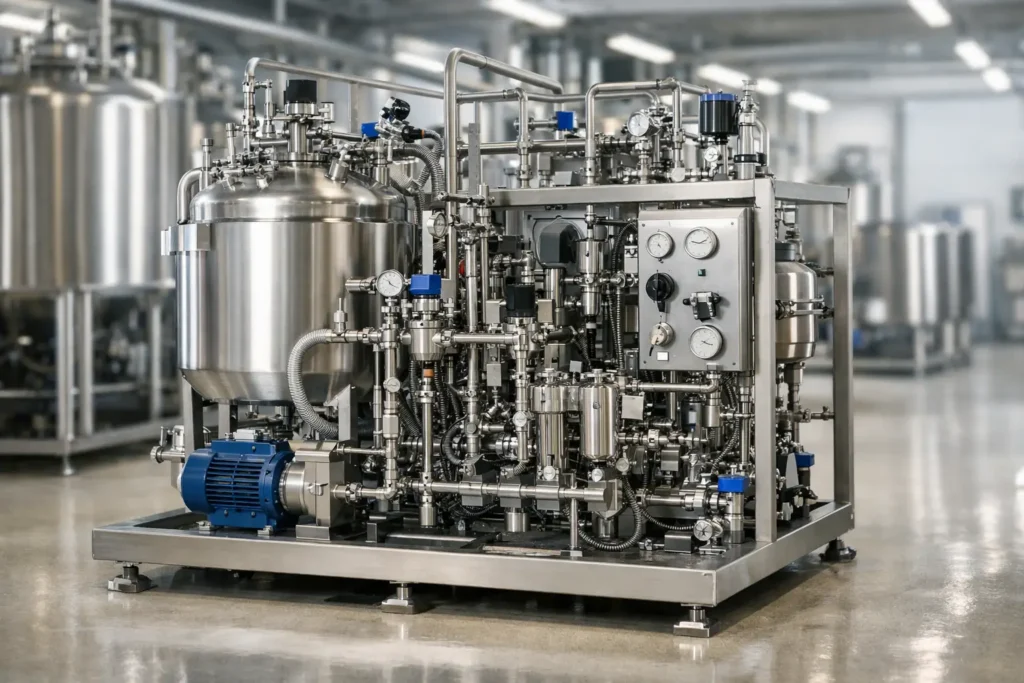
A formulation can meet every target in the development lab and still fail at commercial scale when tanks, pumps, mixers, controls, and cleaning sequences are engineered as separate purchases. Turnkey process skids address that gap by treating the production line as one controlled fluid-processing system. The objective is not simply to place equipment on a common frame. It is to preserve the shear history, residence time, temperature profile, pressure, flow path, and sanitation standard that determine product quality.
For manufacturers producing emulsions, suspensions, dispersions, creams, sauces, coatings, pharmaceutical intermediates, or advanced materials, this integration changes the capital-equipment decision. The question becomes: what processing energy must the product receive, where should it be applied, and how will the system verify that every batch receives it consistently?
What Turnkey Process Skids Are Designed to Control
A turnkey skid is an engineered assembly of process vessels, pumps, inline processing equipment, valves, instrumentation, piping, automation, and often CIP capability. It is designed around a defined process sequence rather than a collection of individual equipment specifications.
That distinction matters because product structure is rarely determined by motor horsepower alone. A cosmetic emulsion may depend on a narrow droplet-size distribution and controlled vacuum deaeration. A protein beverage may require fast powder wetting before agglomerates form, followed by high-pressure homogenization at a defined temperature. A battery slurry may need tightly controlled dispersion energy without excessive temperature rise or contamination. Each application requires a different arrangement of hydraulic energy transfer, recirculation, hold time, and instrumentation.
Traditional batch agitation can blend bulk ingredients, but it often leaves critical variables uncontrolled. Low-energy zones in a vessel can delay hydration. Entrained air can compromise density, appearance, fill accuracy, and downstream pumping. A separate transfer pump may alter flow conditions enough to change the effective performance of an inline mixer. When these components are selected independently, the plant assumes responsibility for resolving those interactions during commissioning.
A properly engineered skid defines those interactions before fabrication. It establishes the operating window for flow rate, viscosity, pressure drop, pump suction conditions, mixer tip speed, recirculation ratio, thermal duty, and cleaning velocity. The result is a process line built to produce a specified outcome, not a line assembled to accommodate available equipment.
The Process Architecture Comes Before the Equipment
The most effective turnkey process skids begin with the formulation and its failure modes. Engineers first determine whether the product challenge is particle reduction, liquid-liquid emulsification, powder incorporation, viscosity development, air removal, heat transfer, or a combination of these requirements.
A high-shear rotor-stator mixer may be the correct processing zone when rapid dispersion and controlled emulsification are required at moderate pressure. Its rotor-stator geometry creates localized velocity gradients, turbulence, and mechanical shear that break down agglomerates and reduce droplet size. For applications requiring finer particle-size reduction or more uniform droplet distributions, a high-pressure homogenizer may be necessary. In that case, the system must also account for feed consistency, inlet pressure stability, heat generation, and downstream cooling.
Vacuum processing systems are appropriate when air removal is part of the product specification. Pulling vacuum during mixing can improve powder wetting and reduce foam, but vacuum level alone does not guarantee performance. Vessel geometry, product viscosity, agitator design, condenser capacity, and the timing of vacuum application all influence deaeration efficiency.
The selection process also determines where powders enter the line. Adding difficult powders through an open vessel can create fisheyes, dust losses, operator exposure, and extended batch cycles. A powder induction system uses controlled vacuum and liquid flow to draw material directly into the process stream, where it can be dispersed immediately. This is particularly valuable for gums, proteins, starches, carbomers, pigments, and other materials that form surface gels or agglomerates when poorly wetted.
The equipment is therefore a consequence of process design. A skid can contain an inline emulsifier, colloid mill, high-pressure homogenizer, vacuum vessel, or deaerator, but only when that technology solves a defined processing problem. More equipment is not automatically better. Extra recirculation, excessive shear, or unnecessary pressure can damage sensitive ingredients, raise product temperature, and increase cleaning complexity.
Instrumentation Turns a Skid Into a Repeatable Process
Mechanical integration is only part of the value. A production system becomes repeatable when critical process conditions are measured, controlled, and recorded.
Depending on the application, that may include temperature, pressure, flow rate, vessel level, load cells, conductivity, pH, vacuum level, mixer speed, homogenization pressure, and differential pressure across filters or processing zones. The PLC/HMI architecture should make these values useful to operators, not bury them in screens that only an integrator can interpret.
Recipe control can sequence ingredient additions, establish agitation speeds, start recirculation, open and close valve paths, manage heat-transfer steps, and hold a product within its validated processing range. Alarms should distinguish between a condition that requires immediate action and a normal deviation that can be corrected without discarding a batch.
For regulated and hygiene-sensitive operations, documentation is equally significant. Material traceability, sanitary weld standards, surface finish requirements, drainability, instrument calibration, FAT procedures, and GMP-ready documentation must be defined early. Retrofitting these requirements after a skid has been designed is costly and can create avoidable qualification delays.
Where Integrated Skids Improve Plant Performance
The clearest operational benefit is reduced variability between batches, shifts, and production sites. When the pump, processing head, piping diameter, controls, and vessel are designed together, the line can deliver the same process conditions repeatedly instead of relying on operator judgment to compensate for equipment mismatches.
Cycle-time reduction is another frequent outcome. Faster powder induction, targeted inline shear, and controlled recirculation can replace long vessel-mixing periods. In many systems, processing can continue while product transfers through a closed loop, reducing handling steps and minimizing exposure to air or contamination.
Sanitary design is often a deciding factor in food, dairy, pharmaceutical, biotechnology, and personal care plants. A skid designed for CIP can use validated flow paths, appropriate spray coverage, hygienic valves, and drainable piping geometry to make cleaning predictable. However, CIP capability should not be treated as a checkbox. High-viscosity products, sticky hydrocolloids, waxes, and pigmented materials may require different cleaning velocities, temperatures, chemical concentrations, or circuit arrangements than low-viscosity aqueous products.
Integrated systems can also simplify scale-up. A lab or pilot process provides useful direction, but scale-up is not a matter of multiplying tank volume. Shear intensity, residence time, pumping capacity, heat removal, and product turnover can change substantially at commercial flow rates. An engineered skid uses process data to maintain the conditions that matter, whether the critical variable is rotor tip speed, energy density, pressure, number of passes, or a specified flow-through residence time.
Decisions That Should Be Made Before Fabrication
A skid quotation should be based on more than batch size and product viscosity. Those inputs are essential, but they do not fully describe the duty. The engineering team needs to understand the ingredient-addition order, target particle or droplet size, throughput requirement, rheology changes during processing, temperature limits, cleaning method, utility availability, and the required level of automation.
It also needs to account for the practical constraints of the plant. Ceiling height, access routes, floor loading, electrical service, compressed air, chilled water, hot water, steam, nitrogen, drain location, and operator access can affect the final design. A system that performs well in a process flow diagram but cannot be installed, serviced, or cleaned efficiently is not a complete solution.
There are trade-offs. A compact skid reduces footprint but may limit maintenance clearance or future expansion. Full automation improves repeatability, yet it adds controls scope and requires disciplined recipe management. A single multipurpose line can support several formulations, but it may need carefully designed cleaning validation and changeover procedures. The correct choice depends on whether flexibility, dedicated throughput, compliance, or development speed has the greatest value to the operation.
Acceptance Criteria Should Reflect Product Performance
Factory acceptance testing should verify more than motor rotation and valve actuation. Meaningful acceptance criteria connect equipment function to the process requirements: specified flow and pressure ranges, temperature control, vacuum capability, CIP sequence performance, automation logic, and, where practical, processing results using representative material.
Before shipment, the project team should confirm utility connections, instrument tags, process and instrumentation diagrams, manuals, spare-parts recommendations, and startup responsibilities. That discipline reduces the familiar commissioning problem where every component works independently, but the line does not yet produce the required product.
EmulXion designs integrated systems around the processing mechanism that governs product quality, then builds the vessels, pumps, controls, and sanitary infrastructure required to support it. That engineering approach is especially valuable when replacing underperforming batch mixers or combining multiple manual operations into one controlled line.
The best skid is not the one with the longest equipment list. It is the one that gives operators clear control over the variables that shape the product, makes cleaning and changeover practical, and carries proven process conditions from development through commercial production.


