
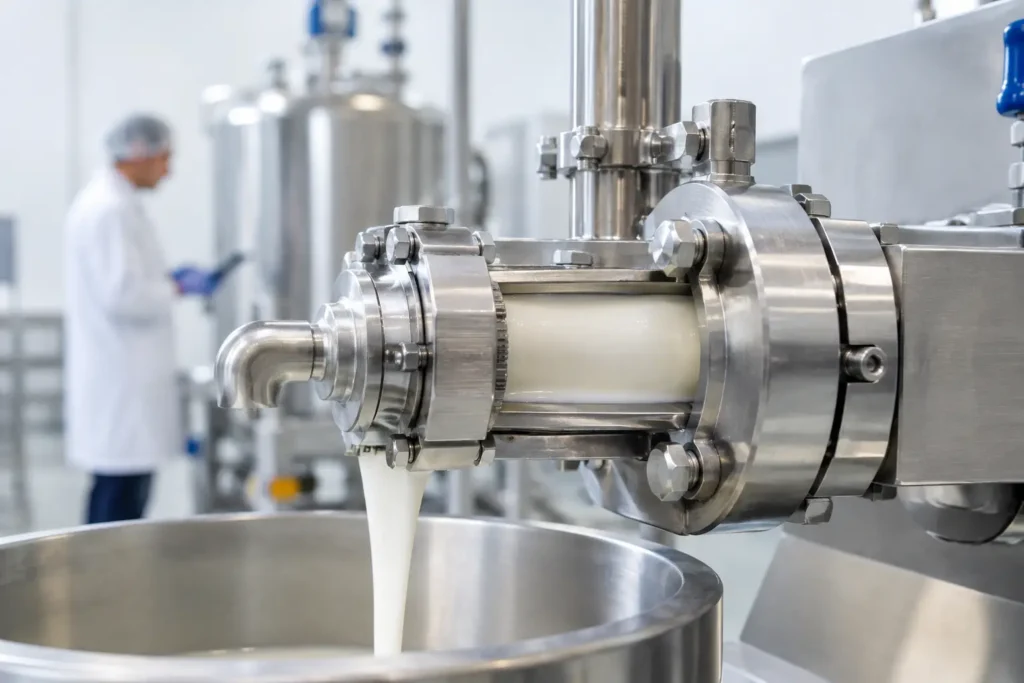
A conventional tank agitator can blend ingredients into the same vessel without necessarily creating the same product structure. For manufacturers developing stable emulsions, fine suspensions, cell disruption processes, or narrow particle-size distributions, the critical question is: how does pressure homogenization work differently? It applies concentrated hydraulic energy in a controlled processing zone, creating forces that batch agitation cannot reliably reproduce.
How Does Pressure Homogenization Work?
Pressure homogenization is a continuous process in which a positive-displacement pump forces product at high pressure through a precisely engineered homogenizing valve. Upstream pressure energy is converted rapidly into fluid velocity as the product passes through a very small, adjustable gap. When the fluid exits that restriction, the pressure drops sharply and the high-velocity stream decelerates within the valve geometry.
That rapid change creates several disruptive mechanisms at once: extreme velocity gradients, turbulence, cavitation, and particle or droplet impact. Together, these mechanisms break larger oil droplets, agglomerates, cells, or dispersed particles into smaller structures. The result can be a more uniform emulsion, a finer suspension, improved hydration, or a more consistent texture, depending on the formulation and process objective.
The operation is continuous rather than dependent on the circulation pattern inside a batch tank. Every portion of product that passes through the valve sees a defined pressure and engineered restriction. That is the foundation for repeatability.
The role of pressure, velocity, and valve geometry
Pressure is necessary, but pressure alone does not determine the final result. A high-pressure homogenizer generates the desired effect through the relationship between pressure, flow rate, valve design, gap setting, and product rheology. The pump supplies hydraulic energy. The valve converts that energy into the localized forces that alter the product.
As fluid accelerates through the valve gap, its velocity rises dramatically. The product then encounters a controlled deceleration zone. Turbulent eddies generate intense shear, while localized pressure changes can form and collapse vapor cavities. In suitable formulations, cavitation contributes to agglomerate and droplet disruption. It must be managed rather than treated as an uncontrolled benefit, since excessive cavitation can accelerate valve wear or damage sensitive components.
Valve design matters because it governs where and how that energy is dissipated. A well-engineered valve creates a repeatable processing environment across operating hours and production campaigns. It is not simply a restriction placed in a pipe.
What Happens to the Product Structure
In an oil-in-water emulsion, large dispersed oil droplets are stretched and fractured into smaller droplets. If sufficient emulsifier is available to cover the newly created interfacial area, the emulsion becomes more stable against coalescence and creaming. Reduced droplet size can also change opacity, mouthfeel, viscosity, and flavor release.
In suspensions, pressure homogenization can break soft agglomerates and distribute solids more uniformly throughout the liquid phase. This can improve consistency in products such as pigment dispersions, ceramic slurries, nutraceutical beverages, coatings, and battery materials. The outcome is not always a smaller primary particle size. Often, the practical objective is deagglomeration and a narrower particle-size distribution.
For biotechnology and pharmaceutical processes, the same concentrated energy can be used for cell disruption. Here, the goal is controlled release of intracellular material rather than emulsion formation. Product temperature, pass count, and pressure become especially important because biological materials may be shear- or heat-sensitive.
The Variables That Control Homogenization Results
A pressure setpoint is only one process variable. Production teams should evaluate the full process window before specifying equipment or defining a validated recipe.
Homogenization pressure. Higher pressure generally increases disruptive energy and may reduce droplet or agglomerate size. However, the relationship is not linear. Beyond a certain point, additional pressure may produce limited improvement while increasing heat load, energy consumption, and wear.
Number of passes. A second pass can improve uniformity when one pass does not sufficiently process the full droplet or particle population. Multiple passes add processing time and thermal exposure, so they should be justified by measured quality improvement rather than assumed.
Product viscosity and rheology. High-viscosity materials require appropriate feed conditions and pumping capacity. Shear-thinning behavior, yield stress, and solids loading influence pressure stability and actual valve performance.
Temperature control. Mechanical energy becomes heat. Temperature rise may be acceptable in sauces or certain chemical products, but it can be limiting for dairy, proteins, active ingredients, fragrances, or live biological systems. A heat exchanger before, between, or after passes may be necessary to maintain the target temperature range.
Formulation chemistry. An emulsifier system, wetting agent, pH, ionic strength, and solids concentration all influence whether newly created droplets or particles remain stable after processing. Homogenization cannot compensate for a formulation that lacks adequate interfacial stabilization.
Why Pre-Processing Often Determines Final Performance
High-pressure homogenizers perform best when the feed is already properly prepared. Powders should be fully wetted and hydrated where the formulation requires it. Oil and water phases should be preblended. Large undissolved particles, foreign matter, or poorly dispersed gum lumps can create inconsistent results and unnecessary wear.
This is why a complete process often combines multiple technologies. An inline high-shear mixer or powder induction system may be used upstream to wet powders, disperse thickeners, and create a uniform premix. The high-pressure homogenizer then refines the microstructure. Downstream deaeration may remove entrained air that would otherwise affect filling accuracy, oxidation, appearance, or cavitation behavior.
For a sanitary process, the line also needs to be designed around cleanability. Hygienic valve materials, appropriate elastomers, dead-leg control, CIP capability, and instrumentation for pressure and temperature verification are part of process control, not afterthoughts. Pharmaceutical and biotech applications may require SIP compatibility, material traceability, and GMP-ready documentation.
Pressure Homogenization Versus High-Shear Mixing
Inline rotor-stator equipment and high-pressure homogenizers both apply intense energy, but they do so through different mechanisms. A rotor-stator mixer generates shear as product passes through the close-clearance interaction between a rotating rotor and stationary stator. It is highly effective for powder incorporation, emulsification, dispersion, and recirculated batch processing, particularly when the required particle or droplet size is within its operating range.
Pressure homogenization concentrates energy in a valve at substantially higher hydraulic pressures. It is often selected when the product requires finer emulsions, stronger stability, cell disruption, or a narrower distribution than a rotor-stator process can achieve alone.
Neither technology is automatically the better choice. High-pressure processing can impose greater capital cost, maintenance requirements, and thermal load. For a moderate-viscosity dressing, lotion, or coating that meets specification after one inline high-shear pass, a pressure homogenizer may be unnecessary. For a shelf-stable beverage or high-value active dispersion where a few microns of droplet size affect stability and performance, the added control can be justified.
From Lab Data to Commercial Throughput
Scale-up should not rely on matching tank volume or motor horsepower. The relevant scale-up factors are pressure, valve configuration, product temperature, flow rate, pass count, and the resulting particle-size distribution or other verified quality attribute. A pilot trial should establish the operating window, including the lowest pressure that consistently meets specification.
At production scale, instrumentation turns that window into a repeatable process. Pressure transmitters verify hydraulic conditions. Temperature measurement identifies heat gain. Flow control establishes residence time and throughput. Sampling plans confirm that droplet size, viscosity, appearance, and stability remain within target through a full campaign.
For integrated systems, the homogenizer must also match upstream and downstream realities: feed tank capacity, premix quality, heat-exchange duty, CIP sequence, packaging rate, and automation architecture. Specifying the machine without engineering the line can move the bottleneck rather than remove it.
The most useful question is not simply whether a homogenizer can generate high pressure. It is whether the process can deliver the required product structure, at the required throughput, with data that proves it will do so again tomorrow.


