
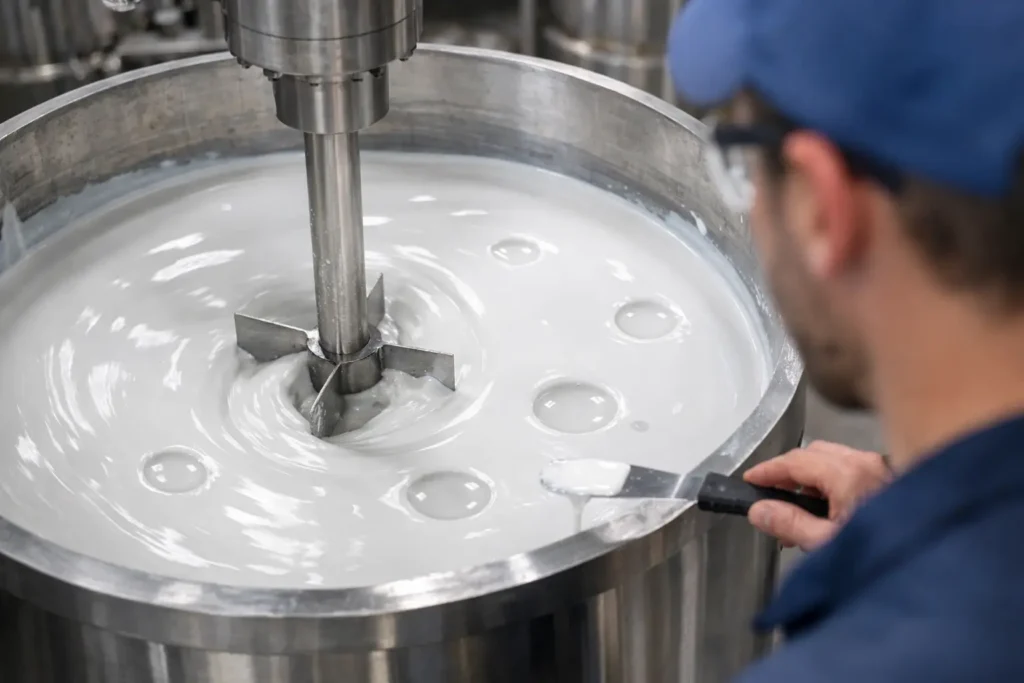
A powder lump that survives hydration can look insignificant in a sample cup and become a major production defect after filling. In sauces, nutrition beverages, creams, coatings, adhesives, and slurry systems, fish eyes create visible specks, unstable viscosity, inconsistent solids distribution, and costly rework. To prevent fish eyes in mixing, manufacturers must control the first seconds of powder-liquid contact, not simply add more batch time after agglomerates have formed.
A fish eye is generally a partially wetted powder agglomerate. Its outer surface hydrates first, creating a gelled or viscous shell around dry powder in the center. Once that shell forms, bulk agitation may move the agglomerate through the vessel without delivering enough localized energy to break it apart and fully wet the material. The result is a defect that can persist long after the tank appears uniformly mixed.
Why Fish Eyes Form During Powder Addition
Fish eyes are a wetting and dispersion problem with a mixing consequence. They occur most often when a hygroscopic, thickening, protein-based, or fine powder meets liquid under uncontrolled addition conditions. Starches, gums, hydrocolloids, proteins, carbomers, cellulose derivatives, cocoa, mineral powders, and certain active ingredients are common examples, but the mechanism depends on the formula.
The central issue is surface hydration rate. If liquid rapidly wets the exterior of a powder cluster while insufficient fluid penetrates its interior, the outside can become a barrier. A conventional propeller or sweep agitator may provide adequate turnover for a finished batch, yet it typically cannot generate the intense velocity gradients required at the moment of particle incorporation.
Several process conditions increase the likelihood of fish eyes:
- Powder is dumped too quickly, creating a floating raft or dense surface layer.
- The addition point sits outside the high-energy mixing zone.
- Liquid viscosity is already too high for effective wet-out.
- The powder is added after a polymer, gum, or emulsifier has thickened the continuous phase.
- Air enters with the powder, allowing dry material to float, clump, or bridge before wetting.
- The system recirculates poorly, leaving dead zones or repeatedly exposing only part of the batch to shear.
The equipment may be operating correctly and still produce fish eyes if the sequence, feed rate, or fluid condition is wrong. This is why troubleshooting should begin with process physics rather than mixer speed alone.
How to Prevent Fish Eyes in Mixing at the Point of Entry
The most reliable approach is to introduce powder into a controlled, high-velocity liquid stream and disperse it before a hydration shell can stabilize. An inline powder induction system paired with an inline rotor-stator mixer is often effective because it draws powder directly into the process liquid under vacuum and immediately exposes the mixture to concentrated mechanical and hydraulic energy.
This differs from adding bags through an open tank manway. Open-top addition gives operators limited control over powder feed rate, entrained air, and where material enters the fluid. The powder can remain on the surface, stick to vessel walls, or form rafts that resist incorporation. An induction system meters the powder into a defined processing zone, improving wetting consistency while reducing dust and operator exposure.
For difficult formulations, the induction point should be close-coupled to the shear zone. The objective is not merely to pull powder into the line. It is to ensure that each incoming stream receives enough turbulence, pressure fluctuation, and rotor-stator shear to separate agglomerates and distribute particles throughout the continuous phase.
Feed rate matters as much as equipment selection. A high-capacity mixer cannot compensate for a powder feed rate that overwhelms the available liquid flow or dispersive energy. Establish a qualified feed window based on powder bulk density, particle morphology, liquid viscosity, recirculation rate, and the viscosity rise expected during hydration. In many systems, slower, controlled induction produces a shorter total batch time because it eliminates downstream rework.
Establish the Right Addition Sequence
The formula sequence often determines whether a process remains stable. Materials that hydrate rapidly or build viscosity should generally be dispersed early, when the liquid phase has low enough viscosity to support circulation and high-shear processing. However, there are exceptions. Some powders require preblending with sugar, oil, or another carrier to limit instantaneous hydration, while others must be added after pH adjustment or temperature control.
A sound sequence identifies four conditions before each powder addition: liquid temperature, pH, soluble solids, and current viscosity. For example, adding a gum into a high-solids syrup or a partially thickened aqueous phase can sharply reduce wetting efficiency. Conversely, an ingredient that requires elevated temperature for dissolution may not respond to room-temperature high shear alone.
Do not treat the order validated in a laboratory beaker as automatically transferable to production. Lab-scale tools can create circulation patterns and surface conditions that do not exist in a 2,000-gallon vessel. Scale-up must account for tip speed, rotor-stator gap, pump flow, residence time through the shear head, and the time required for the full vessel volume to pass through the processing loop.
Select Shear Based on the Defect Mechanism
High shear is not a single operating condition. Rotor-stator geometry, tip speed, stator opening design, process viscosity, and recirculation all influence the energy applied to agglomerates. For many fish-eye problems, an inline high-shear mixer provides the best balance of rapid wetting, dispersion, and full-batch recirculation.
The recirculation loop must be designed for the actual product, not just water-flow capacity. If the loop flow is too low, portions of the tank may receive little exposure to the shear zone. If it is too high for the vessel geometry, vortexing, air entrainment, or bypassing can result. The goal is controlled turnover: every portion of the batch should repeatedly pass through the dispersion zone until particle hydration and size distribution meet the specification.
Some materials need a different technology. A colloid mill can be appropriate when the process requires tighter mechanical reduction of soft agglomerates or fibrous material. A high-pressure homogenizer may be necessary when the defect is tied to fine emulsion droplet size or persistent submicron dispersion requirements rather than powder wetting alone. These systems can deliver exceptional uniformity, but they do not replace good powder induction practices. Feeding poorly wetted, air-laden agglomerates into a downstream homogenizer can limit capacity and increase wear.
For vacuum-sensitive creams, sauces, and personal-care products, vacuum emulsifying systems provide another advantage. Pulling powder under vacuum and deaerating the batch can reduce floating powders, foam, and entrained-air defects. The trade-off is additional system complexity and the need to manage vapor load, temperature, and vacuum stability. The right choice depends on whether air removal is central to product quality or simply a secondary benefit.
Diagnose the Process Before Changing Equipment
A useful fish-eye investigation starts with samples taken at defined stages: immediately after powder addition, after initial recirculation, after any heating or hold step, and at discharge. Evaluate not only visible agglomerates but also viscosity, particle-size distribution, screen residue, density, and entrained air where relevant. A batch that clears visually may still contain partially hydrated material that shifts viscosity during storage.
Then observe the process at the addition point. Is powder entering a vortex, sitting on the liquid surface, accumulating on the vessel wall, or bridging in a hopper? Is the recirculation return aimed at the right zone? Is the tank agitator maintaining top-to-bottom turnover during the viscosity increase? These observations often reveal a flow-pattern limitation that cannot be corrected by extending mix time.
Document operating parameters with enough precision to reproduce successful batches. Record liquid level, temperature, mixer speed, recirculation flow, powder feed rate, addition duration, vacuum level where used, and total passes or recirculation time. For automated systems, these values should become controlled recipe parameters rather than operator judgment calls.
Avoid the Common “More Time” Response
Extending batch agitation is a frequent response to fish eyes, but it is usually the least efficient correction. Once the outer layer of an agglomerate has gelled, low-shear bulk mixing may not open it. Longer mixing can also introduce excess air, heat-sensitive product damage, foam, or unnecessary energy consumption.
More shear is not automatically the answer either. Excessive local energy can alter texture, damage sensitive proteins, increase temperature, or change rheology. The process should deliver sufficient energy in the right zone and at the right time. Engineered outcomes come from matching equipment geometry and operating conditions to the ingredient behavior.
Build Fish-Eye Prevention Into Scale-Up
A production-scale process should be qualified around measurable acceptance criteria, not a visual impression of smoothness. Define the maximum allowable screen residue, viscosity range, particle-size target, hydration time, and air-content limit. Test the process at realistic low and high production rates, because powder feed and recirculation relationships can change substantially across the operating range.
For new formulations or equipment replacements, pilot trials provide the fastest path to a defensible design. They establish whether the material needs simple inline dispersion, vacuum induction, milling, high-pressure homogenization, or a combined process skid with automated dosing and CIP capability. EmulXion approaches this as precision fluid engineering: quantify the defect mechanism, concentrate energy where it changes the product, and validate repeatability before committing to full-scale production.
The practical next step is to map every fish-eye event to its exact addition condition. When the powder, liquid state, feed rate, local shear, and recirculation path are visible as one process, the corrective action becomes far more precise than asking the tank mixer to work harder.


