
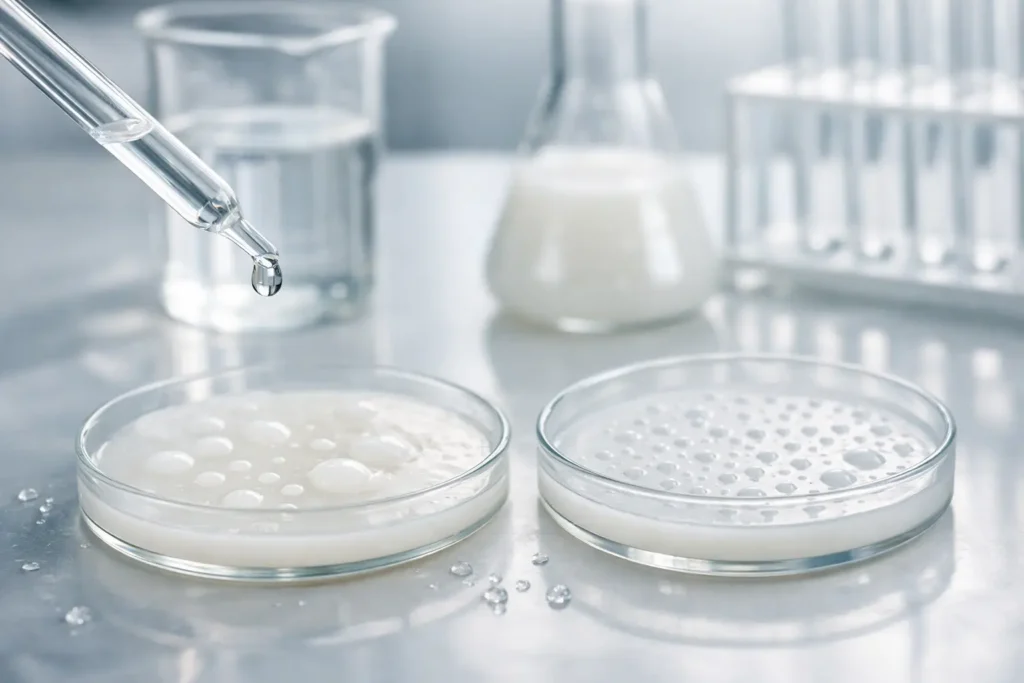
A stable emulsion is not created by mixing longer. It is created when the energy delivered to the dispersed phase exceeds the forces holding larger droplets intact, while the formulation stabilizes the new interfacial area created. To reduce emulsion droplet size reliably, manufacturers must control the interaction between equipment, fluid properties, temperature, emulsifier chemistry, and residence time.
Conventional tank agitation can blend oil and water phases effectively at a macro level, yet it often leaves a broad droplet-size distribution. That variability can appear later as creaming, coalescence, viscosity drift, color inconsistency, poor mouthfeel, or a failed shelf-life test. For food, personal care, pharmaceutical, and specialty chemical manufacturers, the objective is not simply a smaller average droplet size. It is a controlled and repeatable distribution at production throughput.
What Actually Reduces Emulsion Droplet Size?
Droplet breakup occurs when disruptive stresses overcome interfacial tension. In practical processing terms, those stresses come from high local velocity gradients, turbulence, cavitation, and hydraulic pressure drop. The available energy must be concentrated where the phases meet, rather than dissipated across a large tank volume.
Three variables determine the result: the intensity of energy input, the time material spends in the active processing zone, and the ability of the emulsifier system to cover freshly formed droplets before they collide and merge. Raising mixer speed alone addresses only the first variable, and often inefficiently.
A process that produces a D50 target but retains a large coarse-droplet tail may still be unstable. Large droplets tend to rise, settle, or coalesce first. For that reason, process development should evaluate the full particle-size distribution, such as D10, D50, and D90, along with microscopy, viscosity, and accelerated stability testing.
Start With the Formulation, Not the Machine Setting
Equipment cannot compensate indefinitely for an emulsion system that lacks sufficient interfacial stabilization. Before increasing shear or pressure, confirm that the formulation is capable of supporting the target droplet size.
Interfacial tension matters because it resists droplet breakup. A properly selected emulsifier reduces this resistance and adsorbs at the oil-water interface. Emulsifier type, concentration, hydrophilic-lipophilic balance, and addition sequence all influence the outcome. Proteins, phospholipids, surfactants, and polymeric stabilizers behave differently under heat, salt, pH shifts, and high shear.
Viscosity also requires careful interpretation. Higher continuous-phase viscosity can suppress droplet movement and reduce recoalescence, improving stability after processing. But if total viscosity becomes too high, flow through a rotor-stator head or high-pressure valve may become difficult, limiting throughput and increasing heat generation. The right approach depends on which phase is thickened, the rheology of the product, and the selected processing technology.
Phase temperature is equally consequential. Processing an oil phase below the melting range of a waxy component can produce incomplete dispersion or solid-fat artifacts. Processing too hot may damage heat-sensitive actives, alter flavor, or reduce the performance of certain stabilizers. In many systems, both phases should enter emulsification at controlled and compatible temperatures to maintain predictable viscosity and phase behavior.
Match Energy Delivery to the Target Droplet Size
Inline high-shear rotor-stator processing
An inline high-shear mixer creates intense mechanical shear as product is drawn into the rotor-stator workhead, accelerated through closely controlled clearances, and discharged at high velocity. This geometry repeatedly subjects fluid to shear, turbulence, and localized pressure changes. It is highly effective for pre-emulsification, medium-fine emulsions, and continuous recirculation applications.
Rotor-stator selection matters. A coarse generator may provide rapid turnover and strong bulk circulation, while a fine stator pattern increases localized shear and can improve droplet reduction. However, finer screens also increase pressure drop and can become restrictive with high-viscosity products or ingredients prone to agglomeration. Process design must balance droplet-size goals against flow rate, recirculation time, and cleanability.
For many sauces, dressings, creams, lotions, and chemical emulsions, an inline high-shear system provides the most efficient path from tank-scale blending to a controlled production process. A recirculation loop can deliver multiple passes without relying on extended batch agitation, reducing cycle time and improving batch-to-batch repeatability.
High-pressure homogenization
When a narrow submicron or very fine droplet distribution is required, high-pressure homogenization may be the more appropriate technology. Product is pressurized and forced through an engineered homogenizing valve, where hydraulic energy is converted into extreme acceleration, turbulence, cavitation, and impact.
High-pressure processing is particularly relevant for dairy systems, beverage emulsions, nutraceuticals, pharmaceutical suspensions, liposomal applications, and other products where small droplet size directly affects stability, appearance, bioavailability, or sensory performance. It can achieve results beyond typical rotor-stator processing, but it introduces different operating requirements.
The feed emulsion must be adequately prepared before entering the valve. Large oil droplets, unmelted solids, fibers, or poorly hydrated gums can create inconsistent results, excessive wear, or plugging risk. Pressure selection also has limits. More pressure can reduce droplets further until the formulation reaches a practical plateau, after which heat load, energy consumption, and product damage may rise faster than performance improves.
Colloid milling and combined systems
A colloid mill applies high shear across an adjustable rotor-stator gap and is often used for viscous emulsions, pastes, and semi-solid products. It can be valuable where product structure, not only droplet reduction, is central to performance. Mayonnaise, topical creams, grease systems, and certain adhesive formulations are common examples.
Some applications benefit from staged processing: controlled premixing for phase incorporation, inline high shear for initial droplet breakup, then high-pressure homogenization for final refinement. This arrangement prevents the final processor from doing work that should have been completed upstream. It also improves throughput consistency and protects sensitive downstream equipment.
Control the Process Conditions That Cause Variability
A well-specified homogenizer cannot overcome unstable upstream conditions. The most repeatable results come from treating the emulsion line as a controlled process rather than a stand-alone mixer.
Flow rate governs residence time. If throughput rises while processing energy remains fixed, each unit of product receives less treatment. In a recirculation system, the number of theoretical passes and actual tank turnover should be defined rather than estimated from operator experience. A variable-frequency drive, flow measurement, pressure instrumentation, and temperature monitoring provide the operating data needed to hold a validated process window.
Air entrainment deserves equal attention. Entrained air changes apparent viscosity, reduces pumping consistency, promotes oxidation, and can interfere with efficient hydraulic energy transfer. Products containing proteins, surfactants, or high levels of dissolved solids can foam aggressively during tank mixing. Vacuum emulsifying systems and inline deaerators remove air under controlled conditions, improving appearance, fill-weight consistency, and stability.
Temperature rise must be measured at the outlet of the active processing zone, not only in the batch tank. High-shear and high-pressure processing convert energy into heat. A moderate temperature increase may improve flow and emulsification, while excessive rise can degrade temperature-sensitive actives or shift product viscosity outside specification. Heat exchangers, jacketed tanks, or staged cooling may be required for continuous operation.
Avoid the Most Common Scale-Up Errors
The most frequent mistake is scaling by tank volume or agitator horsepower. Neither measurement describes the local shear environment that breaks droplets. A pilot batch may look acceptable because it received many effective passes through a small laboratory device, while the full-scale batch receives far less specific energy.
Scale-up should preserve the relevant process conditions: rotor tip speed and workhead geometry for inline high shear, pressure and valve configuration for high-pressure homogenization, flow rate, pass count, product temperature, and feed quality. The target should be a documented operating window, not a single setting that worked once.
Another common error is postponing powder hydration until after emulsification. Unhydrated gums, proteins, or starches can continue building viscosity after processing, changing the product structure and masking the true emulsion result. Powder induction and controlled wetting upstream can eliminate fisheyes, shorten batch preparation, and provide a more uniform feed to the emulsifying stage.
For sanitary or regulated production, cleanability must be part of process selection. Tight-gap equipment, valves, piping, and instrumentation should be designed for effective CIP or SIP where required. A process that delivers fine droplets but cannot be cleaned, validated, or returned to service predictably is not an engineered production solution.
Build a Measurable Droplet-Reduction Program
A productive development program starts with a defined quality target: droplet-size distribution, viscosity range, stability requirement, sensory or appearance criteria, and required production rate. Then test the formulation across controlled changes in emulsifier level, phase temperature, shear intensity, pressure, and number of passes.
Do not rely on visual appearance alone. Pair laser diffraction or another appropriate sizing method with microscopy and finished-product stability data. Record inlet and outlet temperatures, flow, pressure, motor load, and processing time. Those data establish the relationship between processing conditions and product structure, making troubleshooting faster when raw materials or seasonal conditions change.
EmulXion Process Technologies approaches this work as precision fluid engineering: identify the breakup mechanism required, concentrate energy in the correct processing zone, and verify the result with operating data. The right system may be an inline high-shear mixer, a high-pressure homogenizer, a vacuum emulsifying platform, or an integrated skid that controls the entire sequence.
The practical question is not, “What mixer speed should we use?” It is, “What controlled energy input and formulation conditions will consistently produce the droplet distribution the product requires?” Answer that question with measured process data, and finer emulsions become a repeatable manufacturing outcome rather than a batch-to-batch accident.


