
A sauce that breaks after thermal processing, a lotion with visible agglomerates, or a coating that settles in the drum rarely has a formulation-only cause. In many cases, the limiting factor is energy delivered in the wrong place, at the wrong intensity, or for too little residence time. Shear mixing fundamentals explain why conventional agitation can circulate a batch effectively yet still fail to create the droplet size, particle dispersion, or product structure the process requires.
For manufacturers, shear is not a generic measure of how aggressively a mixer operates. It is a controlled mechanical and hydraulic action that changes the material at the microscopic level. The objective is not maximum force. It is repeatable energy transfer matched to the formulation, target quality attributes, production rate, and sanitary or containment requirements.
What Shear Mixing Actually Does
Shear occurs when adjacent layers of fluid move at different velocities. That velocity difference creates a deforming force within the product. In process equipment, shear can stretch and break liquid droplets, fracture soft agglomerates, distribute solids through a carrier phase, accelerate powder wetting, and renew the interface between ingredients.
A standard tank agitator produces bulk flow. It moves material through the vessel, promotes turnover, and can maintain many low-viscosity blends. Its energy is dispersed across a large volume, however, so it may not generate sufficient localized shear to overcome interfacial tension or break stable agglomerates.
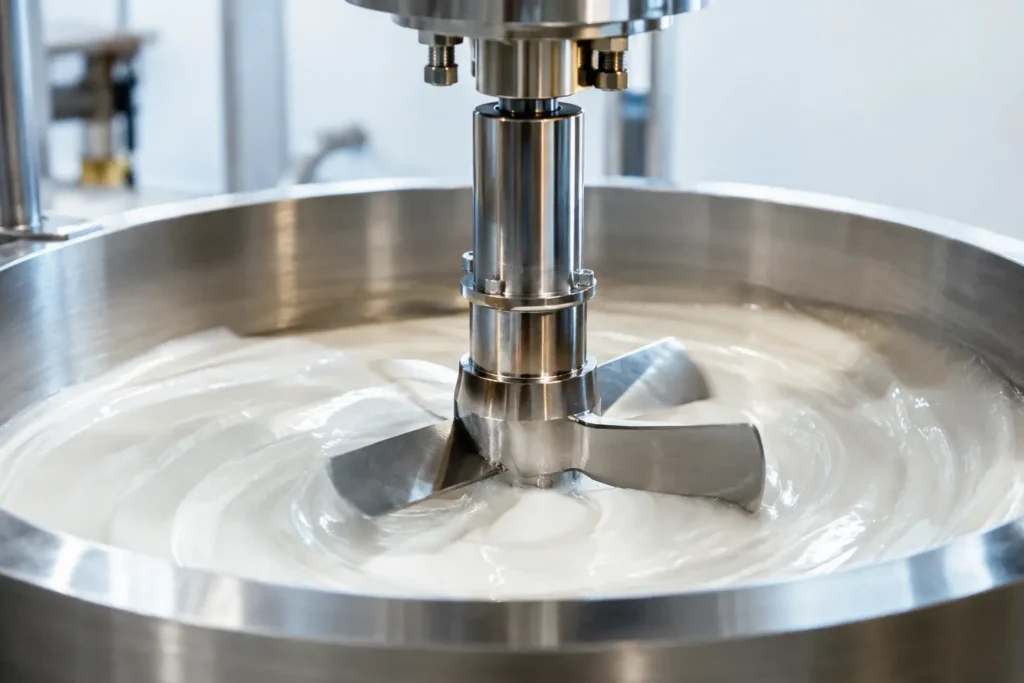
High-shear equipment concentrates energy inside a defined processing zone. In a rotor-stator mixer, a high-speed rotor accelerates product toward a stationary stator. As fluid passes through narrow openings, it experiences intense velocity gradients, turbulence, pressure fluctuations, and, in some applications, controlled cavitation. The result is a much higher probability that each pass changes the product structure.
That distinction matters when quality depends on more than circulation. Emulsions require droplet disruption and stabilization. Suspensions require particle deagglomeration and uniform distribution. Powders require rapid wetting before they form fish eyes. Each outcome depends on the local conditions inside the processing zone, not simply on total mixer horsepower.
The Variables That Determine Shear-Mixing Results
Rotor-stator geometry and tip speed
Tip speed is the linear speed of the rotor’s outer edge. Higher tip speed generally increases fluid acceleration and shear intensity, but it is not a standalone specification for product quality. Rotor diameter, stator-hole geometry, clearance, open-area design, and the number of stages all affect how energy is applied.
A fine-slotted stator can produce a more intensive processing action than a coarse-hole stator, but it may also raise pressure drop, reduce flow capacity, or increase the risk of plugging with fibrous or large particulate products. The correct geometry depends on the material and the required outcome. A system designed for beverage stabilization should not be selected using the same criteria as one intended for viscous cosmetic creams or mineral-filled coatings.
Viscosity and flow behavior
Viscosity changes how product enters, moves through, and exits a shear zone. Low-viscosity fluids may recirculate readily but can demand enough pass count to achieve a narrow droplet-size distribution. High-viscosity materials can resist flow into the rotor-stator head, creating bypassing or poor turnover if the system is not engineered for the duty.
Non-Newtonian behavior adds another layer of complexity. Shear-thinning products may become easier to process as shear increases. Yield-stress materials may require sufficient initial force to begin flowing at all. Process design must account for viscosity at actual operating temperature, solids loading, and stage of addition, rather than relying on a single laboratory viscosity number.
Residence time and pass count
In an inline system, a product does not receive identical treatment merely because it passes through a mixer once. The result depends on residence time in the shear zone, recirculation rate, total batch volume, and flow distribution through the process loop. A high-flow mixer can provide excellent turnover but insufficient energy per pass for a difficult dispersion. A lower-flow unit may deliver stronger processing but extend cycle time.
This is why successful scale-up is based on process targets, not a simple ratio of tank volume. Engineers evaluate flow rate, mixer speed, recirculation strategy, temperature rise, pressure conditions, and the number of effective passes needed to reach the desired particle-size or droplet-size distribution.
Interfacial tension and formulation chemistry
Mechanical shear breaks droplets, but formulation chemistry determines whether those droplets remain separate. In oil-in-water emulsions, surfactants must adsorb quickly enough at the newly created interface to prevent coalescence. If emulsifier addition sequence, concentration, temperature, or hydration is wrong, increasing rotor speed may produce only temporary improvement.
The same principle applies to powder dispersions. A properly selected dispersant can reduce the energy needed to separate particles. Poor wetting chemistry can make even a powerful mixer appear underperforming. Equipment and formulation development must be treated as connected parts of the process.
When High Shear Is the Right Technology
Inline high-shear mixers and homogenizers are effective for many emulsification, dispersion, powder-wetting, and deagglomeration duties. They are particularly valuable when a process needs controlled recirculation, repeatable energy input, and a smaller footprint than a large batch vessel fitted with an oversized agitator.
They are not the answer to every particle-reduction requirement. When a formulation requires submicron droplets, very narrow distributions, or processing at elevated pressure, a high-pressure homogenizer may be the more appropriate technology. The product is forced through an engineered valve or interaction chamber, where extreme pressure drop and hydraulic energy transfer generate intensive disruption.
Colloid mills can be well suited to certain viscous products, pastes, and suspensions where adjustable mechanical clearance is beneficial. Vacuum emulsifying systems become relevant when entrained air compromises appearance, density, filling accuracy, oxidation stability, or emulsion quality. Powder induction systems address a separate but connected problem: getting powders below the liquid surface and wetted quickly enough to prevent agglomeration before high-shear processing begins.
The practical question is not, “Which mixer is strongest?” It is, “Which processing mechanism produces the required result with acceptable cycle time, product temperature, cleanability, and operating cost?”
Heat, Cavitation, and Air: The Trade-Offs
Shear energy does not disappear. A portion becomes heat. For heat-sensitive proteins, flavors, active ingredients, and volatile components, temperature rise can limit rotor speed, residence time, or total recirculation duration. A jacketed vessel or heat exchanger may be necessary to maintain the required processing window.
Cavitation can support disruption in some applications, but uncontrolled cavitation may cause noise, erosion, inconsistent performance, or product damage. It must be managed through equipment geometry, inlet conditions, pressure, and process control. It is an engineering variable, not a universal benefit.
Air entrainment is another common source of misleading results. Agitation can pull air into the batch, while powder addition can introduce substantial entrapped gas. Air changes apparent viscosity, interferes with pump performance, promotes oxidation, and can create inaccurate fill weights. An inline deaerator or vacuum process step may be essential where visual quality and density consistency matter.
Designing for Repeatable Production
A repeatable shear-mixing process starts with measurable targets. These may include median droplet size, particle-size distribution, viscosity range, suspension stability, moisture uptake time, batch cycle time, and final air content. Once the target is defined, the equipment can be selected around the energy and flow profile needed to achieve it.
The design also has to work beyond the pilot run. Production equipment should support predictable cleaning, material traceability, instrument calibration, and documented operating parameters. For sanitary applications, CIP/SIP compatibility, surface finish, seal design, drainability, and hygienic connections are integral to process capability. A mixer that produces an excellent sample but cannot be cleaned or validated efficiently is not a production solution.
Integrated process skids can improve control by coordinating tanks, pumps, powder induction, inline shear stages, heat exchange, deaeration, and PLC/HMI automation around a defined recipe. This approach reduces operator-dependent variation and makes the process easier to transfer from R&D to commercial manufacturing.
A Better Starting Point for Equipment Selection
Before specifying a shear mixer, define the starting material and the finished-product requirement with equal rigor. Document the oil phase, aqueous phase, powder characteristics, solids concentration, viscosity curve, temperature limits, batch size, throughput, and cleaning protocol. Then identify the quality attribute that actually drives the purchase: droplet size, dispersion uniformity, hydration speed, air removal, or stability over time.
EmulXion approaches this work as precision fluid engineering because mixing performance is created by the complete processing system, not by a motor rating alone. When shear intensity, hydraulic flow, residence time, thermal control, and equipment geometry are aligned, manufacturers can control what matters: a consistent product on the first batch, the thousandth batch, and at the next production scale.


