
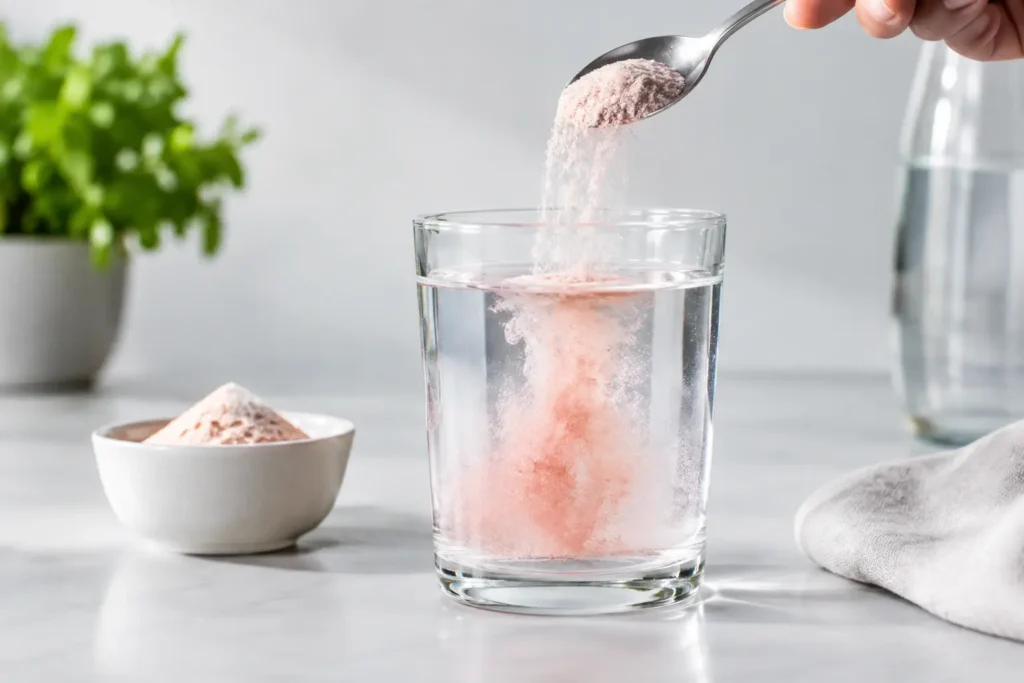
A powder can enter a vessel in seconds and still compromise a batch for hours. Powder wetting is the point at which dry particles first contact the liquid phase, displace air, and begin to hydrate or disperse. When that first contact is poorly controlled, the familiar consequences follow: floating rafts, fish eyes, persistent agglomerates, excessive mixing time, and inconsistent product texture.
For manufacturers handling gums, starches, proteins, carbomers, clays, pigments, APIs, mineral powders, and other difficult solids, wetting is not a minor front-end mixing task. It establishes the conditions for every downstream operation. Particle reduction, homogenization, deaeration, thermal treatment, and filling cannot reliably correct a powder that was never properly incorporated.
Why Powder Wetting Fails in Conventional Tanks
A conventional agitator primarily moves bulk liquid. It can create a visible vortex and strong tank circulation while delivering limited energy at the exact point where powder meets liquid. Dry material lands on the surface, absorbs liquid at its outer layer, and can form a hydrated shell before the particle interior has dispersed. That shell protects the remaining dry core from further wetting.
This effect is especially pronounced with hydrocolloids and high-viscosity-forming powders. A small amount of partially hydrated material can create a lump that resists agitation, passes through screens unpredictably, or appears later as an unacceptable texture defect. Operators often respond by increasing batch time or agitator speed. Those interventions may improve turnover, but they do not necessarily generate the local shear, pressure differential, and liquid velocity required to break the wetting barrier.
Air makes the problem worse. Fine powders entrain air during charging, and particles may float because trapped air lowers their effective density. The result is foam, dusty manual handling, inaccurate additions, and an apparent loss of capacity in the vessel. For sanitary or GMP-oriented operations, open-vessel powder charging also increases exposure to environmental contamination and operator variability.
The Fluid Mechanics Behind Effective Powder Wetting
Successful wetting requires more than pulling powder below the liquid surface. The process must rapidly replace the air around each particle with the process liquid. Surface tension, particle size, powder porosity, liquid viscosity, and the chemistry of the powder-liquid interface all influence how readily that occurs.
A well-engineered powder induction system creates a controlled vacuum at the powder inlet. The pressure differential draws solids directly into a flowing liquid stream rather than relying on gravity addition into a tank. Once entrained, the powder passes immediately through a high-energy processing zone. In an inline rotor-stator mixer, close-clearance rotor-stator geometry accelerates the fluid and subjects the slurry to intense mechanical and hydraulic shear. This promotes wetting, breaks early agglomerates, and distributes solids before they can build a protective gel layer.
The target is not maximum shear in every case. It is the right combination of induction rate, recirculation flow, shear intensity, and residence time. Excessive shear can damage sensitive particles, alter polymer structure, increase product temperature, or create more foam in certain formulations. Insufficient shear leaves agglomerates intact. Engineered outcomes depend on matching the processing zone to the material and the required final product structure.
Wetting, Dispersion, and Hydration Are Different Operations
These terms are often used interchangeably, but they describe different process stages. Wetting is the displacement of air and initial liquid contact. Dispersion is the distribution of individual particles throughout the liquid. Hydration is the absorption of liquid or swelling that develops functional properties such as viscosity, gel strength, or solubility.
A powder may be fully wetted yet require time to hydrate. Conversely, a powder may appear dispersed while retaining dry cores inside agglomerates. This distinction matters when specifying equipment. A powder induction system can provide rapid incorporation, while a recirculating inline mixer, high-pressure homogenizer, or colloid mill may be needed to achieve the required particle-size distribution or finished texture.
Selecting Equipment for Powder Wetting at Scale
The right process configuration depends on powder behavior, batch volume, viscosity profile, sanitation requirements, and production strategy. A low-viscosity beverage stabilizer has different demands than a cosmetic thickener or a battery slurry.
For many applications, a powder induction system paired with an inline high-shear mixer provides the most direct route to controlled incorporation. The system draws powder from a hopper or bag-dump station into a recirculating liquid stream, allowing operators to meter addition rates without opening the main vessel. This approach reduces dust, improves repeatability, and shortens the time between powder addition and dispersion.
An inline rotor-stator mixer is often sufficient when the objective is rapid wetting and deagglomeration in moderate-viscosity products. Multiple passes through the processing head may be used when the formulation requires more complete dispersion. For finer emulsions, cellular disruption, or narrow droplet-size control, a high-pressure homogenizer can follow the induction stage. It applies hydraulic energy at significantly higher intensity, but it is generally not the first tool for pulling dry powder into liquid.
Colloid mills are useful where milling action and controlled gap settings support the product requirement, particularly in pastes, sauces, and certain suspensions. Vacuum emulsifying systems can be advantageous for high-viscosity creams, gels, and ointments where powder incorporation, deaeration, heating, cooling, and emulsification must occur in one closed vessel. The trade-off is typically lower continuous throughput than a dedicated inline induction and recirculation loop.
Questions That Define the Process Window
Before selecting equipment, process teams should characterize the powder and the finished product requirement. Four questions have outsized influence on system design:
- Does the powder float, form fish eyes, gel instantly, or contain a wide particle-size distribution?
- What is the liquid viscosity before addition, during hydration, and at the final solids concentration?
- Is the objective simple incorporation, complete hydration, particle reduction, emulsification, or all four?
- What throughput, cleanability, containment, and automation requirements apply at commercial scale?
The answers determine whether a single-pass induction loop is practical or whether the process needs staged addition, a premix vessel, controlled recirculation, temperature management, or downstream homogenization. They also determine the appropriate rotor-stator configuration, pump selection, hopper design, instrumentation, and CIP arrangement.
Operating Variables That Protect Product Quality
Powder feed rate is one of the most consequential variables. Adding material faster than the liquid stream can wet and convey it overloads the processing zone. Agglomerates then form upstream, and operators may mistake the issue for inadequate mixer power. In reality, reducing the feed rate or increasing recirculation flow can produce a cleaner dispersion with less total processing time.
Temperature deserves the same attention. Warmer liquid may lower viscosity and improve wetting, but it can also accelerate hydration at the particle surface. Depending on the powder, that may help dispersion or promote premature gel formation. Heat-sensitive proteins, flavors, actives, and cultures impose further limits. A process should be designed around the allowable temperature rise from both frictional energy and jacket heating.
Control architecture turns these principles into repeatable production. Variable-frequency drives can coordinate powder feed, induction vacuum, recirculation flow, and mixer speed. Load cells, flowmeters, pressure transmitters, temperature probes, and conductivity measurement can provide objective confirmation that additions occur within the validated operating window. In an integrated skid, PLC/HMI recipes reduce dependence on individual operator technique and support batch records, traceability, and consistent scale-up.
Scaling Powder Wetting Without Recreating the Problem
Scale-up should not be based on tank diameter or motor horsepower alone. A larger vessel changes circulation patterns, addition geometry, hydrostatic pressure, and the time a particle spends in the high-shear zone. A process that works in a lab beaker may fail when powder is introduced across a production tank surface.
The more reliable approach is to preserve the processing conditions that matter: induction velocity, powder-to-liquid ratio at the inlet, rotor tip speed, hydraulic residence time, pass count, and thermal profile. Pilot trials should measure hydration time, viscosity development, particle-size distribution where relevant, air content, and finished-product uniformity. These data create a defensible basis for commercial equipment sizing rather than relying on visual appearance alone.
EmulXion Process Technologies approaches powder incorporation as a defined process zone within the broader production line. That means considering not only the mixer, but also sanitary piping, transfer pumps, valves, CIP coverage, controls, and downstream finishing equipment. A system is only as repeatable as its least controlled step.
When a powder is difficult to wet, the answer is rarely to stir longer. Establish controlled induction, apply energy where the powder meets the liquid, and validate the operating window against the finished product specification. That is how powder handling becomes a repeatable manufacturing operation rather than a recurring source of batch risk.


