
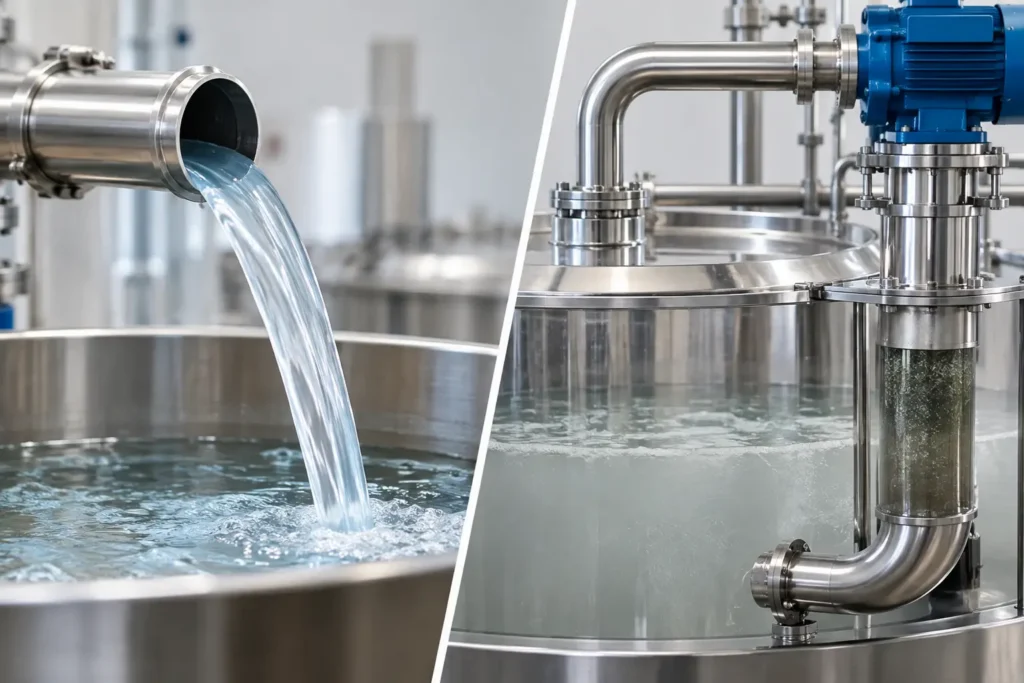
A product can meet specification in a development tank and still fail to hold that result on the production floor. Often, the difference is not the mixer model alone. It is whether the process applies energy once in a controlled flow path or repeatedly through a recirculation loop. The choice between single-pass versus recirculation processing determines residence time, total energy exposure, heat accumulation, throughput, and ultimately the consistency of the finished product.
For emulsions, suspensions, powders, and viscous semi-solids, this decision should be made from the required product outcome backward. A process engineer must define the target droplet or particle-size distribution, hydration level, viscosity profile, air content, temperature limit, and allowable batch time before selecting a flow arrangement.
What single-pass processing changes
In a single-pass process, product travels through an inline processing zone one time before moving to the next production step, a hold vessel, or final fill. The processing zone may be an inline rotor-stator mixer, colloid mill, high-pressure homogenizer, powder induction system, inline deaerator, or a series of complementary devices mounted on a continuous skid.
The engineering advantage is clear: every unit volume receives a defined treatment at a known flow rate and pressure drop. With a properly selected rotor-stator geometry or homogenizing valve, the processor can establish a repeatable relationship between flow, energy input, and product result. There is no broad residence-time distribution created by a large batch tank, where some material may pass the high-shear head several times while other material receives limited exposure.
Single-pass operation is especially effective when the product must be processed continuously and downstream demand is stable. Examples include beverage emulsions, dairy bases, injectable or topical formulations, coatings, chemical intermediates, and high-volume personal-care products. It can also be the better path when excess shear damages the formulation, such as shear-sensitive biological materials, fragile solids, or formulations prone to viscosity loss from overprocessing.
A true single-pass design is not simply an inline mixer installed in a transfer line. The feed system must deliver a stable flow, compatible inlet pressure, and controlled solids addition. Pumps, pipe diameter, valve arrangement, instrumentation, and automation must support the processing device rather than disrupt it. A high-shear mixer cannot provide repeatable results if upstream flow surges or if powder enters as uncontrolled agglomerates.
Advantages of a single-pass arrangement
Single-pass processing can shorten total production time because the product does not repeatedly circulate between a tank and processor. It also reduces unnecessary heat generation, which matters for temperature-sensitive flavors, proteins, waxes, polymers, and active ingredients. In sanitary applications, fewer recirculation cycles can simplify batch control, cleaning validation, and traceability.
It also supports more predictable scale-up. If lab and pilot trials establish the required pressure, rotor tip speed, flow rate, and feed conditions, those processing parameters can be translated to commercial equipment with greater confidence than a process based only on elapsed recirculation time.
The limitation is that a single pass must deliver enough energy to achieve the specification. If the product enters with large agglomerates, highly variable feed conditions, or a broad initial droplet-size distribution, one pass through an inline device may not be sufficient. Increasing intensity can solve that problem, but only to the point where temperature rise, pressure requirements, wear, or product degradation become unacceptable.
When recirculation processing is the better tool
Recirculation processing returns material from a vessel through an external processing loop and back into the vessel. The batch passes through the inline processor multiple times until it reaches a defined endpoint. This is a practical and effective approach for many formulations, particularly when ingredients are added sequentially, when solids require progressive wetting, or when product viscosity changes substantially during production.
A recirculation loop is often the right choice for sauces, dressings, creams, gels, adhesive compounds, cosmetic emulsions, and chemical dispersions. These products may need tank-based blending for bulk handling while relying on an inline rotor-stator, colloid mill, or high-pressure device to apply localized mechanical and hydraulic energy where it matters.
The primary benefit is process flexibility. Operators can add ingredients over time, observe viscosity and temperature development, take samples, and continue processing until the batch reaches specification. The loop can also provide circulation during heating, cooling, deaeration, or powder incorporation.
But recirculation is not automatically more thorough. It can create a false sense of control when the process is governed only by a timer. Ten minutes of recirculation does not guarantee that every portion of the batch received the same processing history. Actual results depend on tank turnover, loop flow rate, vessel geometry, baffle design, agitator performance, product viscosity, and the location of the return stream.
The risk of overprocessing
Repeated passes raise the total energy delivered to the batch. That can improve dispersion and reduce droplet size, but it can also introduce excess heat, foam, air entrainment, or undesirable structural changes. In some emulsions, excessive shear can reduce viscosity or destabilize a carefully balanced droplet structure. In suspensions, prolonged recirculation may grind particles beyond the intended range or increase equipment wear.
Heat load deserves particular attention. A rotor-stator mixer and a high-pressure homogenizer convert process energy into heat. In a recirculation loop, that heat returns to the vessel and accumulates unless the system includes adequate cooling capacity. A batch that begins at an acceptable temperature can cross a critical threshold after several passes, affecting flavor, color, activity, or final rheology.
For this reason, recirculation should be controlled by measurable endpoints where possible: particle-size analysis, viscosity, density, conductivity, temperature, pressure trend, or a validated number of vessel turnovers. Time remains useful, but time alone is a weak process-control variable.
Single-pass versus recirculation processing: key design variables
The most appropriate configuration depends on more than whether a plant operates in batches or continuously. It depends on how the product responds to energy.
First, evaluate the required intensity. Coarse pre-dispersion may require only a moderate-shear inline mixer, while a narrow droplet-size distribution may require high-pressure homogenization. If the target can be achieved in one controlled exposure, single pass generally offers better throughput and a more uniform processing history. If the formulation requires staged ingredient addition or gradual structure development, recirculation may provide the necessary control.
Second, evaluate flow behavior. Low-viscosity fluids move readily through a continuous system. High-viscosity products, yield-stress materials, and formulations containing difficult powders may need a vessel and recirculation loop to maintain flow, prevent bridging, and manage changing rheology. Pump selection is central here. The pump must provide the required flow without introducing excessive shear, pulsation, or air.
Third, account for powder wetting and agglomerate control. A powder induction system can pull powders directly into a liquid stream under vacuum, reducing dust and fisheyes before the product reaches the primary processing zone. This often makes a single-pass or limited-pass process feasible. By contrast, adding powders through an open tank hatch may require recirculation simply to correct incomplete wetting created upstream.
Finally, consider cleanability and production economics. A continuous single-pass line can reduce labor and cycle time, but it requires disciplined startup, product transition, and line-balance planning. A recirculation skid can accommodate more formulation variability, but it may consume more processing time and cooling energy. For sanitary or GMP-ready systems, both configurations should be designed around drainability, CIP/SIP requirements, validated instruments, and documented operating recipes.
A practical selection approach
The correct decision starts with trials that reproduce the intended production conditions. Measure the incoming particle size or agglomerate condition, feed temperature, viscosity, solids loading, and desired endpoint. Then test single-pass performance at defined flow rates and compare it with recirculation performance at controlled turnover rates.
Do not compare equipment based only on motor horsepower. Useful process data includes pressure drop, rotor tip speed, shear-zone geometry, flow rate, temperature rise, pass count, particle-size distribution, and final product stability. These values reveal whether a result came from controlled processing or from simply applying more energy for longer.
EmulXion engineers process systems around that distinction. An integrated skid can combine feed tanks, sanitary pumps, inline high-shear processing, high-pressure homogenization, powder induction, thermal control, deaeration, CIP circuits, and PLC/HMI recipe management so each pass is intentional and measurable.
The best process is not the one with the most passes or the highest shear rating. It is the one that delivers the required product structure with the lowest practical variability, heat load, and cycle time. Establish the product endpoint first, then build the flow path that can reach it repeatedly.


