
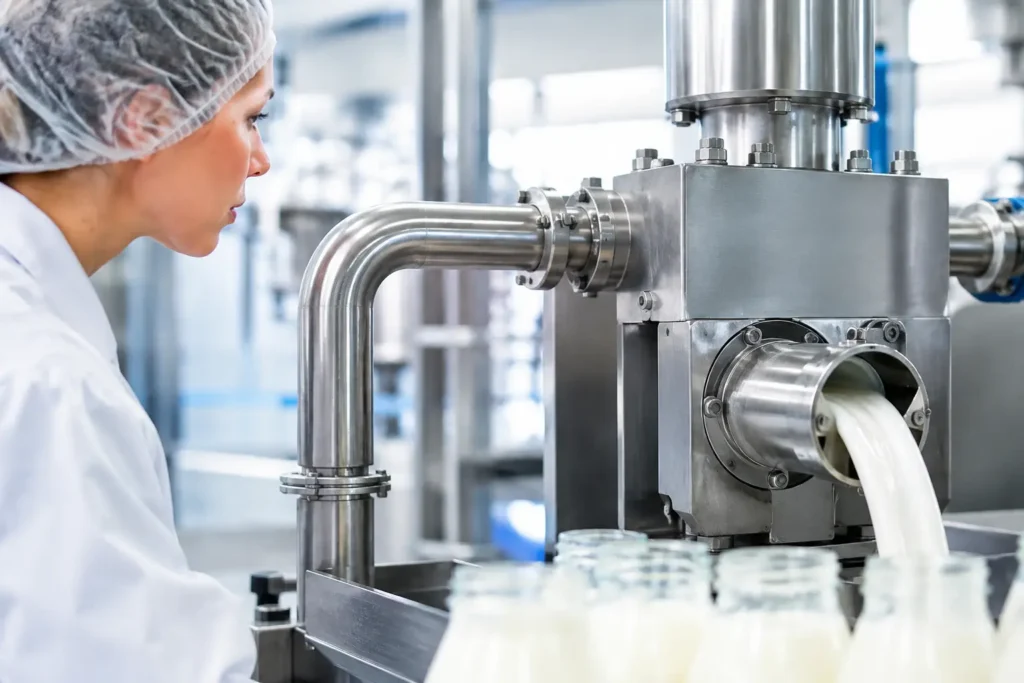
A dressing that breaks after filling, a protein beverage with sediment at the bottom, or a topical cream with an inconsistent feel rarely fails because of a single ingredient. The failure often begins in the process zone. Why choose sanitary homogenization? Because product structure, hygienic control, and production repeatability must be engineered together, not addressed as separate problems after scale-up.
For food, pharmaceutical, nutraceutical, cosmetic, and biotechnology manufacturers, homogenization is not simply a way to make a product look smoother. It is a controlled energy-transfer process that determines droplet size, particle-size distribution, dispersion stability, viscosity development, hydration behavior, and sensory or functional performance. A sanitary system adds the equally critical requirement that every wetted surface, seal, connection, and flow path can be cleaned, inspected, and maintained without introducing avoidable contamination risk.
Why Choose Sanitary Homogenization Instead of Basic Mixing?
Conventional tank agitation moves bulk material. It can be effective for blending compatible, low-viscosity liquids, but it does not consistently deliver the localized mechanical and hydraulic energy required to reduce droplets, disperse fine powders, or break down agglomerates. The result is often an apparently acceptable batch with hidden variability: wide droplet distributions, incomplete powder wetting, trapped air, or gradual separation during storage.
Sanitary homogenization concentrates energy where it matters. In an inline rotor-stator homogenizer, fluid is accelerated through closely controlled gaps, then exposed to intense shear, turbulence, and pressure fluctuations. In a high-pressure homogenizer, product is forced through an engineered valve at high velocity, producing hydraulic shear, impact, and controlled cavitation. Each mechanism can alter product structure, but the correct choice depends on the formulation and target specification.
The sanitary requirement is not a cosmetic upgrade to this process. Product-contact geometry must support complete drainage, repeatable cleaning, and minimized hold-up. Crevices, dead legs, inaccessible seals, and poorly designed connections can retain product after a run. That creates sanitation exposure, wastes material, complicates changeovers, and makes cleaning validation more difficult.
A properly specified sanitary homogenization system therefore addresses two process objectives at once: produce the intended microstructure and preserve the hygienic integrity of the production line.
Product Consistency Is a Measurable Process Outcome
A stable emulsion requires more than high mixer speed. It requires the appropriate balance of shear intensity, residence time, recirculation rate, temperature, viscosity, and interfacial chemistry. If any variable changes substantially from batch to batch, the finished product can change with it.
Consider an oil-in-water emulsion. Large or unevenly distributed droplets are more likely to cream, coalesce, or separate. Reducing and narrowing droplet size distribution can improve physical stability, appearance, mouthfeel, and shelf life. In cosmetic emulsions, the same control affects texture, gloss, spreadability, and active-ingredient delivery. In pharmaceutical or biotech processing, it can influence suspension uniformity and dosage consistency.
Sanitary inline homogenization supports this control by processing product through a defined shear zone rather than relying solely on the variable conditions inside a large vessel. The equipment does not eliminate the need for formulation control, but it gives process engineers a more repeatable mechanism for applying energy to the formulation.
That distinction matters during scale-up. A bench batch made with a small disperser may look successful, yet fail at commercial volume when vessel geometry, batch depth, recirculation patterns, and heat transfer change. An engineered inline or high-pressure process can establish scalable operating parameters such as flow rate, pressure, passes, rotor-stator tip speed, and inlet temperature. Those parameters can then be documented and reproduced.
Hygienic Design Protects More Than Compliance
Manufacturers often begin the equipment conversation with sanitary requirements: 316L stainless steel, sanitary clamps, polished product-contact surfaces, and CIP capability. Those are essential considerations, but sanitary design should be evaluated as a complete cleanability strategy rather than a checklist of component materials.
The system must drain effectively after processing and cleaning. It must maintain sufficient cleaning velocity through process piping and the homogenization chamber. Elastomers, mechanical seals, valves, and instrumentation must be compatible with both the product and the cleaning chemistry. Where sterile production is required, SIP capability, validated temperature exposure, and aseptic boundary control become part of the design basis.
This has direct operational value. A line that cleans consistently can reduce the uncertainty between campaigns, support faster product changeovers, and lower the likelihood of rejected batches tied to microbial, allergen, or cross-product contamination. It also makes investigation easier when quality personnel need objective evidence that the process was run and cleaned within specification.
For regulated applications, GMP-ready documentation, material traceability, surface-finish specifications, weld records, and factory acceptance testing may be as important as the homogenizer’s motor rating. Equipment should be selected for the validation burden it needs to carry, not merely its initial capital cost.
Choosing the Right Homogenization Technology
Sanitary homogenization is a process category, not one machine. The right technology depends on the material, the quality target, and the operating window.
Inline rotor-stator homogenizers
An inline high-shear homogenizer is often the practical choice for emulsification, powder dispersion, deagglomeration, and viscosity development where continuous processing or tank recirculation is desired. Rotor-stator geometry creates a controlled shear field and high fluid acceleration. It can replace long batch-mixing cycles when the formulation responds to mechanical shear and does not require extreme pressure.
This approach is well suited to sauces, dressings, personal-care emulsions, polymer dispersions, coatings, and many nutraceutical products. However, highly abrasive solids, very high viscosity, or a requirement for submicron droplet reduction may call for a different configuration.
High-pressure homogenizers
High-pressure systems are selected when very fine emulsification, cell disruption, or narrow particle-size distribution is required. They are common in dairy, beverages, pharmaceutical suspensions, biotechnology, and specialty formulations where pressure and valve design provide an advantage over rotor-stator processing.
The trade-off is that high-pressure processing can add thermal load and may demand careful control of inlet conditions, pressure rating, valve wear, and downstream cooling. It is not automatically better than high shear. It is better when the product specification requires the energy density and processing mechanism it provides.
Colloid mills and integrated process systems
A sanitary colloid mill can be effective for wet milling, emulsifying, and processing viscous semi-solids that benefit from an adjustable rotor-stator gap. For powders that resist wetting, a powder induction system can draw ingredients directly into a recirculating stream before homogenization. Vacuum emulsifying systems can combine heating, mixing, homogenization, and deaeration where air removal is necessary for density control, visual quality, or oxidation reduction.
In many plants, the strongest answer is not a standalone machine. It is a process skid that integrates tanks, pumps, homogenization, piping, CIP circuits, instrumentation, and PLC/HMI controls. The system can then manage the full process sequence rather than optimizing one device while leaving transfer, temperature, and cleaning variables uncontrolled.
Specify the Process, Not Just the Equipment
A useful homogenizer specification begins with the product, not a preferred machine type. Define the incoming ingredients, solids loading, viscosity range, particle or droplet-size target, flow rate, operating temperature, batch volume, allowable residence time, and cleaning requirements. Also identify what failure looks like: settling, cream separation, fish eyes, visible specks, air entrainment, inconsistent viscosity, or shortened shelf life.
Pilot trials are especially valuable when a formulation contains challenging hydrocolloids, proteins, waxes, high oil fractions, abrasive powders, or shear-sensitive actives. The goal is not simply to confirm that the material can run. It is to generate performance data that links processing conditions to the finished-product specification.
Control philosophy matters as well. Variable speed, flow measurement, pressure monitoring, temperature control, automated valve sequencing, and recipe management help convert process knowledge into repeatable production. Without measurement and control, even a well-designed homogenizer can be operated as a black box.
The Decision Is About Control at Scale
Sanitary homogenization is justified when product quality depends on more than bulk blending and when cleaning performance cannot be left to operator technique. It provides a defined processing zone for applying energy, a hygienic flow path for protecting the product, and a foundation for scale-up that is based on documented operating conditions.
For manufacturers replacing inconsistent batch agitation or assembling a new production line, the best next step is to evaluate the formulation and the complete process path together. When shear, flow, temperature, sanitation, and automation are designed as one system, production performance becomes an engineered outcome rather than an accident.


