
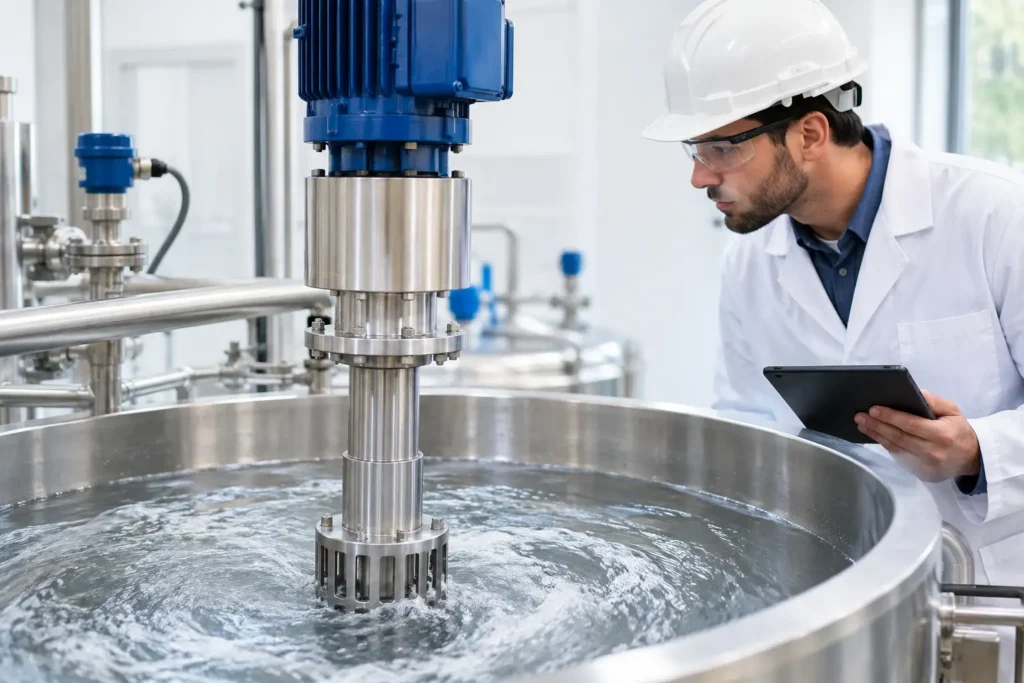
A dispersion that looks acceptable at the end of a pilot batch can fail quickly in commercial production. Powder fisheyes, broad particle-size distribution, temperature rise, air entrainment, and unstable viscosity often point to the same root issue: energy is not being applied consistently where the product needs it. This inline disperser review examines what an inline high-shear disperser can realistically achieve, where its limits begin, and how to evaluate performance beyond motor horsepower.
What an Inline Disperser Actually Does
An inline disperser processes fluid continuously through a controlled high-shear zone rather than relying on bulk circulation inside a tank. Product enters the workhead, accelerates through the tight clearance between a high-speed rotor and a stationary stator, then exits through engineered openings. Within that zone, the fluid experiences intense velocity gradients, turbulence, pressure fluctuation, and, in some applications, controlled hydrodynamic cavitation.
The result can be rapid agglomerate breakdown, improved wetting of powders, finer droplet distribution in emulsions, and more uniform suspension quality. The key word is can. Final product performance depends on the relationship between rotor-stator geometry, tip speed, stator configuration, flow rate, viscosity, recirculation time, and the formulation itself.
A conventional tank agitator moves volume effectively but does not concentrate energy in the same way. It may blend ingredients adequately while leaving poorly wetted powders or oversized agglomerates intact. An inline disperser is selected when the process requires localized, repeatable mechanical and hydraulic energy transfer.
Inline Disperser Review: The Performance Criteria That Matter
A useful equipment review starts with the product specification, not the equipment catalog. Asking whether a unit is “high shear” is less useful than defining the process outcome: target particle-size distribution, droplet-size range, viscosity profile, hydration time, suspension stability, or cycle-time reduction.
Shear intensity is not a single number
Tip speed is a meaningful starting point because it indicates the peripheral velocity of the rotor. Higher tip speeds generally create more intense shear conditions. But tip speed alone does not predict dispersing performance. Two machines operating at similar rotor speeds may produce different results because their rotor diameter, rotor-stator gap, stator hole pattern, number of stages, and internal flow path differ substantially.
A fine-hole stator can increase localized shear and improve the breakdown of soft agglomerates. It can also raise pressure drop, reduce throughput, and increase temperature. A coarse stator may pass more viscous product and support higher flow, but it may not deliver the same particle reduction. The correct geometry is application-specific, particularly when processing shear-sensitive proteins, high-solids slurries, waxes, pigments, or structured emulsions.
Residence time determines the real processing dose
The volume of product passing through an inline head is not necessarily receiving the same treatment. At excessive flow rates, residence time in the rotor-stator zone may be too short to achieve the desired dispersion in a single pass. At lower flow rates or in a recirculation loop, the product receives more cumulative processing, but cycle time and thermal load increase.
This is why flow capacity should be evaluated alongside passes or recirculation time. A disperser rated for a high nominal flow may be suitable for transfer duty but not for fine dispersion at that same rate. Performance data should identify the product viscosity, flow rate, process temperature, number of passes, and the method used to measure particle or droplet size.
Viscosity changes the operating window
Viscosity affects how product enters, moves through, and exits the workhead. Thin liquids can move rapidly and may require flow control to ensure sufficient processing. More viscous materials can require a positive-displacement feed pump, a larger workhead, a recirculation arrangement, or a staged process that combines pre-mixing with inline dispersion.
For high-viscosity creams, gels, adhesive compounds, or concentrated suspensions, an inline disperser may be one part of the solution rather than the complete solution. A vacuum emulsifying system, colloid mill, or high-pressure homogenizer may provide a better path depending on the required final structure.
Where Inline Dispersers Perform Best
Inline rotor-stator technology is particularly effective when ingredients must be wetted and deagglomerated quickly in a continuous or recirculating process. Common applications include sauces and dressings, dairy bases, nutritional beverages, cosmetic emulsions, pharmaceutical suspensions, coatings, pigment dispersions, chemical intermediates, and battery-material slurries.
Powder incorporation is a strong example. An inline disperser can rapidly hydrate gums, proteins, starches, thickeners, and other functional powders after they have been introduced into the liquid stream. Yet an inline disperser alone does not always prevent floating powders, dusting, or lump formation at the point of addition. For difficult powders, a powder induction system can pull material directly into the recirculation stream under vacuum, then route it through the high-shear zone before agglomerates have time to form.
For emulsions, the inline unit can reduce droplet size and narrow the distribution sufficiently for many food, personal care, and chemical products. If the application demands submicron droplets, very tight distribution, or maximum long-term stability, high-pressure homogenization may be required after premixing. That is not a failure of inline dispersion. It is a recognition that rotor-stator shear and high-pressure valve homogenization apply energy differently.
The Trade-Offs Often Missed in Equipment Reviews
The most credible inline disperser review acknowledges that more shear is not always better. Overprocessing can damage texture, destabilize sensitive emulsions, denature proteins, reduce viscosity in shear-thinning systems, or introduce excess heat. In products containing fragile solids, fibers, cells, or encapsulated ingredients, aggressive processing can compromise the feature the manufacturer is trying to preserve.
Heat generation deserves particular attention. Mechanical energy that does not become useful dispersion ultimately appears as heat. A short recirculation loop with a high-speed workhead can raise product temperature quickly, especially in viscous formulations. Temperature control may require a jacketed vessel, heat exchanger, controlled pass count, or a lower-intensity first stage followed by targeted finishing.
Air management is another frequent oversight. Poor tank vortex control, leaking suction conditions, and uncontrolled powder addition can entrain air before product reaches the disperser. The machine may then distribute fine bubbles throughout the batch rather than remove them. Where density consistency, fill accuracy, oxidation control, or appearance matters, inline deaeration or vacuum processing should be considered as part of the system design.
Sanitary Design and Plant Integration
In food, beverage, pharmaceutical, biotechnology, and personal care production, process performance is inseparable from cleanability. A high-shear workhead should be evaluated for drainability, surface finish, elastomer compatibility, seal design, material traceability, and access to CIP or SIP protocols. Dead zones, difficult-to-clean shaft seals, and incomplete drainage can turn an otherwise capable disperser into a production risk.
The surrounding process also matters. A properly engineered system includes compatible feed and discharge pumps, appropriately sized piping, valves that do not restrict the process unnecessarily, instrumentation for pressure, temperature, and flow, and controls that maintain repeatable operating conditions. Variable-frequency drive control can allow operators to adjust rotor speed, but repeatability also depends on recipe-defined flow, temperature, pass count, and powder feed rate.
For validated or regulated production, documented operating ranges are more valuable than a broad claim of flexibility. EmulXion approaches these systems as precision fluid-engineering packages, because the process loop determines whether laboratory results survive scale-up.
Questions to Ask Before Selecting an Inline Disperser
A supplier should be able to discuss the formulation in practical terms. Provide the starting particle or agglomerate condition, target result, batch size or continuous throughput, viscosity across the process temperature range, solids loading, and any sensitivity to heat or air. If the product contains powders, identify their particle characteristics, wetting behavior, addition rate, and tendency to form lumps.
Ask how performance was established. Relevant evidence may include laser diffraction particle-size data, microscopy, emulsion stability testing, viscosity measurements, hydration time, and production trials. A claim of improved dispersion without a defined test method is difficult to use for capital-equipment decisions.
Also clarify the scale-up basis. Geometric similarity alone is insufficient for rotor-stator equipment. The commercial system must maintain the required energy exposure while meeting throughput, pressure-drop, cleanability, and temperature constraints. Pilot trials should replicate the intended process sequence, including ingredient addition and recirculation conditions, whenever possible.
The right inline disperser is not simply the unit with the fastest rotor or largest motor. It is the system that applies the right processing intensity, for the right duration, under operating conditions your plant can repeat shift after shift. Start with the product behavior, define the measurable outcome, and let the process data determine the machine.


