
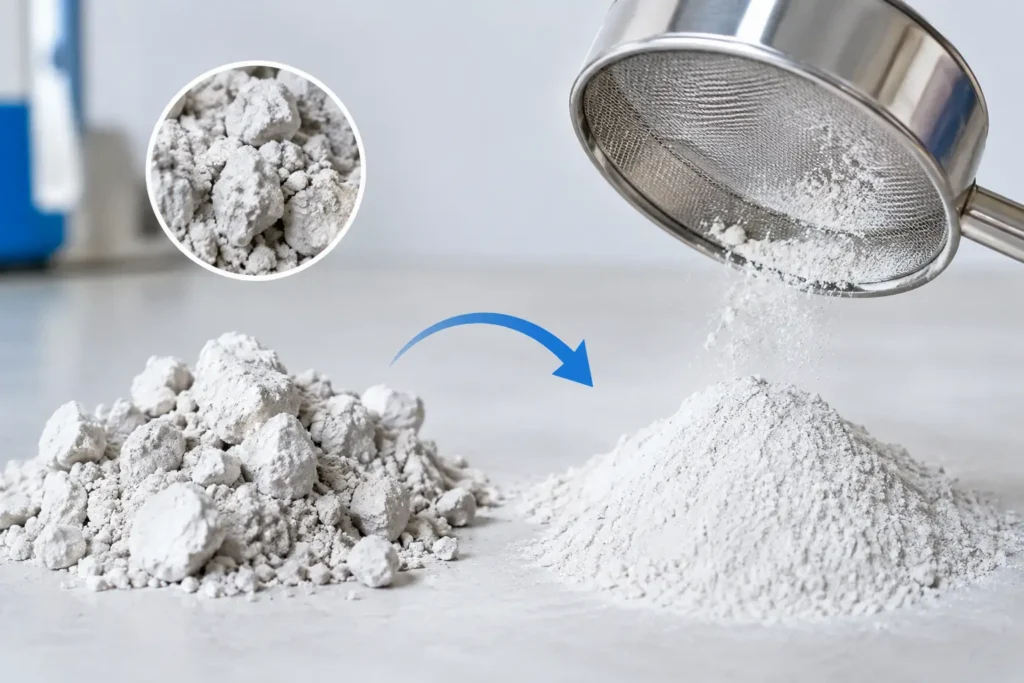
A powder lump that survives hydration is not simply a mixing nuisance. It is a protected dry core surrounded by a wetted outer layer, and it can carry directly into filling, coating, fermentation, or downstream homogenization. To eliminate powder agglomerates reliably, manufacturers must control how powder meets liquid, how quickly the liquid penetrates each particle, and how much mechanical energy reaches the agglomerate before it becomes process scrap.
Traditional batch agitation often fails because it treats powder incorporation as a tank-blending problem. In reality, it is a localized wetting and dispersion event. The highest-value process improvements happen at the point of powder addition and within the high-energy zone that follows it.
Why Powder Agglomerates Form
Agglomeration begins when powder contacts liquid faster than the liquid can wet and penetrate individual particles. Hydrophilic powders may hydrate rapidly at the surface, creating a viscous gel layer that blocks further liquid entry. Hydrophobic powders can resist wetting altogether, floating on the liquid surface or trapping air between particles. Either mechanism creates clusters that a low-speed propeller may circulate for an extended period without breaking apart.
The severity depends on powder chemistry, particle-size distribution, moisture content, liquid viscosity, temperature, and addition rate. Xanthan gum, carbomers, pectin, proteins, starches, cocoa, milk powders, mineral fillers, fumed silica, and certain active ingredients each present distinct wetting behavior. A process that works for a free-flowing salt blend may fail immediately with a fast-hydrating hydrocolloid.
Operators often compensate by extending mix time. That can reduce visible lumps, but it is not always a reliable correction. Long batch times consume capacity, expose sensitive products to additional shear or heat, and still may leave a broad particle-size distribution. When a product specification depends on texture, suspension stability, dissolution, or bioavailability, visual inspection is not an adequate endpoint.
Eliminate Powder Agglomerates at the Addition Point
The most effective strategy is to prevent uncontrolled surface wetting before it starts. Powder should enter a moving liquid stream or engineered wetting zone where it is immediately dispersed, accelerated, and subjected to controlled hydraulic forces.
A powder induction system does this by using vacuum to draw powder directly from a hopper, bag dump, or bulk handling interface into a recirculating liquid stream. Instead of relying on an open tank vortex, the system meters powder into a controlled inlet and passes the mixture through an inline high-shear rotor-stator zone. The negative-pressure induction point improves operator handling while the high-velocity liquid stream pulls particles below the surface before they can form a floating raft.
This approach is particularly effective for powders that create fish eyes, which are agglomerates with a hydrated exterior and dry center. The objective is not merely to pull the powder into the tank. It is to expose each particle to liquid and mechanical energy before surface hydration creates a barrier.
Addition rate remains critical. Even a properly designed induction system can be overloaded if powder enters faster than the liquid flow and shear zone can process it. The correct feed rate is application-specific and should be established against measurable criteria: viscosity development, particle-size distribution, conductivity, dissolution time, or finished-product appearance. A controlled loss-in-weight feeder or variable-speed powder feed arrangement can maintain that rate more consistently than manual bag addition.
Match Shear Technology to the Agglomerate Mechanism
Not every agglomerate requires the same equipment. Selection should begin with what must be achieved after wetting: deagglomeration, complete dissolution, particle reduction, emulsification, or a combination of these outcomes.
Inline High-Shear Mixers for Wetting and Deagglomeration
An inline high-shear mixer uses close-tolerance rotor-stator geometry to accelerate fluid through openings in the stator. The resulting velocity gradients, turbulence, and pressure changes pull agglomerates into a concentrated processing zone. This is generally the first choice when the need is rapid powder wetting, dispersion, and breakdown of soft or moderately cohesive clusters.
Rotor speed alone does not define performance. Tip speed, stator design, recirculation flow, residence time, product viscosity, and the number of passes through the shear head all influence the result. A unit that provides sufficient shear in water may underperform once a thickened sauce, gel, adhesive, or personal-care base raises system viscosity.
Inline high shear is often installed in a recirculation loop from the batch tank. This provides repeatable passes through the processing zone and gives the operator a clear means to control treatment time. For continuous production, the mixer can be placed directly in the product line, provided upstream powder induction and downstream residence requirements are engineered together.
Colloid Mills for Tighter Mechanical Refinement
A colloid mill may be better suited when the process requires more aggressive mechanical treatment of cohesive solids or a narrower final particle-size distribution. Its adjustable rotor-stator gap creates intense shear and milling action, making it useful for products such as sauces, nut-based systems, pigment dispersions, cosmetic creams, and certain chemical slurries.
The trade-off is that a colloid mill can generate more heat and may not be appropriate for heat-sensitive proteins, volatile flavors, or formulations vulnerable to excessive mechanical input. It is also not a substitute for proper powder wetting. Feeding a mill with dry-core agglomerates can increase wear, restrict flow, and produce inconsistent results.
High-Pressure Homogenizers for Fine Final Structure
When agglomerates are tied to a demanding particle-size or droplet-size target, a high-pressure homogenizer may be required after initial wetting and premixing. High-pressure processing forces product through an engineered valve at high velocity, using hydraulic energy transfer, turbulence, impact, and controlled cavitation to reduce dispersed-phase size.
This technology is common in dairy, beverage, pharmaceutical, nutraceutical, and emulsion applications where final product stability depends on a tight distribution. It is not typically the most efficient first-stage tool for introducing dry bulk powder. A properly designed premix step protects the homogenizer from feed inconsistency and helps maintain predictable throughput.
Design the Full Recirculation Loop, Not Just the Mixer
A high-shear head cannot correct every upstream and downstream constraint. The tank geometry, pump selection, pipe diameter, return location, liquid level, and batch viscosity determine whether all material receives consistent treatment.
Poor return placement can create short-circuiting, where material leaving the inline mixer returns directly to the suction zone rather than mixing through the entire vessel. Dead zones near tank walls, under agitators, or around poorly positioned baffles can retain underprocessed material. For hygienic production, these areas also complicate CIP coverage and increase the risk of retained product.
An engineered loop should provide enough turnover to move the full batch through the processing zone within the required cycle time. It should also maintain stable suction conditions. A pump that entrains air, cavitates, or loses flow as viscosity rises will weaken induction performance and create foam. Where aeration is unavoidable, an inline deaerator or vacuum emulsifying system may be needed to remove entrained air before filling or downstream processing.
Process Variables That Should Be Tested During Development
A practical development trial should not focus only on whether the final batch looks smooth. It should document the operating window that produces repeatable results. At minimum, assess powder feed rate, liquid temperature, initial liquid volume, recirculation flow, rotor-stator speed, processing time, and final viscosity or particle-size data.
For sensitive formulations, track product temperature throughout the run. High shear converts mechanical energy into heat, which may be beneficial for hydration in some systems and harmful in others. Starch-based products may gelatinize prematurely, proteins can denature, and fragrance or volatile components can be lost if energy input is not managed.
It also helps to compare powder lots and storage conditions. Powders absorb moisture, compact during storage, and vary by supplier lot. A process engineered with sufficient operating range will tolerate normal material variation without requiring operators to improvise addition methods on the production floor.
Common Corrections That Do Not Solve the Root Cause
Increasing agitator speed can improve bulk circulation, but it rarely delivers the localized shear needed to rupture dry-core agglomerates. Adding powder more slowly may help, yet it can turn a short production cycle into an hours-long bottleneck. Screening powder can remove oversized foreign material, but it will not prevent hydration-driven fish eyes.
Changing ingredient order can be effective when one ingredient alters viscosity, pH, ionic strength, or surface tension enough to affect wetting. However, formulation order should be validated rather than treated as an operator preference. In many cases, the durable solution is a controlled powder induction and dispersion step that makes ingredient addition less dependent on individual technique.
Build Repeatability Into Scale-Up
Lab success does not automatically scale with tank volume. A larger vessel changes circulation paths, hydrostatic pressure, powder handling logistics, and the ratio of mixer capacity to batch mass. Scaling by agitator RPM is especially misleading because it ignores tip speed, flow, and energy density.
A better scale-up method uses application testing to establish the required powder feed rate, flow through the processing zone, number of effective recirculation passes, and finished-product quality metrics. Equipment can then be sized around throughput and validated process conditions rather than a generic horsepower estimate. EmulXion applies this engineering approach to standalone processing equipment and integrated skids, where induction, mixing, pumping, controls, and CIP requirements must operate as one system.
The right system does more than make lumps disappear. It gives production teams a defined, repeatable path from powder addition to finished product – so quality is controlled by the process, not recovered through extra mixing time.


