
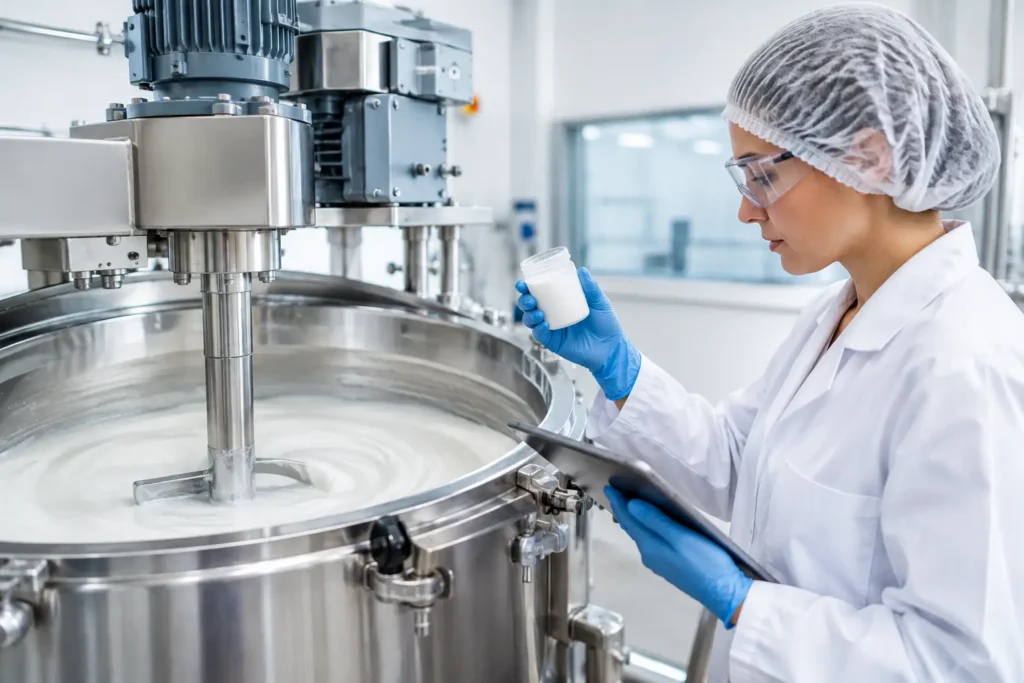
A formulation can meet specification in a development vessel and still fail at commercial scale because the mixing mechanism changed. Pharmaceutical mixers are not interchangeable tank accessories. They establish the hydraulic energy, shear exposure, residence time, and sanitary control that determine whether an API disperses uniformly, a suspension remains stable, or an emulsion reaches its intended droplet-size distribution.
For process teams, the right question is not simply, “What mixer can move this batch?” It is, “What processing conditions must be reproduced to create the required product structure every time?” That distinction separates bulk circulation from controlled fluid processing.
Why Pharmaceutical Mixing Is a Product-Critical Step
Many pharmaceutical liquids and semisolids depend on structures that are not visible to the operator. A vaccine adjuvant dispersion, topical cream, oral suspension, lipid emulsion, or high-solids nutraceutical slurry can appear uniform immediately after mixing while containing broad particle populations, entrained air, unhydrated powder, or localized concentration differences.
Conventional batch agitators are effective for general blending, heat transfer, and keeping low-viscosity liquids in motion. Their limitation appears when the formulation requires narrow particle-size control, rapid powder wetting, stable emulsification, or repeatable deagglomeration. In these cases, bulk flow alone does not provide enough localized energy to overcome interfacial tension, break agglomerates, or fully incorporate difficult powders.
Product quality is shaped by several connected variables: rotor-stator geometry, tip speed, shear rate, pressure drop, recirculation rate, temperature rise, viscosity, and total passes through the active processing zone. Changing one variable can alter the others. A higher pump rate, for example, may increase production throughput but reduce residence time in an inline high-shear zone. More shear can improve dispersion while also creating heat that threatens a temperature-sensitive ingredient.
The engineering objective is controlled energy transfer, not maximum intensity. Pharmaceutical manufacturers need enough process energy to achieve the required result, with a processing window that is practical to validate and stable across production shifts.
Selecting Pharmaceutical Mixers by Processing Mechanism
The most suitable equipment depends on the formulation and the quality attribute that needs control. A process designed for simple solution blending should not be specified the same way as a micronized suspension or an oxygen-sensitive cream.
Inline High-Shear Mixers and Homogenizers
An inline high-shear mixer uses a high-speed rotor and stationary stator to accelerate product through closely engineered openings. The resulting hydraulic shear, turbulence, and localized pressure changes can disperse powders, reduce agglomerates, and create fine emulsions.
This approach is often appropriate when a batch requires faster hydration, improved uniformity, or a repeatable recirculation process. It can also reduce the dependence on long tank-mixing cycles. Rotor-stator selection matters: an open stator may support high flow and rapid circulation, while a finer screen or tighter geometry can provide greater shear intensity at the expense of pressure drop and throughput.
Inline high shear is not automatically the answer for every particle-reduction target. If a formulation requires extremely fine and narrow distributions, a high-pressure homogenizer may deliver more controlled results.
High-Pressure Homogenizers
High-pressure homogenizers force product through a precision valve or interaction zone at elevated pressure. The process concentrates energy through hydraulic acceleration, pressure release, impact, and controlled cavitation. This can produce substantially finer emulsions and dispersions than a conventional agitator, particularly for difficult oil-water systems, liposomes, nanosuspensions, and other products with demanding size specifications.
Pressure is only one part of the specification. Valve design, number of passes, inlet condition, temperature management, and product rheology all affect the final result. A higher pressure setting may improve size reduction, but it can also raise product temperature, increase wear, and alter sensitive actives. Trials should establish the lowest practical pressure and pass count that meet the critical quality target.
Vacuum Emulsifying Systems
Vacuum emulsifying systems combine controlled batch processing with vacuum capability, typically using an integrated homogenizer and sweep agitation. They are frequently used for creams, ointments, gels, and other viscous products where powder incorporation, deaeration, and heat transfer must occur in one sanitary vessel.
Vacuum supports two important outcomes: it can draw powders into the batch more effectively and remove entrained air that would otherwise affect fill accuracy, appearance, oxidation stability, or downstream pumping. The trade-off is a more integrated capital system that requires careful consideration of vessel geometry, heating and cooling requirements, cleanability, and automation sequence.
Colloid Mills, Powder Induction, and Deaeration
Colloid mills are useful when formulations need consistent wet grinding, dispersion, or particle reduction in viscous products. Powder induction systems address a different challenge: they use vacuum to pull powders directly into a liquid stream, improving wet-out while limiting dust exposure and manual addition time.
An inline deaerator may be necessary when air removal is a dedicated process requirement rather than a side benefit of vessel vacuum. This is particularly relevant for products susceptible to oxidation, foaming, density variation, or unstable downstream filling. Each technology solves a specific fluid-processing problem. Combining them in the correct sequence often matters more than selecting any one machine in isolation.
From Lab Result to Commercial Throughput
Scale-up is where many pharmaceutical mixing projects become difficult. Matching vessel volume or motor horsepower does not reproduce process conditions. A lab mixer may expose every gram of product to an intense shear zone, while a larger batch vessel creates uneven circulation patterns and longer exposure times.
A defensible scale-up strategy begins with measurable targets: particle-size distribution, droplet size, viscosity, assay uniformity, dissolved oxygen, temperature profile, and cycle time. The development process should also record the operating conditions that produced those results, including flow rate, pressure, rotor-stator configuration, recirculation volume, and number of passes.
For inline equipment, scale-up can be more predictable when the processing zone and energy density are maintained while flow capacity is increased appropriately. Still, product behavior must be verified. Non-Newtonian materials, shear-thinning gels, and high-solids slurries may respond differently as pipe diameter, pump selection, or line velocity changes.
The same principle applies to batch systems. Tank diameter, impeller position, baffle arrangement, liquid level, and wall-scraper design all influence circulation and heat transfer. Treating the vessel as part of the process, rather than as a container around the mixer, prevents expensive surprises during qualification.
Sanitary Design Is Part of Process Control
In pharmaceutical production, a high-performing mixing head is not enough. Product-contact surfaces, drainability, elastomer selection, surface finish, clean-in-place coverage, and documentation determine whether the system can be operated and maintained within a compliant manufacturing program.
GMP-ready pharmaceutical mixers should be engineered for hygienic access and repeatable cleaning. Dead legs, poorly drained low points, and inaccessible seals create risks that cannot be corrected by mixing intensity. Where sterile processing is required, the design must also address SIP capability, validated temperature exposure, pressure ratings, aseptic connections, and containment of the full product path.
Automation strengthens repeatability when it captures the parameters that matter. A properly designed PLC/HMI system can control recipe steps, pump speeds, homogenizer operation, vacuum level, temperature ramps, recirculation time, and CIP sequences. It should also provide useful batch records and alarms, not merely replace manual start-stop functions.
Specify the System, Not Just the Mixer
A mixer quotation based only on batch volume and viscosity leaves too much unresolved. The process specification should describe the liquid and powder phases, solids loading, target particle or droplet size, temperature limits, viscosity range, sensitivity to air, required throughput, cleaning method, and available utilities.
It should also account for upstream and downstream conditions. A powder induction skid may require a feed hopper and dust-control strategy. A high-pressure homogenizer may need positive inlet pressure, thermal control, and a compatible feed pump. An inline mixer can only perform consistently if the recirculation loop, valves, piping diameter, and tank return location support stable flow.
For new lines or equipment replacements, an engineered skid can reduce interface risk by integrating tanks, pumps, processing equipment, instrumentation, CIP connections, piping, and controls as one defined system. EmulXion Process Technologies approaches these projects as precision fluid engineering, with the goal of controlling the conditions that govern product structure rather than treating mixing as a commodity purchase.
The most useful next step is to define the quality attribute that the process must protect, then test the equipment against that requirement under realistic production conditions. When the process window is documented before capital is committed, the selected system has a far better chance of delivering predictable batches long after commissioning.


