
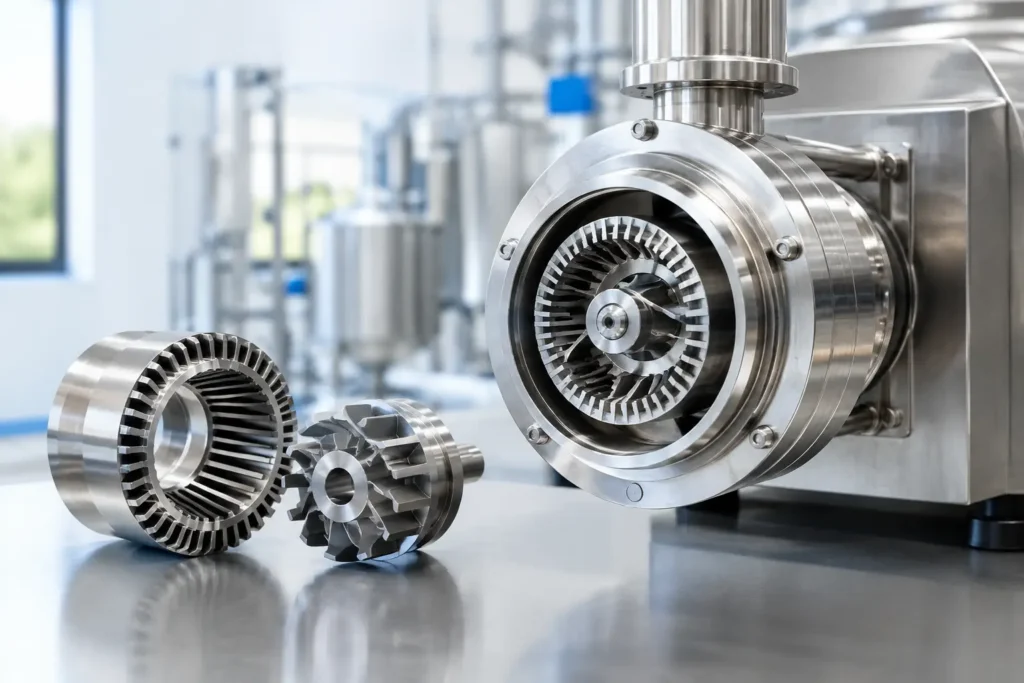
A rotor-stator homogenizer can turn an unstable emulsion into a uniform product in one pass, or it can create excess heat, air entrainment, and a costly production bottleneck. Knowing how to select rotor-stator homogenizers starts with the product specification, not motor horsepower. The correct machine concentrates mechanical and hydraulic energy where the formulation needs it, delivering a controlled particle or droplet-size distribution at the required throughput.
Start With the Required Product Outcome
“Homogenized” is not a sufficient process target. Define what the equipment must change and how that change will be measured. For an oil-in-water emulsion, the relevant target may be median droplet size, distribution width, viscosity stability, and resistance to separation. For a powder dispersion, it may be agglomerate elimination, hydration time, suspension uniformity, and the absence of fisheyes. In coatings, adhesives, battery materials, and ceramics, the priority may be deagglomeration without damaging sensitive solids or shifting rheology.
Set acceptance criteria before comparing equipment. Specify the finished particle or droplet-size range, allowable maximum particle size, batch or continuous throughput, temperature limit, viscosity range, and required hold time or number of passes. If the product must meet a shelf-life, appearance, dissolution, or downstream filtration requirement, include that requirement in the process brief.
This distinction matters because rotor-stator systems create high local shear through fluid acceleration, turbulence, and controlled pressure changes across the generator. They are highly effective for many emulsification, dispersion, and wetting duties, but they do not produce the same energy density as a high-pressure homogenizer. When submicron emulsions or very narrow distributions are non-negotiable, a high-pressure stage may be the appropriate finishing technology. When the objective is efficient inline mixing, powder wetting, or repeatable micron-scale dispersion, an inline rotor-stator homogenizer is often the more practical process choice.
How to Select Rotor-Stator Homogenizers by Shear and Flow
Rotor-stator selection is a balance between shear intensity and volumetric flow. Higher tip speed generally increases shear, but tip speed alone does not define process performance. Rotor diameter, stator hole or slot geometry, generator stages, recirculation rate, product viscosity, and residence time all determine how much useful energy reaches the fluid.
A coarse-slotted stator processes larger solids and higher-viscosity products with lower restriction. It can provide high circulation and rapid bulk turnover, making it useful for initial incorporation and pre-dispersion. A finer stator opening raises localized shear and can improve droplet breakup or agglomerate reduction, but it also increases pressure drop, heat generation, and the risk of plugging if the feed contains oversized particles.
Multi-stage generators add successive zones of acceleration and shear. They can reduce the need for repeated tank recirculation and improve pass-to-pass consistency. However, more stages are not automatically better. A highly shear-sensitive formulation, such as a protein-containing beverage, a fragile biological suspension, or a viscosity-building polymer system, may lose quality if processed too aggressively. The selection question is not “What produces the most shear?” It is “What produces the required structure with the least damaging energy input?”
For continuous production, calculate the relationship between flow rate and effective residence time inside the shear zone. An inline machine sized only for peak line flow may provide inadequate processing if the product receives too little exposure to the rotor-stator generator. Conversely, oversizing the motor without matching the hydraulic circuit, pump capacity, and piping can leave the homogenizer underfed and unable to perform predictably.
Evaluate the Entire Process Circuit
A rotor-stator homogenizer is part of a process system, not an isolated machine. The tank geometry, feed method, recirculation loop, valves, pipe diameter, and downstream equipment influence the result as much as the mixer itself.
For batch recirculation, assess whether the tank agitator can maintain uniform feed to the inline unit. Poor tank turnover can allow floating oil, settled solids, or concentrated powder pockets to bypass the high-shear zone inconsistently. A properly engineered loop draws product from the correct tank location, returns it to promote circulation, and maintains adequate net positive suction conditions at the feed pump.
For continuous lines, consider feed stability and upstream variability. Rotor-stator generators perform best when flow, temperature, and formulation ratios are controlled. If powders enter intermittently, a dedicated powder induction system may be necessary to pull material into the liquid stream under vacuum and wet it before agglomerates form. If entrained air is affecting density, filling accuracy, oxidation, or visual appearance, inline deaeration or vacuum processing should be evaluated as part of the same system.
Use actual operating viscosity, not a water-based estimate. Many products change significantly during hydration, cooling, neutralization, or concentration. A sauce may become far more viscous after starch activation. A personal-care emulsion may build body as waxes crystallize. A slurry may show shear-thinning behavior that changes the pressure profile across the process loop. The equipment must be evaluated across the full viscosity curve, including startup, normal operation, and cleaning conditions.
Match Materials and Sanitary Design to the Application
For food, dairy, beverage, pharmaceutical, biotechnology, and personal-care production, hygienic design is a production requirement. Product-contact materials, elastomer compatibility, surface finish, drainability, seal arrangement, and clean-in-place coverage should be assessed early. An otherwise capable homogenizer becomes a liability if it creates retention points, cannot fully drain, or requires excessive disassembly between campaigns.
Specify the required sanitary standard and documentation package based on the plant’s quality system. This may include material traceability, weld documentation, surface-finish records, pressure testing, FAT protocols, and GMP-ready documentation. For aseptic or SIP applications, seal configuration and thermal design require additional scrutiny.
Chemical and advanced-materials applications may place different demands on metallurgy and sealing. Solvents, abrasive solids, corrosive ingredients, and high-temperature service can require specialty alloys, hardened rotor-stator components, double mechanical seals, or engineered flush systems. Abrasion is especially relevant for mineral slurries, ceramic dispersions, graphene, and battery materials. Fine stator clearances can deliver excellent processing but may wear faster when abrasive solids are present. Factor in expected service life and replacement access, not just initial purchase price.
Plan Scale-Up With Process Data, Not Geometric Assumptions
Scale-up is where many homogenization projects lose repeatability. A laboratory unit can prove formulation feasibility, but it does not automatically predict commercial production. Matching vessel volume or motor horsepower is not enough. The scale-up basis should include tip speed, energy input, generator geometry, flow rate, recirculation passes, temperature rise, and the measured product outcome.
A disciplined development program captures operating data at each stage. Record feed temperature, flow rate, pressure, amperage, number of passes, particle-size results, viscosity, and visual stability. Where possible, run pilot trials using a generator configuration representative of commercial equipment. This provides a more defensible path from bench formulation to production throughput.
Five inputs should be prepared before requesting equipment sizing:
- Product composition, including phase ratio, solids loading, particle hardness, and any shear-sensitive ingredients.
- Viscosity data across the actual processing temperature range and at key formulation stages.
- Required throughput, batch size, allowable cycle time, and whether the process is batch, recirculating, or continuous.
- Particle-size or droplet-size targets, together with the analytical method used to verify them.
- Plant requirements for sanitary design, utilities, controls, CIP/SIP, hazardous area classification, and automation integration.
Specify Controls That Protect Repeatability
A rotor-stator homogenizer delivers repeatable results only when the process conditions are repeatable. Variable-frequency drive control allows operators to set and document rotor speed rather than relying on a fixed-speed machine. Flow measurement, pressure monitoring, temperature instrumentation, and automated valve sequencing provide the operating visibility needed to prevent drift between batches.
For higher-value or regulated products, integrate the homogenizer into a PLC/HMI platform that manages recipes, permissives, alarms, batch records, and CIP sequences. The goal is not automation for its own sake. It is controlled hydraulic energy transfer under defined conditions, with a record that demonstrates the process ran as intended.
When the project involves an aging agitator, a slow batch cycle, or a competitor unit with inconsistent results, request application testing against the current process. EmulXion approaches this work as precision fluid engineering: measure the starting condition, define the required endpoint, and engineer the processing zone and surrounding system accordingly.
The best rotor-stator homogenizer is the one that makes product quality predictable at production rate, while fitting the realities of cleaning, maintenance, utilities, and operator use. Start with the measurable outcome, then build the shear system around it. That is how a homogenizer becomes a controlled production asset rather than another variable in the batch.


