
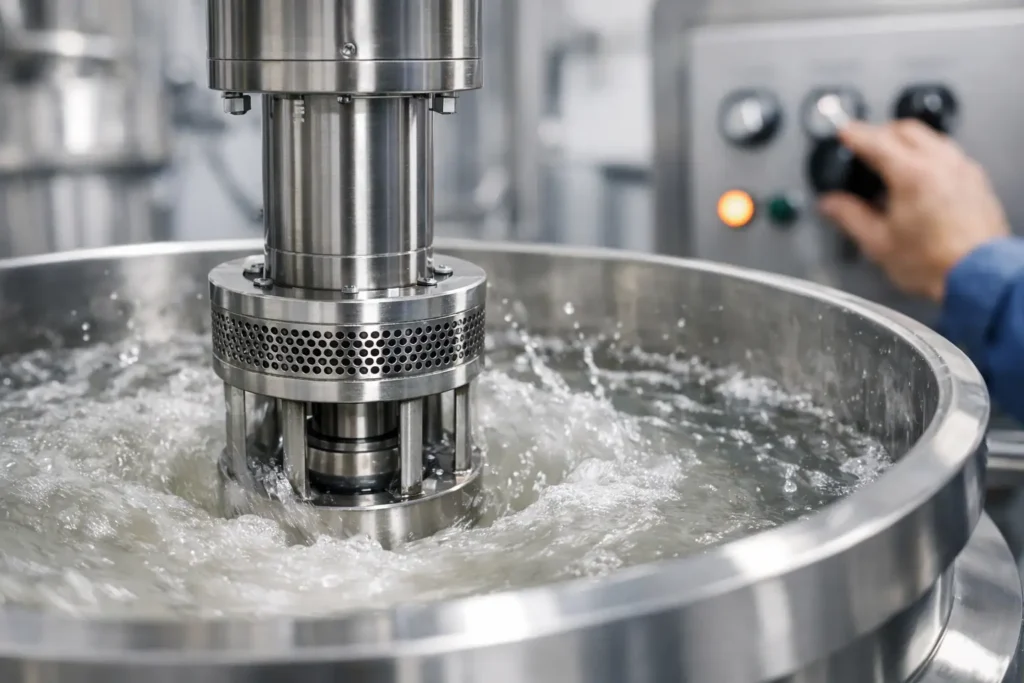
A sauce that breaks after filling, a lotion with visible agglomerates, or a coating that drifts in viscosity rarely has a single cause. In many cases, the root issue is rotor stator mixer operation: the process is producing energy, but not applying that energy consistently where the formulation needs it.
A rotor-stator mixer is not simply a faster agitator. It is a controlled high-shear processing zone that accelerates product through close-tolerance components, creating intense mechanical and hydraulic forces. When speed, flow, geometry, viscosity, temperature, and recirculation are aligned, the result can be a tighter droplet-size distribution, faster powder wetting, more uniform suspensions, and repeatable batch performance. When they are not aligned, higher RPM alone can create heat, air entrainment, excess recirculation time, or incomplete dispersion.
How Rotor-Stator Mixer Operation Creates Shear
The rotor is the rotating element. It pulls fluid into the mixer head and drives it outward at high velocity. The stator is the stationary, perforated or slotted component surrounding the rotor. Product is forced through the rotor-stator clearance and then through the stator openings, where velocity gradients, turbulence, impact, and localized pressure changes act on droplets, particles, and agglomerates.
This processing action can break down soft agglomerates, disperse powders, reduce droplet size in emulsions, and maintain particulate uniformity. It can also generate cavitation under certain operating conditions. Controlled cavitation may support dispersion in some applications; uncontrolled cavitation can contribute to noise, component wear, variable processing, and product damage. The objective is not maximum violence inside the mixer. It is a repeatable energy profile that produces the target product structure.
Tip speed is one of the most useful operating references. It is determined by rotor diameter and rotational speed. A larger rotor at the same RPM has a higher tip speed, while a smaller rotor may require higher RPM to develop a comparable local shear condition. Tip speed alone, however, does not define performance. Rotor-stator gap, stator-hole geometry, product viscosity, flow rate, and the number of effective passes through the head all influence the final result.
An inline unit processes product as it moves through a pipe loop or continuous process line. A batch-mounted unit processes material directly in the vessel, often with an anchor or sweep agitator supporting bulk turnover. Each arrangement has a different operating logic. Inline processing is well suited to controlled recirculation, continuous production, closed sanitary systems, and documented residence time. Batch processing can be effective when the mixer head is correctly positioned and the tank has sufficient bulk movement to bring all product repeatedly into the high-shear zone.
The Variables That Determine Product Quality
The most reliable rotor-stator mixer operation begins with the formulation, not the motor nameplate. A low-viscosity emulsion, a yield-stress gel, and a high-solids ceramic slurry may all require high shear, but they do not behave the same way inside the processing head.
Rotor-Stator Geometry and Stator Selection
Rotor and stator designs are selected for the work being performed. Coarse openings may support high throughput, rapid circulation, and initial powder incorporation. Fine slots or smaller perforations generally increase localized shear and can improve droplet or particle reduction, but they also raise pressure drop and may limit flow with viscous materials.
A finer stator is not automatically better. If the formulation contains large particulates, fibers, fragile inclusions, or poorly hydrated powder clusters, a restrictive head can plug or create excessive temperature rise. Some processes benefit from staged treatment: a more open geometry for incorporation and a finer geometry for finishing. The correct design depends on the target particle-size distribution, allowable temperature increase, required throughput, and material rheology.
Flow Rate, Recirculation, and Number of Passes
In an inline recirculation loop, flow rate governs how often product passes through the rotor-stator head and how long it experiences the high-shear zone. High flow can improve tank turnover and reduce batch nonuniformity, but excessively high flow may reduce the energy applied per pass. Lower flow may increase per-pass intensity, yet it can extend cycle time and create dead zones if tank circulation is weak.
The practical measure is total processing history, not simply minutes on the timer. A 1,000-gallon batch recirculated at 100 gallons per minute has a different pass profile than the same batch processed at 300 gallons per minute. Neither condition is inherently superior. The process should be validated against measurable outcomes such as droplet size, viscosity, particle-size distribution, hydration time, visual appearance, conductivity, or stability after thermal cycling.
For continuous operation, residence-time distribution matters just as much. Product bypassing, short-circuit flow, or unstable feed pressure can produce a broad processing history from one package to the next. Proper line design, feed control, and backpressure management are therefore part of mixer performance.
Viscosity, Temperature, and Feed Conditions
Viscosity changes the hydraulic behavior of the entire system. As viscosity rises, pressure losses increase, tank turnover becomes harder, and the mixer may need a positive-displacement feed pump or a different rotor-stator configuration. Materials with yield stress may not readily enter the high-shear zone without an appropriately designed recirculation path and vessel agitation.
Temperature often changes during processing because shear energy becomes heat. That may be useful for melting fats or accelerating hydration, but it can be unacceptable for heat-sensitive actives, proteins, flavors, or volatile components. Monitor inlet and outlet temperatures, then define an operating envelope for maximum temperature rise. A jacketed vessel, external heat exchanger, or lower-intensity multi-pass strategy may be required.
Feed order matters as well. Adding powder too quickly can create floating rafts or dense agglomerates that resist later processing. Adding oil before the aqueous phase has reached the correct temperature or viscosity can reduce emulsion consistency. For difficult powders, a powder induction system can pull material under vacuum into a controlled liquid stream, reducing dust, fisheyes, and operator-dependent addition rates.
Start-Up and Shutdown Are Part of the Process
High-shear equipment should not be treated as a switch-on, switch-off device. Before starting, confirm that the system is filled, suction conditions are stable, valves are in the intended position, and the recirculation path is open. Running an inline rotor-stator mixer dry can damage mechanical seals, generate excessive heat, and compromise sanitary integrity.
Start at a validated speed and establish flow before increasing intensity. Watch motor load, inlet pressure, discharge pressure, temperature, and batch appearance. A sudden motor-load increase can indicate rising viscosity, a plugged stator, or a restriction downstream. A pressure change may indicate an air pocket, a valve-position error, or a developing blockage.
During shutdown, reduce speed according to the process procedure, maintain sufficient flow to clear the head, and transition into drain, flush, or CIP mode without leaving product in narrow clearances. For sanitary food, dairy, pharmaceutical, and personal-care systems, cleanability is an operating requirement, not a maintenance afterthought. Rotor-stator heads, seals, piping, valves, and instrumentation must be arranged to support validated CIP and, where required, SIP protocols.
Common Operating Problems and What They Indicate
If the product remains grainy or shows undispersed powder, the issue may be inadequate powder wetting before high shear, insufficient passes, an overly open stator, or poor bulk circulation. Increasing RPM may help, but it will not correct a tank vortex that keeps material away from the processing zone.
If an emulsion is unstable, examine more than mixer speed. The formulation may require different phase addition, higher processing temperature, a narrower rotor-stator gap, more passes, or high-pressure homogenization after premixing. Rotor-stator technology is highly effective for many emulsions, but some low-droplet-size or long-term-stability targets require a second-stage homogenization process.
Foam and entrained air point to a different set of causes: excessive surface vortexing, poor suction conditions, uncontrolled return-line discharge, or powder addition that carries air into the batch. A vacuum emulsifying system or inline deaerator may be appropriate when air removal is essential to fill accuracy, appearance, oxidation control, or product density.
Excessive temperature rise suggests that the processing load is too high for the current flow, geometry, viscosity, or batch duration. Reducing speed is one response, but increasing flow, improving cooling capacity, changing the processing sequence, or selecting a different mixer head may produce a better result without sacrificing quality.
Scale-Up Requires More Than Matching RPM
A laboratory mixer can demonstrate whether a formulation responds to shear, but commercial scale-up requires a broader process model. Matching RPM between a 5-liter trial and a 2,000-gallon production batch does not match tip speed, circulation rate, residence time, heat removal, or energy density.
Scale-up should begin with the product target and the critical process variables. Define acceptable droplet or particle size, viscosity range, temperature limit, processing time, and stability criteria. Then evaluate pilot data using the same intended rotor-stator geometry, approximate tip speed, and a production-representative recirculation strategy. This creates a defensible basis for equipment selection rather than relying on motor horsepower alone.
For engineered production lines, the mixer, pump, tank geometry, return location, heat transfer, instrumentation, and automation should operate as one system. EmulXion designs these elements around the processing objective because predictable results come from controlling the entire fluid path, not just installing a high-shear head.
The best operating procedure is a documented window, not a single fixed setting. Establish permitted ranges for speed, flow, temperature, feed rate, and processing time, then connect those ranges to verified product results. That approach gives operators clear control limits, gives quality teams meaningful records, and gives engineering a process that can hold its performance as production demand changes.


