
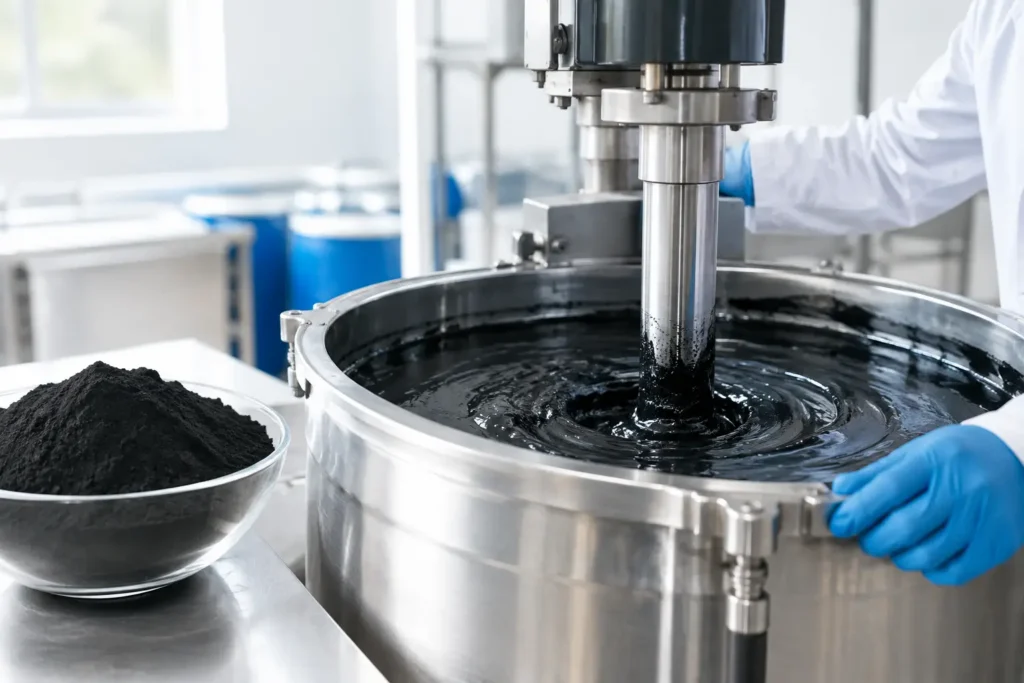
Carbon black can look fully incorporated while still containing agglomerates large enough to compromise color strength, gloss, conductivity, viscosity, filtration, and surface finish. Knowing how to disperse carbon black means designing for more than circulation. The process must first wet the powder, then separate agglomerates, and finally stabilize the resulting particles against reflocculation.
For coatings, inks, adhesives, plastics, battery slurries, rubber compounds, and specialty chemical formulations, carbon black dispersion is a controlled energy-transfer problem. A conventional propeller agitator may distribute powder through a vessel, but it rarely applies enough localized shear to consistently break down carbon black structures. Production-scale success depends on the right combination of formulation chemistry, powder addition method, equipment geometry, residence time, and verification data.
Why Carbon Black Is Difficult to Disperse
Carbon black has a high surface area, strong particle-to-particle attraction, and a pronounced tendency to form dry clusters during addition. Its primary particles are often measured in nanometers, but those particles exist as fused aggregates and larger, loosely bound agglomerates. The objective is not necessarily to separate every primary particle. It is to reduce agglomerates to the size distribution required for the product’s optical, rheological, mechanical, or electrical specification.
Poor wetting is often the first failure point. When dry carbon black contacts a liquid phase, air can remain trapped within the powder bed. The result is floating powder, fisheyes, persistent specks, and long batch cycles. Once partially wetted clusters form, low-energy agitation tends to move them around the tank rather than break them apart.
Dispersion requirements also vary by grade. Furnace blacks, channel blacks, conductive blacks, and pigment blacks can respond very differently because structure, surface chemistry, particle size, and surface area are different. A process that produces acceptable drawdown quality for one pigment black may be inadequate for a high-structure conductive carbon black in a battery electrode slurry.
Start With Wetting, Not Maximum Shear
The first stage of carbon black processing should create rapid, complete wetting. This requires the liquid vehicle and dispersant package to reach fresh particle surface before dry agglomerates become stabilized by trapped air or partially wetted binder.
Formulation chemistry matters. The vehicle must have sufficient affinity for the carbon surface, while the dispersant must adsorb effectively and provide steric or electrostatic separation appropriate to the system. Solventborne, waterborne, and high-solids systems require different approaches. Increasing dispersant may improve initial particle separation, but overdosing can create foam, alter viscosity, reduce film performance, or interfere with downstream cure.
Mechanical design matters just as much. A powder induction system can pull carbon black directly into a high-velocity liquid stream and immediately expose it to intense hydraulic and mechanical shear. Compared with manually dumping bags into an open tank, closed-loop induction reduces airborne dust, shortens powder incorporation time, and prevents the formation of floating rafts that conventional agitators struggle to recover.
For lower-viscosity premixes, an inline rotor-stator mixer is often effective during the wetting stage. Fluid is accelerated into the rotor-stator workhead, where it experiences high velocity gradients, turbulence, and repeated passage through precisely controlled openings. This creates a far more concentrated processing zone than vessel agitation alone.
Use the Right Equipment for Agglomerate Reduction
After wetting, equipment selection should be based on the dispersion endpoint, viscosity range, throughput target, and sensitivity to heat or contamination. More shear is not automatically better. The objective is enough energy, delivered in the right processing zone and for the right residence time, to meet a measured specification.
Inline High-Shear Mixing for Deagglomeration
Inline high-shear rotor-stator mixers are commonly used for premixing and recirculation-based dispersion. They work well when carbon black agglomerates are moderate, the liquid phase is pumpable, and multiple passes can be controlled. Rotor-stator geometry, tip speed, stator opening size, flow rate, and recirculation volume determine the actual energy delivered to the batch.
The advantage is process control. Instead of relying on an operator’s judgment of whether a tank “looks mixed,” the system can run at defined speed, flow, pass count, temperature, and batch turnover rate. For many coatings, inks, and liquid chemical products, this provides a practical balance between throughput and dispersion quality.
Colloid Milling for Tighter Particle Control
A colloid mill is often appropriate when the formulation requires a narrower agglomerate size distribution than an inline mixer can reliably achieve. Adjustable rotor-stator clearance creates a high-shear milling zone that can reduce stubborn clusters while handling many medium- and higher-viscosity products.
Clearance should be selected carefully. A tighter gap can increase dispersion intensity, but it also increases heat generation, wear, and pressure drop. Carbon black formulations containing abrasive fillers require a realistic maintenance plan, particularly if the process operates continuously or at high solids.
High-Pressure Homogenization for Fine Dispersions
For demanding fine-particle applications, high-pressure homogenization can provide a more intense and repeatable energy input. Product is pressurized and forced through an engineered valve or interaction zone, where hydraulic energy is converted into extreme velocity, turbulence, impact, and controlled cavitation.
This method is especially useful when very fine dispersion, stable rheology, or conductivity consistency is required. However, it is not a substitute for proper premixing. Feeding dry or poorly wetted carbon black into a high-pressure homogenizer invites plugging, unstable pressure, excessive wear, and inconsistent results. A properly designed process uses upstream induction and premixing to deliver a uniform feed.
Control Recirculation, Temperature, and Residence Time
Carbon black dispersion is often performed in a recirculation loop, but pass count alone is not a meaningful control variable. One pass through an oversized high-shear unit at low speed is not equivalent to one pass through a correctly sized unit operating in its intended hydraulic range.
Track total batch turnover, inline flow, rotor speed or homogenization pressure, and product temperature. These values establish whether each portion of the batch has received comparable processing. If viscosity changes significantly during dispersion, flow behavior and actual energy input can change as well. This is common in high-solids coatings, conductive pastes, and binder-rich formulations.
Heat control deserves particular attention. Shear energy becomes heat, and carbon black’s optical properties can make temperature rise difficult to observe visually in a dark batch. Excessive temperature can reduce viscosity too far, damage temperature-sensitive binders, increase solvent loss, destabilize dispersants, or complicate downstream deaeration. Jacketed vessels, heat exchangers, and temperature interlocks should be engineered as part of the dispersion system rather than treated as optional accessories.
Prevent Reagglomeration After Processing
A good mill base can still fail after it leaves the high-shear zone. Reagglomeration occurs when the dispersant package cannot maintain separation, when pH drifts in aqueous systems, or when the formulation sees long hold times, temperature swings, or incompatible letdown ingredients.
Add letdown components under conditions that protect the established particle distribution. In many formulations, lower shear during final dilution is preferred to avoid entraining air or changing rheology unnecessarily. If the product must be deaerated, use vacuum-capable processing or inline deaeration after the required dispersion endpoint has been achieved. Removing entrained air improves density control, filling accuracy, appearance, and measurement reliability.
Closed processing also improves housekeeping and repeatability. Carbon black dust is difficult to contain, difficult to clean, and capable of cross-contaminating light-colored products. Systems designed with sealed powder induction, hygienic or cleanable piping, CIP capability where required, and controlled transfer paths reduce those operational risks.
Measure Dispersion Instead of Judging Color by Eye
Visual inspection is useful, but it is not enough for a controlled process. Carbon black can mask defects that would be obvious in a lighter pigment system. The best quality method depends on the application.
For coatings and inks, common checks include fineness of grind, drawdown appearance, gloss, tint strength, jetness, haze, and rub-out. Rheology measurements can reveal incomplete wetting or poor stabilization. Conductive formulations may require resistivity or conductivity testing alongside particle-size analysis. Battery and advanced-materials applications may also monitor slurry viscosity under defined shear conditions, coating uniformity, and electrochemical performance.
Set an acceptance range, not merely a single target. Process capability comes from showing that the system can repeatedly achieve the required distribution across normal variations in raw material lots, ambient conditions, and production schedules. That is the difference between an R&D batch that works once and a manufacturing process that can be validated and scaled.
Scale Up by Matching Process Intensity
A larger tank and a larger agitator do not automatically reproduce lab results. Scale-up should preserve the mechanisms that produced the desired dispersion: powder wetting rate, high-shear-zone intensity, residence time, recirculation behavior, thermal control, and final deaeration.
Pilot testing should establish the relationship between throughput and quality before capital equipment is specified. Useful data includes particle-size distribution, pressure or rotor speed, flow rate, pass count, temperature profile, viscosity, and finished-product performance. An engineered skid can then integrate the required tank, powder induction, inline high-shear mixer, mill or homogenizer, heat exchanger, instrumentation, automation, and CIP features into one repeatable production sequence.
For manufacturers replacing inconsistent batch agitation, EmulXion approaches carbon black processing as a defined fluid-engineering problem: control where energy enters the product, verify the resulting particle structure, and build the production line around that evidence. The best dispersion process is not the one with the highest advertised shear. It is the one that produces the required carbon black performance, batch after batch, with measurable operating margins.


