
A batch may look uniform at the tank surface while still carrying oversized droplets, unhydrated powder, entrained air, or a broad particle-size distribution. Inline homogenizers address that gap by forcing product through a defined energy zone where shear, fluid acceleration, turbulence, and pressure gradients can be controlled from pass to pass. The result is not simply more mixing. It is a more predictable product structure.
Why Batch Agitation Reaches Its Limit
Conventional tank agitators are effective for bulk turnover, blending compatible liquids, and maintaining low-viscosity suspensions. Their limitation appears when product quality depends on microscopic uniformity. An impeller distributes energy across a large tank volume, so local shear varies significantly with distance from the blades, liquid level, viscosity, and vessel geometry.
That variability becomes costly when processing emulsions, pigment dispersions, protein beverages, creams, pharmaceutical suspensions, or powder-thickened systems. Longer mix times may improve apparent uniformity, but they do not necessarily reduce droplets or agglomerates to the required range. They can also introduce air, increase heat exposure, and create batch-to-batch variation.
An inline system separates bulk circulation from intensive processing. A feed pump or recirculation loop delivers product through a compact processing head at a controlled flow rate. Every processed volume experiences the same rotor-stator geometry or high-pressure restriction. That defined exposure is the foundation for repeatability.
How Inline Homogenizers Create Process Control
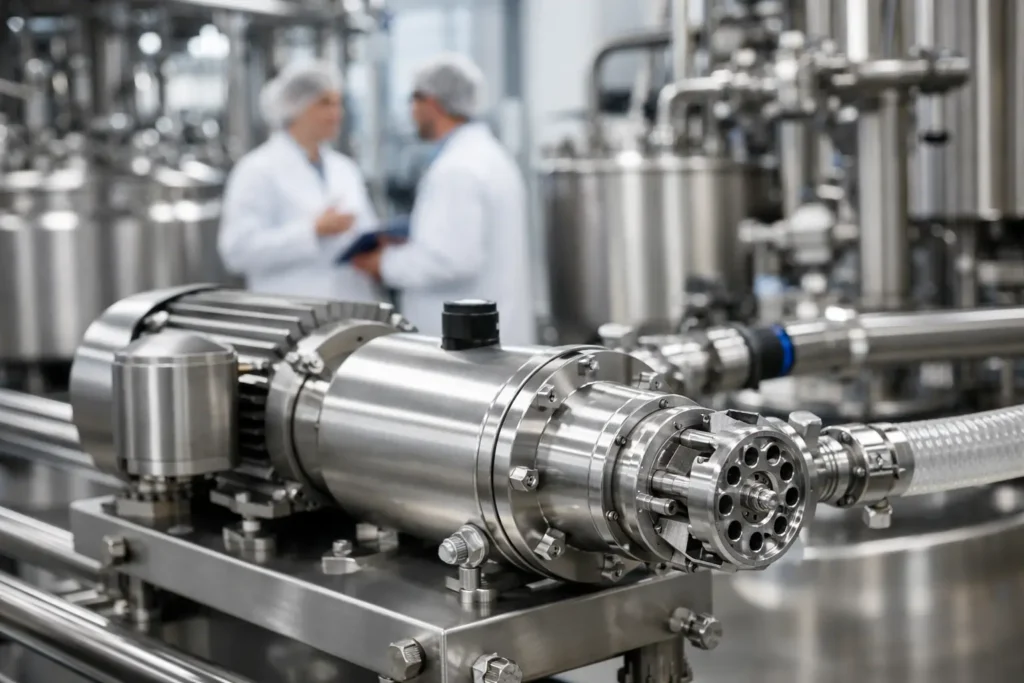
Most inline high-shear homogenizers use a high-speed rotor operating within a close-tolerance stator. Product is accelerated by the rotor and discharged through stator openings at high velocity. The resulting hydraulic shear, turbulence, pressure fluctuation, and localized cavitation break down agglomerates and reduce droplet size.
The geometry matters. Rotor tip speed affects the available shear intensity, while stator slot or hole design influences residence time, discharge velocity, and the number of mechanical events a fluid element experiences. A coarse first-stage stator may be appropriate for rapid powder wetting or initial dispersion. Finer stages can support tighter emulsification and more controlled particle-size distribution.
Processing performance is also determined by variables outside the machine. Viscosity, interfacial tension, temperature, solids loading, flow rate, recirculation volume, and the number of passes all affect the final result. A homogenizer selected only by motor horsepower can miss the actual requirement. The engineering question is whether the system can deliver the required energy density at the target throughput without damaging the product or creating an impractical cycle time.
For applications that require submicron emulsions, cell disruption, or exceptionally narrow droplet distributions, an inline high-pressure homogenizer may be the better fit. In those systems, positive-displacement pumping forces product through an engineered valve or interaction chamber. The pressure drop creates intense hydraulic energy transfer, including turbulence, impact, and cavitation. High-pressure processing can achieve a finer result than a rotor-stator unit, but it has higher pressure requirements, greater sensitivity to upstream particle size, and different maintenance considerations.
Selecting the Right Inline Homogenizer Technology
The right equipment begins with the product objective, not a generic equipment category. A sauce producer may need rapid hydration of starches and gums without fisheyes. A cosmetics manufacturer may need a stable oil-in-water emulsion with smooth sensory properties. A battery-material producer may need to deagglomerate conductive additives while protecting a specified particle morphology. Each duty requires a different balance of shear, flow, temperature control, and residence time.
Inline rotor-stator homogenizers are commonly selected when manufacturers need continuous emulsification, powder dispersion, deagglomeration, particle reduction, or accelerated recirculation processing. They are especially useful where sanitary design, CIP capability, and scalable throughput are required. Multiple processing stages can be configured when one pass through a single shear zone does not provide sufficient reduction.
A colloid mill may be preferable for viscous products that benefit from adjustable mechanical gap control, including nut pastes, ointments, and certain sauces. A vacuum emulsifying system can be more effective for batch products prone to air entrainment, such as creams, gels, and high-viscosity personal-care formulations. Powder induction systems solve a different problem: they pull dry ingredients directly into a liquid stream under vacuum, improving wetting before or during high-shear processing.
These technologies can be combined in a single engineered line. For example, a powder induction unit can introduce stabilizers into a recirculation loop, an inline homogenizer can disperse and hydrate them, and an inline deaerator can remove entrained air before filling. The value is not in adding equipment indiscriminately. It is in arranging each processing step around the material behavior and acceptance criteria.
Design Around Measurable Outcomes
A technically sound specification defines what must be controlled. Useful targets may include mean droplet size, D90 particle size, viscosity range, suspension stability, hydration time, dissolved solids, air content, temperature rise, and production rate. These criteria allow process engineers to compare alternatives based on performance instead of relying on visual appearance or a vendor’s general application claim.
Scale-up deserves the same discipline. Matching laboratory RPM to production RPM is not a reliable method because rotor diameter, flow rate, head geometry, and batch volume change the energy relationship. A stronger approach evaluates tip speed, flow through the processing head, recirculation turnover, pass count, and product temperature at each scale. Pilot trials should establish a practical processing window rather than a single ideal setting.
For sanitary food, dairy, pharmaceutical, and biotechnology operations, equipment construction is part of performance. Product-contact materials, surface finish, elastomer compatibility, drainability, seal design, and CIP/SIP requirements should be reviewed before final selection. A processing head that delivers excellent shear but cannot be cleaned and validated efficiently will create a production constraint.
Installation Details That Affect Results
Inline equipment performs best when the surrounding piping system supports stable product flow. Suction conditions must prevent cavitation at the feed pump. Pipe diameter should be sized for the viscosity and required flow, while avoiding excessive pressure loss. Dead legs, poorly drained low points, and unnecessary restrictions can complicate sanitation and increase product hold-up.
Instrumentation turns a capable machine into a controllable process. Flow measurement confirms the actual throughput through the homogenizer. Pressure indicators reveal restrictions, wear, or changes in product behavior. Temperature monitoring protects heat-sensitive formulations, and variable-frequency drives allow operators to adjust rotor speed within an established operating range. In an automated skid, PLC/HMI controls can coordinate tank level, pump speed, valve position, recirculation time, CIP sequences, and production recipes.
It also helps to plan for maintenance access early. Rotor-stator components are wear items in abrasive slurries and high-solids products. Seal selection depends on pressure, temperature, solvent compatibility, and the consequences of leakage. A well-designed system makes inspection and service straightforward without compromising hygienic design.
Common Application Patterns
In food and beverage production, inline homogenization can reduce oil droplet size in dressings, disperse stabilizers in dairy bases, and improve consistency in sauces. The intended outcome may be improved shelf stability, a smoother texture, or faster batch turnaround. Thermal exposure still matters, particularly with heat-sensitive proteins and flavor systems, so processing temperature must be managed alongside shear intensity.
In cosmetics and personal care, the focus is often emulsion stability, texture, and freedom from visible agglomerates. Vacuum processing may be paired with inline shear where air removal and controlled addition of powders are equally critical. In chemical, coating, and advanced-material applications, the priority may shift toward pigment deagglomeration, conductive additive dispersion, or stable suspension of high-density solids. Abrasion, solvent compatibility, and solids concentration become major design inputs.
Questions to Resolve Before Purchase
Before specifying an inline homogenizer, establish whether the process is continuous or batch recirculation, what throughput is required, and which quality attribute is non-negotiable. A unit that meets hourly flow but cannot achieve the required droplet distribution is undersized for the real duty. Conversely, selecting maximum shear without considering product sensitivity can increase temperature, alter rheology, or create unnecessary operating cost.
Representative product trials are valuable when formulation behavior is uncertain. Test the actual ingredients at meaningful temperatures and solids levels, then measure particle size, viscosity, stability, and processing time. This creates data that operations, R&D, engineering, and procurement can evaluate together.
The best homogenization system is one that makes product quality less dependent on operator judgment. EmulXion designs processing equipment around that standard: control the energy input, verify the operating conditions, and build repeatability into the production line before variability reaches the finished product.


