
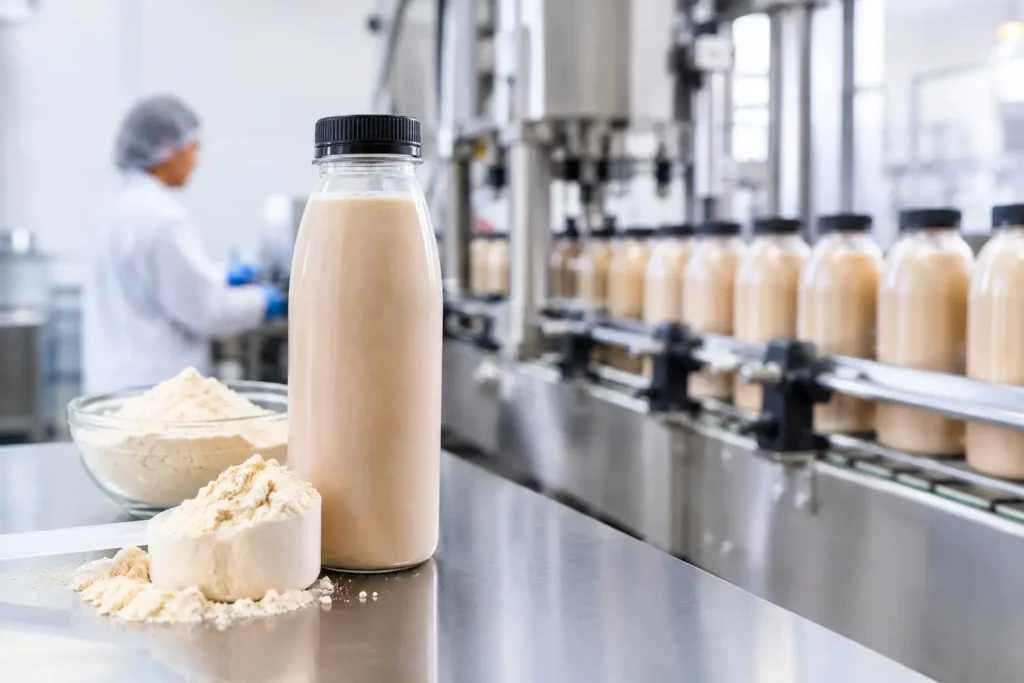
A protein beverage that performs cleanly in a 20-gallon pilot batch can fail quickly at commercial volume. During protein beverage scale-up, longer powder addition times, different recirculation paths, higher thermal loads, and entrained air can change viscosity, sedimentation, flavor release, and finished-package appearance. The problem is rarely solved by specifying a larger tank and a larger agitator.
Commercial success depends on reproducing the process conditions that created the desired product structure in development. That means controlling how powders enter the liquid, how quickly particles hydrate, where mechanical energy is applied, how long material remains in the high-shear zone, and what happens to the product after processing. Engineered outcomes require a defined process window, not an approximate equipment size ratio.
Why Protein Beverage Scale-Up Is Not Linear
Proteins are functional ingredients, not simply solids to dissolve. Whey protein isolates, milk protein concentrates, caseinates, pea protein, soy protein, collagen, and blended systems each respond differently to pH, ionic strength, temperature, shear exposure, and hydration time. A formula may look uniform immediately after mixing but develop sediment, viscosity drift, or an astringent mouthfeel after thermal processing or several weeks in storage.
At pilot scale, operators can often compensate for weak process control. They may add powder slowly by hand, scrape vessel walls, extend mixing time, or adjust an ingredient addition based on visual observation. Those interventions do not transfer reliably to a continuous or high-throughput production line. At commercial rates, the same powder can form persistent fisheyes, wet slowly at the particle surface, or carry air into the system before it reaches the homogenizer.
Scale-up must therefore preserve the relevant fluid-mechanics conditions rather than merely increasing batch volume. The key question is not, “What horsepower does the larger mixer need?” It is, “What combination of flow, shear, pressure, residence time, temperature, and vacuum produces the target particle-size distribution and suspension stability?”
Powder Wetting Sets the Starting Point
Many protein beverage defects begin at powder introduction. Protein powders often resist wetting, especially where a dry powder layer contacts a poorly dispersed liquid surface. Once agglomerates form, even aggressive downstream processing may not fully hydrate their interiors. The result can be visible specks, gritty texture, reduced protein yield, or instability after UHT treatment.
A powder induction system can create controlled vacuum at the point of addition, drawing powder directly into a liquid stream rather than relying on open-vessel vortexing. Inline rotor-stator processing immediately downstream breaks agglomerates and distributes the powder through the carrier phase. This approach can reduce dust, shorten hydration time, and make ingredient addition repeatable across shifts.
The required level of shear depends on the formula. A low-viscosity ready-to-drink beverage may need fast dispersion with limited air incorporation. A high-protein shake with fibers, cocoa, stabilizers, or nut ingredients may require staged processing: powder induction, high-shear hydration, controlled hold time, and final homogenization. Applying maximum shear everywhere is not a process strategy. It can increase temperature, alter viscosity, or create excessive foam.
Energy Density Must Be Reproduced, Not Assumed
Tank agitators create bulk circulation, but bulk circulation does not guarantee local particle disruption. In large vessels, fluid velocity and turbulence vary substantially by location. Dead zones near the vessel wall, low turnover in the upper volume, and inadequate flow through the impeller zone can leave sections of the batch underprocessed.
Inline equipment concentrates mechanical and hydraulic energy in a defined processing zone. Rotor-stator mixers subject product to controlled acceleration, turbulence, and shear as it passes through precision gaps. High-pressure homogenizers apply hydraulic energy through a restricted valve geometry, generating intense pressure drop, turbulence, and controlled cavitation. Each technology produces different results, and each must be matched to the product target.
For protein beverages, the scale-up specification should establish at least four measurable process variables:
- Powder feed rate relative to liquid flow rate
- Recirculation flow and total passes through the processing zone
- Rotor-stator tip speed or homogenization pressure profile
- Product temperature at each critical processing stage
These values provide a foundation for repeatability. They also make troubleshooting possible when a new protein lot, flavor system, or packaging format produces a different result.
Build the Protein Beverage Scale-Up Process Window
A process window defines the acceptable operating range that delivers finished-product performance. It should be developed around product attributes, not around the preferred equipment configuration. Start with measurable targets such as viscosity, particle-size distribution, sediment volume, overrun or dissolved oxygen, pH, sensory texture, and stability after thermal treatment.
Then test the conditions that influence those targets. For example, hydration temperature may improve powder wetting but also increase the risk of protein aggregation. Higher homogenization pressure may reduce particle size and improve suspension stability, yet it can raise product temperature and change the perception of body. A formulation with hydrocolloids may require a separate hydration sequence because adding gum and protein simultaneously can create competition for water and localized viscosity spikes.
Pilot work should intentionally test the edges of the operating range. If the product only performs at one narrow setpoint, it may be difficult to manufacture consistently at commercial volume. A stronger process is one that maintains quality through realistic variation in powder bulk density, incoming liquid temperature, flow rate, and operator timing.
Residence time is particularly important. A laboratory sample may receive five minutes of high shear because the batch is small. On a production skid, a given portion of product may pass through an inline mixer for seconds per pass. The design must account for recirculation rate, tank turnover, and the number of effective processing passes. Without that calculation, a line can appear to have adequate installed power while delivering inadequate treatment to most of the batch.
Select Unit Operations by Failure Mode
The correct processing train depends on what must be corrected or protected. For rapid wetting and deagglomeration, a powder induction system paired with an inline high-shear mixer is often the appropriate starting point. It provides controlled powder capture and immediate dispersion while reducing reliance on manual additions.
When the finished beverage requires a finer, more uniform dispersion or a narrower particle-size distribution, high-pressure homogenization may be necessary. This is common in systems where long-term suspension stability, smooth mouthfeel, or emulsion stability is critical. Pressure, valve design, and number of passes must be validated against the actual formulation. More pressure is not automatically better, particularly with heat-sensitive proteins or delicate flavor systems.
Inline deaeration becomes valuable when entrained air compromises appearance, filling accuracy, oxidation stability, or downstream thermal performance. Air may enter through open-top mixing, powder addition, pump suction conditions, or recirculation turbulence. Vacuum deaeration removes dispersed and dissolved gases under controlled conditions, reducing foam and helping create a more stable processing environment.
A sanitary shear pump may provide both transfer and moderate inline processing, but it should not be expected to replace a high-energy homogenizer where micron-scale dispersion is required. Similarly, a colloid mill can be effective for certain solids and viscous dispersions, but its suitability depends on particle hardness, throughput, and required final texture. Equipment selection must follow the mechanism of the defect, not the familiarity of the machine.
Design for Thermal Processing, CIP, and Production Reality
Protein beverages are frequently exposed to pasteurization, UHT treatment, aseptic filling, or refrigerated distribution. The upstream mixing process must account for what heat will do to the dispersion. A beverage that is stable before thermal treatment may develop aggregate formation afterward if hydration, pH control, mineral balance, or homogenization conditions are inconsistent.
Sanitary design is equally central to scale-up. Dead legs, poor drainability, inaccessible seals, and poorly selected instruments introduce risk in products that support microbial growth. Production equipment should be designed around validated CIP flow paths, appropriate surface finishes, sanitary connections, and the required level of documentation for the application. For aseptic or highly regulated operations, SIP capability, hygienic valve selection, and automation records may be part of the process requirement rather than optional upgrades.
Automation improves repeatability when it controls the variables that matter. A well-designed PLC/HMI system can sequence ingredient addition, maintain flow and pressure setpoints, log temperatures, manage vacuum levels, and provide batch records. It cannot compensate for an undefined process. First establish the process window, then automate its execution.
Commission Against Finished-Product Performance
Factory acceptance testing should verify mechanical operation, but site commissioning must verify product outcomes. Use production-scale trials to compare hydration time, energy input, temperature rise, viscosity, particle-size results, foam level, and stability against approved pilot benchmarks. Test at normal conditions and at credible operating limits, including maximum powder feed rates and minimum available utility temperatures.
The most useful scale-up package connects formulation knowledge to process design: tank geometry, pump curves, pipe velocities, inline processing capacity, heat-transfer requirements, CIP strategy, instrumentation, and control logic. This is where a turnkey process skid can reduce handoff risk. EmulXion designs these systems around the processing conditions required for repeatable fluid performance, rather than treating the mixer as an isolated purchase.
A commercial protein beverage line should give operations teams clear operating limits and clear evidence of product quality. When hydration, shear, pressure, heat, and air removal are controlled as one process, scale-up becomes a disciplined engineering exercise rather than a sequence of production-floor corrections.


