
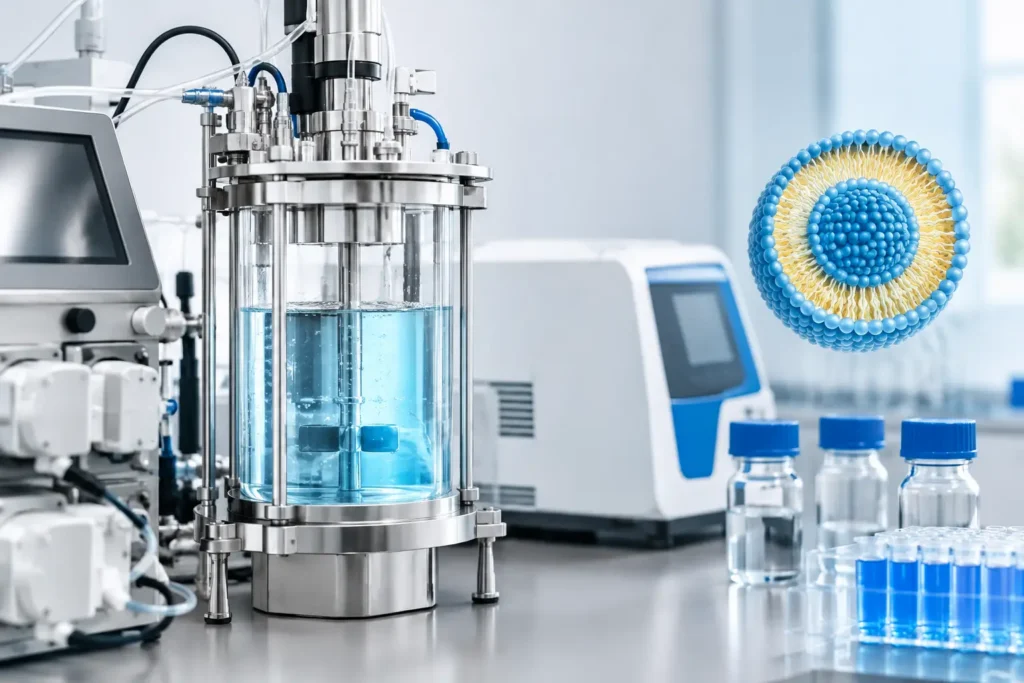
Liposome quality is decided long before final filling. The best equipment for liposome production must do more than circulate a lipid suspension: it must control hydration, energy input, temperature, particle-size distribution, oxygen exposure, and sanitary transfer from one repeatable processing environment. A conventional tank agitator can blend bulk liquid, but it rarely delivers the localized hydraulic energy or narrow residence-time control needed to produce consistent liposomal dispersions at commercial scale.
For process engineers, the correct equipment choice depends on the target vesicle size, lipid system, aqueous phase, batch volume, sterility requirements, and downstream filtration strategy. A process designed for nutraceutical liposomes may prioritize throughput and oxidation control. A GMP pharmaceutical or vaccine process may place aseptic containment, validated CIP/SIP, and batch-record integration ahead of raw output. The equipment should be selected around the process window, not purchased as a generic mixing package.
What Determines Liposome Processing Performance
Liposomes form when amphiphilic lipids contact water under controlled conditions. The resulting vesicles can vary widely in diameter, lamellarity, encapsulation efficiency, and physical stability. Those characteristics are affected by lipid concentration, solvent removal method, hydration temperature, buffer composition, mixing intensity, pressure, and the number of size-reduction passes.
The central engineering challenge is applying enough mechanical or hydraulic energy to disperse and reduce the lipid structures without creating excessive temperature rise, foaming, oxidative exposure, or unnecessary damage to sensitive active ingredients. This is why a single equipment type is seldom the complete answer. High-shear mixing may prepare a uniform feed, while high-pressure homogenization establishes the final particle-size distribution. Vacuum deaeration, jacketed tanks, and recirculation control may be equally important to final product stability.
Best Equipment for Liposome Production by Process Stage
Jacketed process vessels for controlled hydration
Lipids often require processing above their phase-transition temperature to hydrate and organize effectively. A sanitary, jacketed vessel with accurate temperature control provides the foundation for this step. It should be designed around the actual fluid behavior of the batch, including lipid loading, viscosity changes during hydration, and the need to maintain uniform temperature throughout the vessel.
Traditional top-entry agitation can create dead zones, particularly in higher-viscosity systems or at low liquid levels. An engineered recirculation loop with an inline processing head improves bulk turnover and exposes the entire batch to a defined energy zone. For sensitive formulations, the vessel should also support nitrogen blanketing or closed processing to limit oxygen pickup.
Inline high-shear mixers for lipid dispersion and pre-processing
An inline rotor-stator mixer is highly effective when the process requires rapid wetting and dispersion of lipids, emulsifiers, or powdered functional ingredients before final size reduction. Within the rotor-stator workhead, fluid is accelerated through precisely controlled openings, generating intense shear, turbulence, and hydraulic pressure differentials. This prevents the large agglomerates and poorly hydrated lipid domains that can burden downstream homogenization.
The value is not simply higher RPM. Rotor-stator geometry, tip speed, stator opening design, flow rate, and recirculation volume determine the actual energy delivered to the product. A properly sized inline high-shear mixer can shorten hydration time and improve feed uniformity, but it may not independently produce the narrow nanoscale distribution required for all liposome products. It is generally a preparation and conditioning technology, not a substitute for final particle-size control when tight specifications apply.
High-pressure homogenizers for particle-size reduction
For many commercial liposome processes, a high-pressure homogenizer is the primary size-reduction platform. Product is forced at controlled pressure through an engineered valve or interaction zone, where extreme velocity gradients, turbulence, shear, and cavitation reduce larger vesicles and lipid structures. Multiple passes can progressively tighten particle-size distribution.
This approach offers a major advantage over uncontrolled batch mixing: the energy input is measurable and repeatable. Pressure, pass count, flow rate, inlet temperature, and valve geometry become defined process parameters rather than operator judgment. That improves scale-up discipline and provides a clearer path to process validation.
There are trade-offs. Higher pressure is not automatically better. Excessive hydraulic energy can generate heat, alter sensitive actives, affect encapsulation performance, or create product instability. A recirculating homogenization system should include cooling capacity and instrumentation for inlet and outlet temperatures, pressure, flow, and batch pass count. The objective is to reach the target distribution with the least damaging energy exposure.
Membrane extrusion systems for narrow size targets
Membrane extrusion is often used when a formulation requires a defined vesicle size and a narrower distribution than bulk homogenization alone can provide. The liposome dispersion is passed through membranes with controlled pore sizes, typically in one or more stages. This can be valuable in development and specialized production applications where uniformity is the dominant requirement.
However, extrusion capacity is constrained by membrane area, fouling behavior, lipid concentration, and pressure limits. It can become a throughput bottleneck at larger commercial volumes. It is best evaluated as part of a complete process train, often following a controlled hydration and pre-homogenization step rather than as the sole production method.
Vacuum emulsifying and deaeration systems for oxidation-sensitive products
Air management is frequently underestimated in liposome manufacturing. Entrained air can contribute to foam, inaccurate volumetric filling, oxidation of unsaturated lipids, and inconsistent downstream filtration. Vacuum-capable processing systems remove entrained gas during mixing and can support more stable, repeatable product handling.
A vacuum emulsifying system is especially useful when powder addition, viscosity, or formulation chemistry makes air incorporation difficult to avoid. Inline deaeration can also be applied after recirculation or before final filtration. The right approach depends on whether oxygen control is a formulation requirement, a processing improvement, or both.
Equipment Features That Matter at Production Scale
Commercial liposome production requires more than an effective processing head. The system must preserve performance from development batches through full-scale manufacturing. That starts with hygienic design: sanitary materials of construction, drainable piping, minimal hold-up volume, appropriate surface finishes, and CIP/SIP compatibility where required.
Automation is equally important. A PLC/HMI system should control and record the variables that define product quality, including tank temperature, pressure, homogenizer passes, recirculation time, flow rate, vacuum level, and alarms. For regulated production, recipe management, audit-ready data collection, and documented process repeatability should be considered during equipment specification, not added after installation.
Heat management deserves specific attention. High-pressure processing and intense inline shear both convert mechanical energy into heat. Jacketed vessels, heat exchangers, insulated piping, and temperature interlocks protect the process window. If the active compound is heat-sensitive, the system may require single-pass cooling between homogenization stages or lower-energy multiple-pass operation.
Why Standalone Machines Often Create Scale-Up Problems
A standalone mixer or homogenizer may perform well in a trial, then underperform once connected to production tanks, long transfer lines, filters, and filling equipment. The issue is often system hydraulics rather than the machine itself. Pipe diameter, pump selection, pressure drop, valve configuration, dead legs, and recirculation-loop volume all affect residence time and actual energy exposure.
An integrated process skid addresses these interactions as one engineered system. It can combine lipid hydration vessels, inline high-shear processing, high-pressure homogenization, heat exchange, vacuum capability, sanitary pumps, instrumentation, and CIP circuits in a controlled layout. This approach reduces handoffs between vendors and gives the manufacturer a more defensible basis for factory acceptance testing and scale-up performance.
EmulXion Process Technologies approaches this work as precision fluid engineering: selecting processing zones and system controls around measurable outcomes rather than assuming that more agitation will solve a formulation problem.
How to Specify the Right System
Start with the finished-product specification, not a preferred equipment category. Define the required particle-size range and distribution, target concentration, batch or continuous throughput, temperature limits, allowable oxygen exposure, viscosity profile, and cleaning standard. Then determine which process stage creates the greatest risk: incomplete hydration, wide particle distribution, thermal load, foaming, or loss of sterility.
Pilot testing should establish the relationship between pressure or shear input and liposome size, stability, and encapsulation performance. Those data provide the scale-up basis. The production system can then be designed with enough turndown to accommodate formulation changes without operating continuously at the edge of its performance envelope.
The most effective liposome line is rarely the one with the highest nominal horsepower or pressure rating. It is the one that applies controlled energy at the right point, records the conditions that matter, and produces the same dispersion after the thousandth batch as it did during development.


