
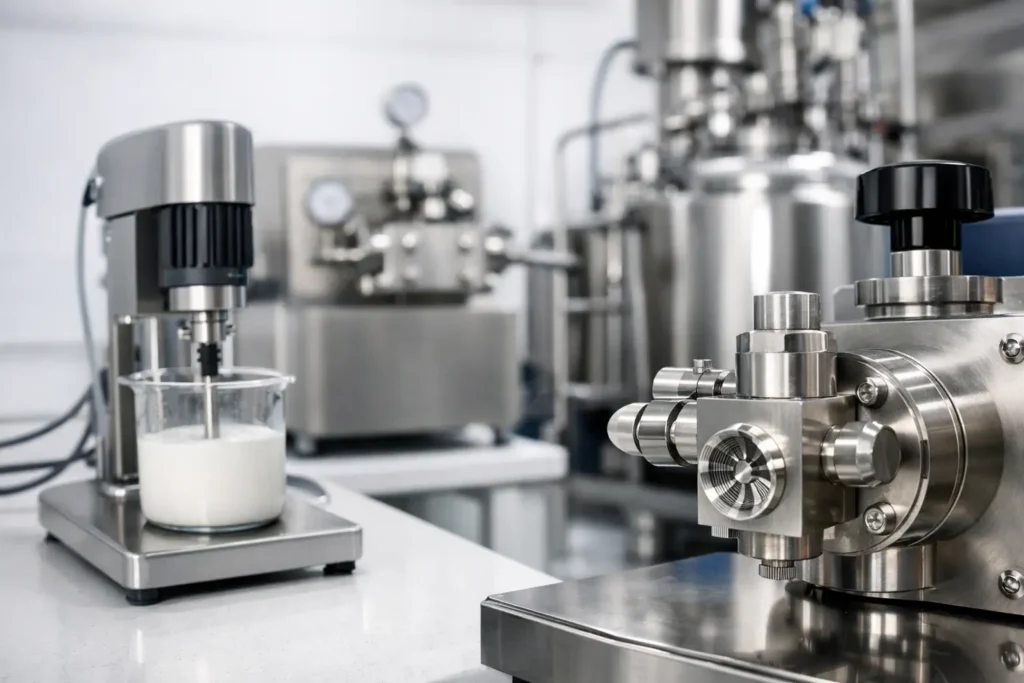
A successful homogenizer scale up process is not a matter of selecting a larger machine with a larger motor. Product structure is created inside a defined processing zone, where shear, pressure, turbulence, cavitation, residence time, and temperature act on the fluid. If those conditions change materially between development and production, droplet size, particle-size distribution, viscosity, stability, and sensory properties can change with them.
That is why scale-up must begin with the finished-product specification, not the production target alone. A process that makes an acceptable 20-gallon pilot batch may fail at 2,000 gallons if the larger system changes the number of passes, hydraulic energy transfer, powder addition rate, or thermal history. Engineered outcomes require a measurable connection between lab results and commercial operating conditions.
Why a Homogenizer Scale Up Process Is Not Linear
Traditional batch agitation is often scaled by tank volume, impeller diameter, tip speed, or motor horsepower. Those parameters can be relevant, but they do not fully describe what happens in an inline rotor-stator homogenizer or a high-pressure homogenizer. The critical work occurs in a narrow, high-energy zone rather than throughout the bulk vessel.
For an inline high-shear system, fluid is accelerated into the rotor-stator workhead, subjected to intense velocity gradients and turbulence, then discharged back into the process loop or downstream pipework. A high-pressure homogenizer instead forces product through a precision valve at controlled pressure, creating hydraulic shear, impact, and cavitation effects. These are different mechanisms, and they cannot be scaled using one universal rule.
Production capacity also changes the fluid path. A lab unit may process a small batch through multiple recirculation passes. A commercial line may require single-pass operation, a controlled number of loop turnovers, or parallel homogenizers to meet throughput. The target is not simply matching RPM or pressure. The target is matching the product-changing conditions that deliver the required quality attributes.
Start With Critical Product Attributes
Before specifying equipment, define what the homogenization step must achieve. For an emulsion, that may be a median droplet diameter, a narrow droplet-size distribution, resistance to creaming, and a defined final viscosity. For a suspension, it may be deagglomeration, uniform solids distribution, no settling during the production window, and controlled particle reduction without damaging sensitive ingredients.
The development team should establish both target values and acceptable operating ranges. A formulation that performs well at 8,000 psi but breaks down above 10,000 psi has a process window, not a single operating point. Likewise, a sauce may require high shear for gum hydration but show unacceptable temperature rise after excessive recirculation.
At minimum, a scale-up study should document four connected categories:
- Product quality: particle or droplet size, viscosity, appearance, density, stability, and sensory or functional performance.
- Material properties: viscosity curve, solids loading, particle hardness, interfacial chemistry, temperature sensitivity, and air entrainment tendency.
- Process conditions: flow rate, pressure, rotor-stator configuration, recirculation time, pass count, inlet temperature, and outlet temperature.
- System constraints: required throughput, sanitation standard, clean-in-place requirements, available utilities, batch size, and allowable hold time.
This information prevents a common error: treating a difficult fluid as though it were water. Viscosity and rheology directly affect pumping behavior, pressure drop, residence-time distribution, and the energy that reaches the processing zone.
Characterize the Development Process Before Scaling
A useful lab trial creates data that can be translated. Record the exact equipment configuration, including workhead geometry, rotor-stator gap, valve type, valve condition, pressure, pump speed, and process route. Record formulation sequence as carefully as machine settings. The order in which oil, surfactant, powder, water, and temperature-sensitive ingredients enter the system can determine whether the process is repeatable.
Temperature deserves particular attention. Mechanical and hydraulic energy eventually become heat. In a small development batch, heat can dissipate quickly or be masked by a chilled vessel. At commercial scale, longer recirculation paths, higher feed temperatures, or greater total energy input can move the product outside its acceptable temperature range. Proteins may denature, volatile components may be lost, and viscosity may shift enough to change homogenization performance.
Sampling must also represent the process. A sample taken from a tank after an extended hold may not reflect the product exiting the homogenizer. Where possible, compare feed, first-pass discharge, final discharge, and post-hold samples. This separates actual homogenization performance from changes caused by downstream aging, deaeration, cooling, or settling.
Match the Technology to the Mechanism
Scale-up decisions become more reliable when the equipment is selected for the physics of the application.
Inline High-Shear Homogenization
Inline rotor-stator homogenizers are effective where rapid wetting, dispersion, emulsification, deagglomeration, and recirculated batch processing are required. Scale-up centers on maintaining appropriate tip speed, workhead geometry, flow through the shear zone, and total exposure to the workhead. Too little flow can increase heat and create unnecessary recirculation. Too much flow can reduce residence time in the shear zone and limit dispersion efficiency.
For many products, the commercial solution is an engineered recirculation skid with a process tank, inline homogenizer, transfer pump, instrumentation, and automated control of flow and temperature. This creates a repeatable number of effective passes rather than relying on operator judgment about when a batch “looks finished.”
High-Pressure Homogenization
High-pressure systems are often selected when a narrow droplet-size distribution, fine particle reduction, cell disruption, or highly stable emulsion is required. In this case, pressure alone is not enough. Valve geometry, flow capacity, product viscosity, inlet conditions, and number of passes influence the result.
A production unit must sustain the validated pressure at the required flow rate without excessive pulsation, inlet starvation, or temperature rise. Some products benefit from two lower-energy passes rather than one extreme-pressure pass. Others require a single-pass process to avoid overprocessing. The correct approach depends on formulation sensitivity and the commercial throughput requirement.
Complementary Process Equipment
Homogenization frequently fails upstream of the homogenizer. Poor powder wetting can send dry agglomerates into a rotor-stator head. Inadequate premixing can create an unstable feed that varies from minute to minute. Entrained air can interfere with density, filling accuracy, emulsion appearance, and pump performance.
Powder induction, vacuum emulsification, colloid milling, inline deaeration, and controlled premix agitation may be necessary parts of the scale-up solution. The production line should be designed as a process, not as a standalone homogenizer connected to an undersized tank and inconsistent feed stream.
Validate at Pilot and Production-Relevant Conditions
Pilot work should test the conditions that are most likely to change at scale: maximum solids loading, highest expected viscosity, shortest practical cycle time, warmest feed temperature, and target production flow rate. A favorable result obtained under ideal lab conditions is useful, but it is not a scale-up validation.
During pilot and factory acceptance testing, compare product data against the defined critical attributes. Confirm not only mean particle size but also distribution width, stability after storage, and batch-to-batch variation. Monitor pressure, flow, temperature, motor load, and recirculation time. Those operating values become the basis for a production recipe and a troubleshooting baseline.
Instrumentation and automation have a direct effect on repeatability. Flow measurement confirms actual residence conditions. Pressure transmitters verify hydraulic energy delivery. Temperature control prevents formulation damage. PLC/HMI recipes reduce operator variation in sequence, pass count, and endpoint decisions. For sanitary, pharmaceutical, and high-value applications, the scale-up package should also account for CIP/SIP coverage, drainability, surface finish, material traceability, and GMP-ready documentation.
Failure Modes That Create Scale-Up Risk
The most expensive failures usually come from assumptions rather than equipment defects. A system may be oversized on paper yet unable to produce the desired particle size because flow bypasses the intended processing conditions. Conversely, a high-energy machine can overprocess a product, creating excess heat, viscosity loss, foaming, or damaged functional ingredients.
Another frequent problem is specifying throughput without defining whether that number means feed rate, net production rate, or recirculated loop flow. These are not interchangeable. A 1,000-gallon batch processed for 20 minutes at a 100-gpm recirculation rate experiences a different process history than a 1,000-gallon-per-hour single-pass line.
Sanitation can also become a hidden constraint. Dead legs, poor drainability, inaccessible seals, or a workhead that does not clean effectively may force longer cleaning cycles and undermine the capacity calculations that justified the equipment purchase. A production-scale design must protect both product quality and operating availability.
Build the Scale-Up Plan Around Evidence
The strongest scale-up programs use formulation data, measured process conditions, and representative pilot trials to define a commercial operating envelope. They identify what must remain constant, what can vary safely, and what equipment features are needed to control those variables.
For manufacturers moving from bench development to commercial production, the practical question is not whether a larger homogenizer can process more volume. It is whether the complete system can repeatedly create the same product structure at production rate, under normal operating conditions. When that question drives the design, scale-up becomes a controlled engineering exercise rather than a production gamble.


