
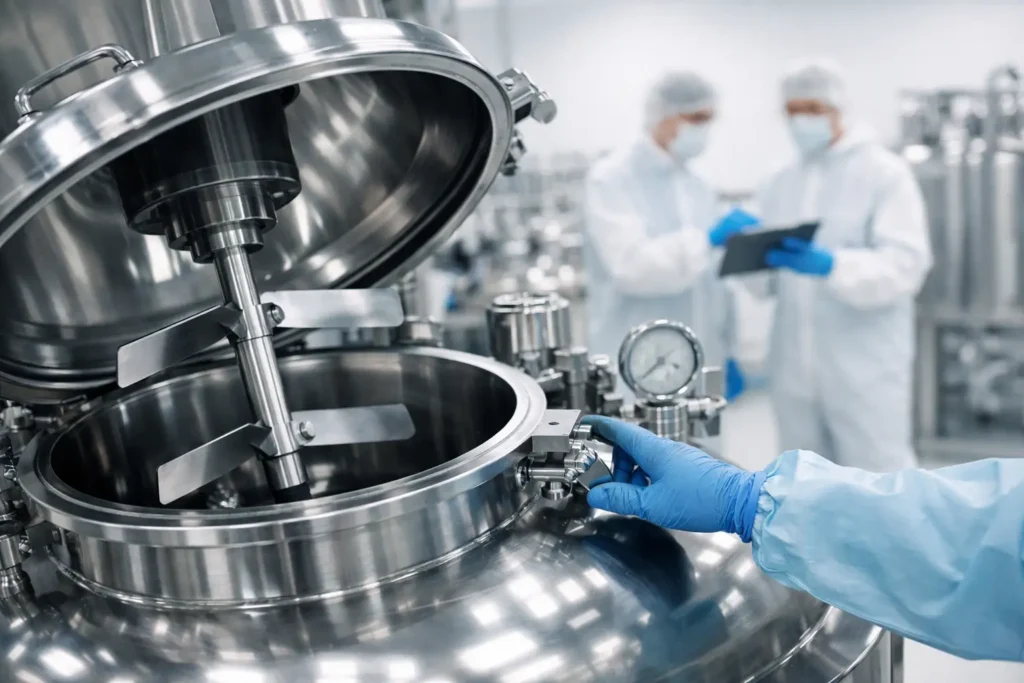
A mixer can produce an acceptable batch on day one and still become a GMP liability over time. The failure point is often not motor horsepower or nominal flow rate. It is a stagnant seal cavity, an uncleanable weld, a poorly drained housing, or a control system that cannot prove what occurred during a batch. GMP mixer design requirements must therefore address both product transformation and the ability to repeatedly clean, inspect, operate, and document that transformation.
For pharmaceutical, biotech, nutraceutical, food, personal care, and specialty chemical manufacturers, the mixer is part of the controlled process. Its geometry affects particle-size distribution, emulsion stability, powder wetting, temperature rise, aeration, and cycle time. Its sanitary design determines whether those results can be reproduced without introducing contamination risk.
GMP Mixer Design Requirements Start With the Process
GMP is not a single equipment feature or a material certificate. It is a design discipline that connects product risk, process conditions, cleaning method, operating procedures, and documentation. A high-shear mixer designed for a low-viscosity nutritional beverage has different requirements than a vacuum emulsifying system for a topical cream or a closed inline homogenization skid for a sterile intermediate.
The first engineering question is not, “What size mixer is needed?” It is, “What must the process control?” That may include droplet size, powder incorporation rate, viscosity development, temperature exposure, dissolved air, microbial risk, or prevention of cross-contamination between campaigns.
Traditional tank agitation can maintain bulk movement while leaving localized powder rafts, unmixed zones, and long batch cycles. In GMP production, those process gaps become quality risks. An engineered rotor-stator zone, inline recirculation loop, high-pressure homogenizer, or vacuum system should be selected based on the energy density and hydraulic conditions required to achieve the product target.
Define the Design Basis Before Selecting Equipment
A meaningful design basis identifies the product’s viscosity range, solids loading, particle characteristics, batch volume, required throughput, shear sensitivity, temperature limits, and cleaning chemistry. It should also define whether the process is batch, semi-continuous, or continuous; whether materials are hazardous or potent; and whether the system must support CIP, SIP, or both.
This work prevents a common mistake: specifying a sanitary mixer based only on gallons per minute. Flow rate alone does not describe the shear field inside a rotor-stator workhead, the pressure drop through an inline system, or the residence time needed for a uniform result. The correct configuration depends on the interaction between fluid rheology, required energy transfer, and the acceptable processing window.
Hygienic Geometry Must Eliminate Product Traps
Product-contact surfaces must be designed for full cleanability, not simply fabricated from stainless steel. A 316L wetted housing is a common starting point, but material selection alone does not prevent retained product, residue buildup, or microbial harborage.
Mixer housings, pipe transitions, valve bodies, instrument connections, and seal areas should minimize dead legs and inaccessible crevices. Internal surfaces should be smooth enough to resist adhesion and support effective cleaning, with welds ground and finished to the specified standard. The required surface finish depends on the product and regulatory environment, but the principle is consistent: surfaces must be inspectable, cleanable, and appropriate for the chemistry they contact.
Drainability deserves the same attention as surface finish. A housing that retains rinse water or cleaning solution after a CIP cycle can dilute the next batch, support microbial growth, or create an avoidable validation concern. GMP-ready systems use intentional slope, low-point drainage, properly located ports, and process connections that do not create hidden hold-up zones.
Seals and Bearings Are Critical Control Points
Mechanical seals are frequent sources of both contamination risk and maintenance-driven downtime. The right design depends on pressure, temperature, viscosity, abrasiveness, cleaning conditions, and whether the process is open or closed. Single mechanical seals may suit many hygienic applications, while double seals, barrier systems, or other containment strategies may be required for solvents, potent materials, high-pressure service, or applications where leakage control is essential.
Bearings should be isolated from the product zone. Where possible, the mixer design should allow seal inspection and service without dismantling unnecessary sections of the process line. This is not only a maintenance preference. Repeated disassembly creates opportunities for assembly error, damaged elastomers, and inconsistent requalification.
Elastomers, gaskets, and seal faces must also be compatible with the product, cleaning chemicals, sterilization temperature, and expected pressure cycling. A gasket that swells after repeated exposure to caustic or solvent can compromise both hygienic integrity and batch consistency.
Clean-in-Place Performance Must Be Engineered, Not Assumed
A system is not CIP-capable because it includes a spray device. Effective CIP requires sufficient flow, velocity, chemical concentration, temperature, time, and complete coverage of all product-contact surfaces. The mixer itself must be compatible with that cleaning regime.
For inline high-shear mixers and emulsifiers, cleaning validation often depends on the ability to flush the rotor-stator workhead, seal zone, inlet, outlet, and associated recirculation piping without manual intervention. For batch vessels, the design must account for the tank wall, agitator shaft, impeller, baffles, lid penetrations, powder induction connections, and vacuum piping.
CIP design should be evaluated under actual operating conditions, including minimum and maximum flow, return-line conductivity, drainage, and the potential for air pockets. A cleaning circuit may appear adequate on a piping diagram yet fail to deliver enough mechanical action through a complex processing head. Engineering review should confirm that the equipment geometry supports the validated cleaning recipe.
SIP requirements add another layer. Steam exposure can affect seal materials, instrumentation, motor isolation, and thermal expansion. If SIP is required, it should be incorporated into the mixer design from the outset rather than added after equipment selection.
Control Architecture Must Support Repeatability
GMP manufacturing depends on controlled, repeatable execution. A variable-frequency drive and manual speed setpoint may be sufficient for a straightforward process, but more demanding applications benefit from an integrated PLC/HMI platform that records the conditions affecting product quality.
Critical parameters can include mixer speed, recirculation flow, tank temperature, vacuum level, pressure, homogenization pressure, batch time, ingredient addition sequence, and CIP phase status. The required level of automation depends on risk and process complexity. A cosmetic emulsion system may need recipe management and temperature control, while a regulated pharmaceutical process may require tighter access control, electronic records, alarm history, and audit-ready batch data.
Instrumentation should be selected for accuracy, cleanability, calibration access, and compatibility with the process. A flow meter that cannot reliably measure a viscous recirculation stream does not provide useful control. Likewise, a pressure transmitter placed where pulsation obscures the true process condition can lead operators to make incorrect adjustments.
Automation should support the process, not obscure it. Operators need a clear view of what the system is doing, why an interlock has stopped a sequence, and which corrective action is permitted. Good controls reduce dependence on individual operator judgment while preserving practical troubleshooting capability.
Documentation and Qualification Need a Defined Scope
GMP equipment purchases should include documentation proportionate to the application. Typical requirements may include material traceability for product-contact components, weld records where specified, surface-finish verification, certificates of conformance, calibration records, pressure-test documentation, electrical drawings, control narratives, manuals, spare-parts lists, and factory acceptance testing records.
For higher-risk systems, the project may also require design qualification support, FAT protocols, site acceptance testing, IQ/OQ documentation, software specifications, and traceable change control. The appropriate package depends on the manufacturer’s quality system and regulatory obligations. Over-specifying documentation can add cost and delay; under-specifying it can leave the validation team without the evidence needed to release the system.
The strongest approach is to align the documentation matrix with the user requirement specification before fabrication begins. That creates accountability around critical design decisions, including product-contact materials, cleanability, instrument ranges, alarm philosophy, and software functions.
Scale-Up Cannot Be Based on Tank Volume Alone
A laboratory mixer and a production unit may share a product name while producing different results. Scale-up must account for tip speed, rotor-stator geometry, hydraulic throughput, residence time, pressure, temperature rise, and the number of effective passes through the processing zone.
This is particularly important for emulsions, suspensions, nanoparticle dispersions, and powder-containing systems. A large tank with an undersized inline mixer may achieve circulation without achieving the required particle reduction or deagglomeration. Conversely, excessive shear can damage fragile actives, alter viscosity, introduce heat, or destabilize a formulation.
Pilot trials and process data are valuable because they establish a performance window rather than a theoretical equipment size. The goal is not maximum shear. It is controlled energy input that consistently produces the specified product structure at commercial throughput.
Design for the Reality of Production
A GMP mixer must perform after hundreds of batches, repeated CIP cycles, operator shift changes, seal replacements, and formula adjustments. That is why maintainability, sanitary access, control visibility, and documented performance belong in the original design discussion.
For manufacturers replacing conventional agitation, the opportunity is larger than a new mixer. A properly engineered system can shorten hydration time, improve emulsion uniformity, reduce rework, and create a cleaner path from development-scale evidence to full production. Control what matters at the processing zone, and quality becomes a designed outcome rather than an end-of-batch question.


