
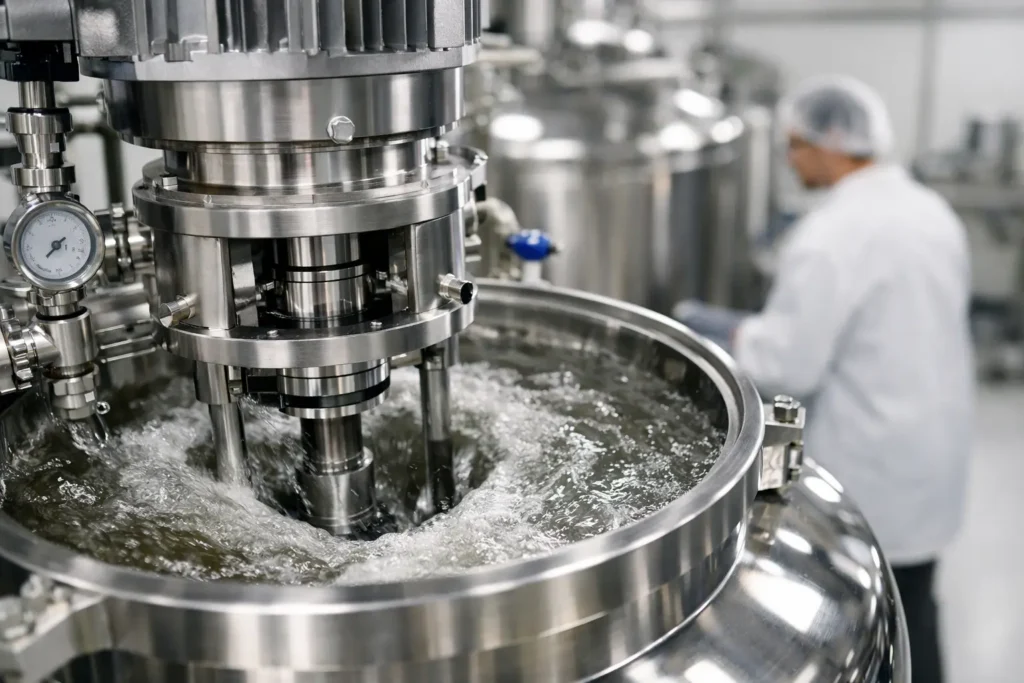
A product that looks uniform in the tank can still fail where it matters: on a particle-size test, after thermal processing, on the filling line, or three months into shelf life. High shear mixers are designed for these outcomes. Rather than relying on bulk circulation alone, they concentrate mechanical and hydraulic energy in a controlled processing zone to break down agglomerates, reduce droplets, rapidly wet powders, and create a more repeatable product structure.
For manufacturers of emulsions, suspensions, creams, sauces, coatings, pharmaceutical intermediates, and advanced materials, that control can separate a stable commercial process from a batch that requires rework. The correct machine is not simply the one with the highest motor horsepower. It is the system that applies the required shear intensity, residence time, flow pattern, and sanitary design to the specific formulation.
What High Shear Mixers Actually Do
Most industrial high shear mixers use a high-speed rotor operating within a stationary stator. Product is drawn into the rotor-stator workhead, accelerated through precisely engineered openings, and discharged at high velocity. The resulting velocity gradients, turbulence, hydraulic shear, and localized pressure changes act on droplets, particles, and powder agglomerates far more intensely than a conventional propeller or paddle agitator.
This action can support several distinct process objectives. In an oil-in-water emulsion, the goal may be a narrower droplet-size distribution that improves stability, texture, opacity, and shelf life. In a powder-liquid application, the goal may be rapid wet-out and deagglomeration before fisheyes form. In a chemical suspension, it may be maintaining a uniform solids distribution while reducing oversized particles.
The distinction matters because shear is not a single number. Rotor tip speed, stator geometry, rotor-stator clearance, flow rate, viscosity, product temperature, and the number of passes through the workhead all influence the result. A process designed only around RPM can produce inconsistent results when formulation concentration, raw-material particle size, or batch volume changes.
Rotor-Stator Energy Is Localized Energy
Conventional tank agitation is effective at moving volume. It creates bulk turnover, supports heat transfer, and can keep many low-viscosity products moving. But bulk movement does not guarantee that every portion of the batch has received enough energy to disperse a difficult powder or reduce a droplet to the required range.
A rotor-stator mixer creates a defined high-energy zone. In an inline configuration, every gallon directed through the unit receives that treatment on each pass. This makes recirculation rate and processing time meaningful design variables. A batch may require a few passes for simple dispersion or many passes for a fine, stable emulsion. The appropriate approach depends on the formulation and the quality target.
Why Conventional Agitation Reaches Its Limit
A tank agitator can often blend ingredients to visual uniformity, yet leave unresolved agglomerates, broad droplet populations, or localized concentration differences. This is especially common when adding hydrocolloids, proteins, starches, carbomers, fumed silica, pigments, gums, or other powders that hydrate or thicken at their surface before the interior has been wetted.
The result is often longer batch cycles and more operator intervention. Production teams may compensate by increasing mix time, raising vessel speed, changing the addition sequence, or manually breaking lumps. Those measures can help, but they do not necessarily create controlled energy at the point where it is needed.
High shear processing changes the mechanism. A properly selected inline mixer can pull material through the workhead repeatedly, disperse solids as they enter the liquid phase, and reduce the dependence on prolonged tank agitation. It can also reduce the risk of overprocessing the entire tank merely to correct a small population of agglomerates.
That does not mean high shear is always the right answer. Very shear-sensitive materials can lose viscosity, damage fragile particles, alter crystal structure, or incorporate unwanted heat if the process is not managed correctly. For these products, lower-shear agitation, a specialized milling approach, vacuum processing, or a high-pressure homogenizer may be the better choice.
The Process Variables That Determine Results
Equipment selection should begin with the product, not a generic mixer category. The first question is what must change in the fluid. Is the target a stable emulsion, a powder-free solution, a reduced particle size, a deaerated cream, or a suspension that remains uniform through filling?
Viscosity is a major constraint. Low- to moderate-viscosity liquids typically circulate efficiently through inline rotor-stator systems. As viscosity rises, the system may require positive-displacement pumping, a recirculation loop designed for pressure loss, or a vacuum emulsifying vessel with a bottom-entry homogenizer. A high-viscosity personal-care cream and a low-viscosity beverage emulsion should not be treated as the same mixing problem.
Particle and droplet targets also define the technology. An inline high shear mixer can achieve excellent dispersion and emulsification for many products, but it is not a universal substitute for high-pressure homogenization. When a formulation requires extremely fine droplets, narrow distribution, or cell disruption at elevated pressure, a high-pressure homogenizer may provide the required energy density. When the principal challenge is dry powder incorporation, a powder induction system can eliminate dusting and reduce the time between addition and wet-out.
Temperature and air management deserve equal attention. Shear generates heat, and recirculation can continue raising product temperature over the cycle. Some products need a jacketed tank or heat exchanger to hold the process window. Others benefit from vacuum processing or inline deaeration to remove entrained air that can affect density, appearance, oxidation, fill weight, and downstream packaging performance.
Selecting High Shear Mixers for Production Scale
The most reliable selection process starts with application data: formulation composition, solids loading, viscosity curve, temperature range, batch size or continuous flow rate, required processing time, and measurable quality criteria. A statement such as “we need better mixing” is a useful starting point, but it is not a complete equipment specification.
For batch production, an inline mixer is commonly installed in a recirculation loop with a process tank and appropriate pump. The loop must be sized to provide useful turnover without excessive pressure drop, air entrainment, or bypassing. The tank agitator and inline unit then perform different jobs: the agitator maintains bulk uniformity while the inline mixer supplies localized shear.
For continuous production, flow rate and residence time through the workhead become central. The system must maintain stable feed conditions and avoid starving the mixer, particularly when processing viscous or gas-containing products. Instrumentation for flow, pressure, temperature, and motor load turns the process from an operator-dependent procedure into a controlled production method.
Scale-up should preserve the processing mechanism, not merely increase vessel volume. Matching motor horsepower alone does not preserve rotor tip speed, shear-zone geometry, recirculation behavior, or pass count. Pilot testing and documented process data reduce the risk of producing an acceptable laboratory batch that cannot be repeated at commercial throughput.
Sanitary Design Is Part of Process Control
In food, dairy, pharmaceutical, biotech, and personal-care operations, cleanability is not an accessory feature. Product hold-up, seal design, surface finish, drainability, elastomer compatibility, and CIP or SIP requirements directly affect changeover time, contamination risk, and validation effort.
A hygienic high shear system should be engineered as part of the complete process path. That includes the mixer, tank, pump, valves, piping, instrumentation, and controls. Dead legs, poorly drained low points, and components that cannot tolerate the intended cleaning chemistry can undermine an otherwise capable mixing platform.
For GMP-oriented operations, documentation also has operational value. Material traceability, weld documentation, surface-finish specifications, instrument records, and automation support make qualification and maintenance more manageable over the life of the system.
Questions to Resolve Before You Specify a Mixer
Before requesting a quote, define whether the process is batch, recirculated batch, or continuous; whether the product contains difficult-to-wet powders or shear-sensitive components; and what quality metric proves success. That metric may be particle size, droplet size, viscosity, dispersion uniformity, dissolution time, density, or shelf-life stability.
Also establish the required throughput and cleaning standard. A mixer that achieves the target in an R&D vessel may not meet production needs if it creates excessive cycle time, cannot be cleaned in place, or requires frequent manual intervention. The best design balances intensity with throughput, maintenance access, energy use, and repeatability.
EmulXion approaches this decision as a fluid-engineering problem rather than a catalog selection exercise. The goal is to define the processing zone, system configuration, and controls that consistently deliver the product specification.
The right high shear mixer does more than make a batch look blended. It gives engineering and operations teams a controlled way to produce the same structure, at the same quality level, from one production run to the next.


