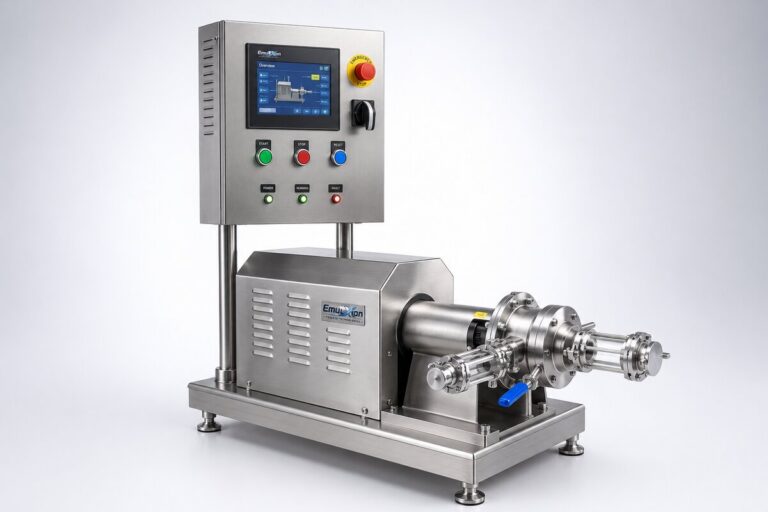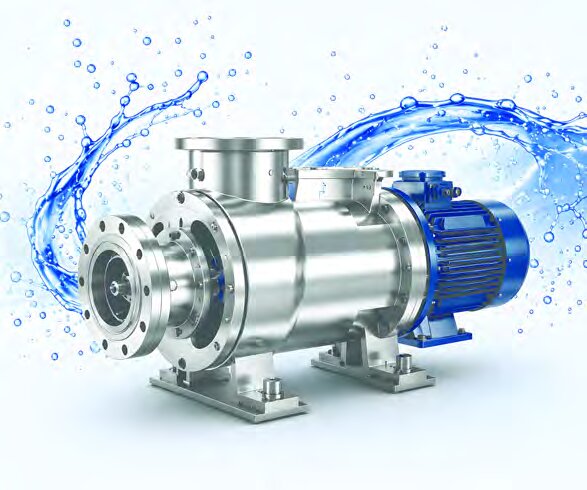
Few questions come up more often in process engineering than this one — and few are answered as badly. Vendors who only make one technology tend to recommend the one they make. Because EmulXion manufactures both rotor-stator high shear mixers and high-pressure homogenizers, we can give you the honest version.
The short answer
It comes down to target particle size. If your specification lives in the 1–10 micron range — most emulsions, dispersions, sauces, lotions and suspensions — a rotor-stator high shear mixer will get you there efficiently, at lower capital and operating cost. If your specification is sub-micron to nanometer — nano-emulsions, liposomes, injectables, cell disruption, dairy standardization, battery slurries with tight distribution requirements — you need the extreme, uniform energy of high-pressure homogenization.
How each technology applies energy
A high shear mixer accelerates product through narrow gaps between a rotating rotor and a stationary stator. Every particle that passes the work head experiences mechanical shear, hydraulic shear, turbulence and cavitation. Multi-stage designs stack rotor-stator pairs in series so droplets are refined progressively in a single pass.
A high-pressure homogenizer pressurizes the entire product stream and forces it through a precision-engineered valve gap. The pressure drop at the gap converts to intense turbulence, cavitation and impact — the most concentrated and most uniform energy input available in fluid processing, which is why it reaches particle sizes rotor-stator machines cannot.
| Factor | High Shear Mixer | High-Pressure Homogenizer |
|---|---|---|
| Typical particle/droplet size | 1–10 µm (sub-micron possible on easy emulsions) | Sub-micron to nanometer |
| Capital cost | Lower | Higher |
| Handles coarse feed / powders | Yes — excellent pre-mixer and disperser | No — needs a uniform, fine pre-mix |
| Viscosity range | Broad, including moderately viscous products | Pumpable, lower-viscosity streams |
| Energy per unit volume | Moderate | Very high, very uniform |
| Typical role in a line | Dispersion, hydration, pre-emulsion, finishing many products | Final micronization and stabilization |
The answer nobody tells you: it’s often both
A high-pressure homogenizer performs dramatically better when it is fed a uniform pre-emulsion — droplet sizes entering the valve affect droplet sizes leaving it, and coarse, inconsistent feed causes pressure fluctuation and valve wear. That is why well-designed lines for demanding products put a high shear mixer upstream of the homogenizer: the mixer wets powders, builds the pre-emulsion and knocks the distribution down to a few microns; the homogenizer then finishes at sub-micron scale in fewer passes, at lower pressure, with less wear.
Rule of thumb: if the homogenizer is your bottleneck or your pass count is climbing, the cheapest fix is usually a better pre-mix — not a bigger homogenizer.
Decision checklist
- Spec ≥ 1 µm, moderate stability requirement → high shear mixer, single or multi-stage.
- Spec ≥ 1 µm but long shelf life / no separation over months → multi-stage high shear mixer; validate stability, upgrade to HPH only if testing demands it.
- Spec < 1 µm, bioavailability, cell disruption, injectables → high-pressure homogenizer, with a high shear pre-mix stage.
- Viscous, coarse or fibrous feed → start with a colloid mill or high shear mixer; HPH only downstream if the spec requires it.
- Powder incorporation is the real problem → the mixing technology matters less than the feeding method — see vacuum-assisted powder induction.
Get a specific answer
Send us your formulation, current particle size distribution, target distribution and throughput — we’ll tell you which technology (or combination) hits the spec at the lowest total cost, and back it with performance data. Ask an engineer →