A powder addition step can determine whether a finished product is uniform, pumpable, stable, and commercially repeatable – or whether operators spend hours chasing fisheyes, undispersed solids, foam, and viscosity variation. Batch versus inline powder wetting is not simply a choice between two equipment layouts. It is a decision about where hydraulic energy is applied, how quickly each particle contacts liquid, and how consistently the process can be controlled from one production run to the next.
For products containing gums, starches, proteins, thickeners, mineral powders, active ingredients, pigments, carbomers, or other difficult-to-wet solids, conventional tank agitation often becomes the limiting operation. The right approach depends on powder behavior, required throughput, formulation sensitivity, sanitation requirements, and the level of automation expected at scale.
Why powder wetting fails before dispersion begins
Wetting is the first barrier to successful dispersion. A dry powder particle must contact the liquid phase and displace the air at its surface before it can hydrate, dissolve, or deagglomerate. When powder is added too quickly to a low-energy tank vortex, the outside of a particle or agglomerate may hydrate immediately. This creates a gelled surface that shields dry material inside.
These partially hydrated agglomerates are commonly called fisheyes. They are especially persistent with hydrocolloids, protein concentrates, modified starches, and high-viscosity polymer systems. More time on a slow-speed agitator rarely solves the underlying problem because the needed energy is not reaching the protected dry core.
Air entrainment creates a second problem. Powder dumped into an open vessel can carry substantial air into the batch. The result may be foam, inaccurate fill weights, oxidation risk, poor heat transfer, or downstream instability. In pharmaceutical, nutraceutical, and personal-care production, entrained air can also complicate deaeration and create variability in density or appearance.
Batch versus inline powder wetting: the process difference
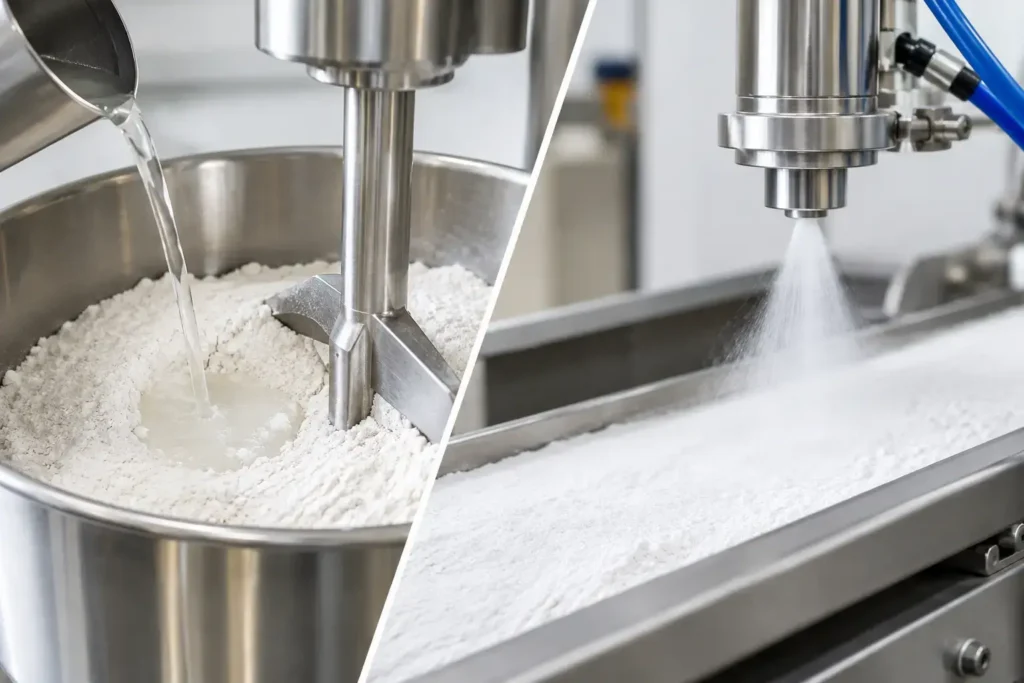
In batch powder wetting, powder is typically introduced into a vessel containing liquid while an agitator, high-shear mixer, or recirculation loop provides mixing energy. The entire batch receives treatment over time. In inline powder wetting, powder is metered into a controlled liquid stream and drawn directly into a high-energy processing zone, commonly through a powder induction system coupled with an inline rotor-stator mixer.
The distinction matters because an inline system concentrates mechanical and hydraulic energy at the point of addition. The liquid stream accelerates through engineered rotor-stator geometry, creating localized pressure differentials, turbulence, and shear. Powder is pulled below the liquid surface, wetted quickly, and conveyed into the recirculating or downstream process stream before large surface agglomerates can form.
A batch vessel distributes energy across a much larger volume. This can be appropriate when the formulation hydrates easily, throughput is modest, or the process needs extended holding time for swelling, dissolution, heating, or reaction. But it also means performance depends heavily on vessel geometry, impeller selection, liquid level, addition rate, operator technique, and the position of the powder feed relative to the flow pattern.
Where batch wetting remains appropriate
Batch processing is not inherently inferior. It is often the practical choice for low-volume development, frequently changing formulations, or processes that require several ingredients to be staged and verified in a single vessel. A tank also provides useful residence time when a powder must hydrate slowly under controlled temperature and pH conditions.
For readily soluble ingredients such as certain sugars, salts, and low-use-level powders, a properly designed batch system may provide sufficient performance. A high-shear batch mixer or recirculation loop can improve the result substantially when compared with an agitator alone. The critical question is whether the vessel can consistently achieve complete wetting without excessive cycle time, manual intervention, or rework.
Batch wetting becomes more difficult as viscosity rises. As the product thickens, bulk circulation weakens and the surface vortex may collapse. Operators may respond by adding powder more slowly, which protects quality but extends the batch cycle. At larger production volumes, that trade-off can constrain output far more than the nominal mixer horsepower suggests.
What inline wetting changes on the production floor
An inline powder induction system creates a controlled pathway from powder source to process fluid. Rather than relying on an operator to feed a vortex, the system uses vacuum at the induction point to draw powder into the liquid stream. The powder is exposed to immediate wetting and high shear, then circulated through the tank or directed to the next processing stage.
This approach can reduce powder addition times dramatically for applications that otherwise require slow manual charging. It also improves repeatability because powder feed rate, liquid flow, rotor-stator speed, recirculation rate, and batch endpoint can be defined in the recipe. Those controls matter when product quality is tied to viscosity development, suspension uniformity, particle-size distribution, or final solids content.
Inline processing is particularly valuable where powder dust, operator exposure, and sanitation are concerns. A closed transfer path can reduce open handling while supporting CIP-ready system design. For food, dairy, pharmaceutical, and cosmetics applications, the full system must still be engineered around hygienic valves, drainability, material compatibility, and validation requirements. An inline mixer alone does not make a process sanitary.
There are limits. Inline wetting does not eliminate the need for adequate tank turnover, residence time, or thermal control. Some materials need time to hydrate after initial wetting. Others require a downstream colloid mill, high-pressure homogenizer, or additional rotor-stator pass to achieve the required particle or droplet distribution. The induction system solves the entry problem; it should be specified as part of the complete fluid-processing sequence.
Evaluate the powder, not just the mixer
The most reliable equipment selection starts with material behavior. Bulk density affects feeder sizing and conveying stability. Particle size, moisture content, cohesiveness, and angle of repose influence whether a powder flows consistently into an induction hopper. A light, aerated gum behaves very differently from a dense mineral filler, even if both are added at the same percentage.
Hydration kinetics are equally important. Some powders wet rapidly but disperse slowly. Others form a surface gel within seconds and need immediate high shear. Oil-soluble powders, heat-sensitive actives, and ingredients that require pre-blending introduce further variables. The liquid phase also matters: temperature, viscosity, surface tension, pH, and dissolved solids can all change wetting behavior.
This is why throughput claims alone are insufficient. A system rated to induct a stated mass flow of free-flowing powder may process a cohesive hydrocolloid at a much lower practical rate. Application testing should establish the feed rate that maintains complete wetting without overloading the rotor-stator zone, causing line pressure instability, or introducing unacceptable air.
Engineering criteria for selecting the right method
For a straightforward batch operation, focus on vessel geometry, agitator flow pattern, high-shear head location, powder addition point, and recirculation path. A dead zone near the tank wall or below an impeller can preserve agglomerates even when the surface appears well mixed. Scale-up should preserve the relevant fluid-mechanics conditions, not merely increase motor size.
For inline powder wetting, size the system around powder feed behavior and required liquid flow through the processing zone. Rotor-stator geometry, tip speed, flow rate, suction capability, line velocity, and available recirculation volume all affect results. The system must also accommodate how the powder arrives – bags, drums, bulk bags, vacuum transfer, or automated loss-in-weight feeding.
Controls should match the cost of variation. A recipe-driven skid with flowmeters, load cells, VFDs, pressure transmitters, and PLC/HMI logic can hold a repeatable addition sequence across shifts and plants. For lower-risk applications, a simpler manually operated induction package may be appropriate. The engineering objective is not maximum automation by default. It is control of the variables that affect product quality.
A practical decision framework
Choose a batch-centered approach when formulation flexibility, lower capital cost, long hydration holds, or small campaign sizes outweigh cycle-time pressure. Add targeted high shear or recirculation when traditional agitation cannot reliably break agglomerates.
Choose inline powder induction when the process is constrained by slow powder charging, fisheyes, dust, inconsistent operator additions, or growing production demand. It is especially effective when fast wetting must occur before a gum, protein, polymer, or fine solid can form a resistant outer layer.
For many commercial lines, the strongest design is hybrid: an inline induction and high-shear loop for controlled powder incorporation, paired with a batch vessel for hydration, blending, heating, cooling, and final adjustment. This configuration separates two jobs that are often forced onto one tank agitator: rapid particle wetting and bulk batch management.
A meaningful comparison should be based on product trials, not assumptions. Measure addition time, complete hydration time, viscosity consistency, undispersed material, entrained air, cleaning time, and operator intervention. EmulXion Process Technologies applies this application-engineering approach to match powder induction, inline shear, deaeration, and downstream processing to the behavior of the actual formulation.
The useful next step is to map the powder addition sequence as it happens now, including where operators slow down, where agglomerates appear, and where quality checks fail. Those details usually reveal whether the process needs more time, more shear, or a better-controlled point of wetting.