
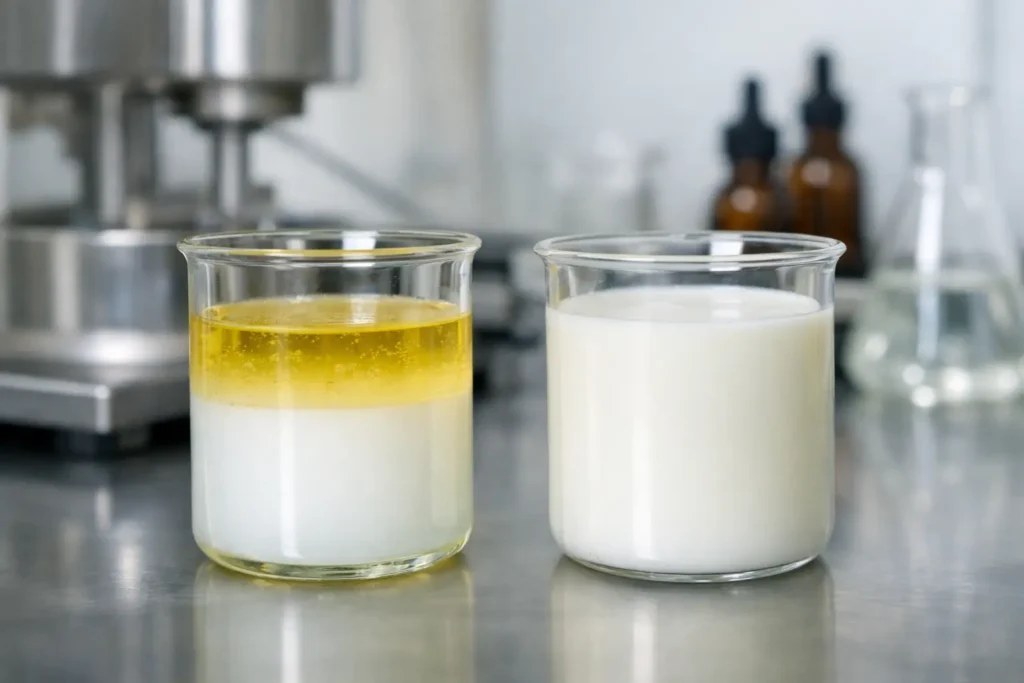
A mayonnaise batch that breaks after filling, a lotion that creams in the warehouse, or a coating that develops a clear serum layer is not simply a mixing problem. The question of what causes emulsion separation is really a question of whether the process created, and then preserved, a stable droplet structure under the actual conditions of production, storage, shipping, and use.
An emulsion is inherently metastable. Oil and water do not remain finely dispersed because they want to. They remain dispersed because formulation chemistry and processing energy have created a barrier against droplet movement, collision, and coalescence. When that barrier is inadequate, inconsistent, or damaged later in the process, separation becomes visible.
What Causes Emulsion Separation at the Microscopic Level?
Most visible separation begins with changes that are initially microscopic. Individual droplets may grow, migrate, flocculate, or merge long before a distinct oil layer, cream layer, or watery serum appears. The failure mechanism matters because the corrective action for one mechanism can worsen another.
Creaming or sedimentation occurs when droplets move upward or downward because of density differences between the dispersed and continuous phases. Oil droplets commonly rise in water-based emulsions. Dense dispersed phases can settle instead. The droplets may still be intact, which means the emulsion can sometimes be redispersed. However, concentration of droplets in one region increases collision frequency and raises the risk of permanent coalescence.
Flocculation occurs when droplets cluster without fully merging. It often reflects insufficient electrostatic or steric repulsion, changes in pH, high salt concentration, or depletion effects from polymers in the continuous phase. Flocculated droplets behave as larger effective particles, making creaming faster and product appearance less uniform.
Coalescence is the more damaging failure mode. The protective interfacial film between droplets fails, droplets merge, and the average droplet size rises. Once extensive coalescence occurs, simple remixing will not restore the original particle-size distribution or shelf-life performance.
Ostwald ripening is another route to instability, particularly when the dispersed phase has measurable solubility in the continuous phase. Smaller droplets dissolve more readily than larger droplets, allowing material to diffuse and enlarge larger droplets over time. A product can leave the plant looking stable and still separate months later through this slow redistribution process.
Droplet Size Distribution Determines Stability
Droplet size is one of the strongest process-controlled drivers of emulsion stability. Smaller droplets generally cream or settle more slowly because gravitational separation decreases sharply as droplet diameter falls. But average droplet size alone is not enough.
A broad distribution with a small number of oversized droplets can destabilize an otherwise well-processed batch. Large droplets migrate faster, collide more readily, and can act as early sites for coalescence. For this reason, a process target should include both a representative mean droplet size and control of the distribution tail.
Traditional tank agitation can circulate bulk liquid effectively while leaving a population of large droplets untouched. The impeller may create adequate turnover but insufficient localized stress to disrupt the dispersed phase consistently. Inline rotor-stator homogenizers, colloid mills, and high-pressure homogenizers concentrate energy in defined processing zones, producing more predictable droplet disruption when selected and operated correctly.
The trade-off is real: more shear is not always better. Excessive processing can heat the batch, damage shear-sensitive polymers, degrade proteins, entrain air, or alter the rheology that helps stabilize the final product. The goal is not maximum energy input. It is the required droplet-size distribution at the lowest practical thermal and mechanical burden.
Interfacial Chemistry Can Fail Before the Mixer Does
An emulsifier must reach newly created interface quickly enough to protect droplets as they form. If interfacial coverage is incomplete, freshly disrupted droplets can collide and merge almost immediately after leaving the high-shear zone. This is why a high-energy mixer cannot compensate indefinitely for an emulsifier system that is underdosed, poorly selected, or improperly hydrated.
Emulsifier selection depends on emulsion type, oil-phase polarity, pH, ionic strength, process temperature, and the presence of proteins, gums, surfactants, salts, solvents, or active ingredients. A system that performs in a benchtop formulation can fail at commercial scale if ingredient addition order, residence time, or local concentration differs during manufacturing.
Phase inversion is a related concern. Oil-in-water and water-in-oil systems require different emulsifier balance and processing conditions. Changes in phase ratio, temperature, or surfactant behavior can push the system toward inversion or transient instability. In concentrated systems, the process window may be narrow enough that minor variation in raw material composition creates a major shift in product structure.
Temperature, Viscosity, and Storage Conditions Matter
Temperature changes influence viscosity, density difference, interfacial tension, solubility, and emulsifier behavior at the same time. A hot batch may appear homogeneous because reduced viscosity allows easy circulation, then destabilize as it cools and the continuous phase structure changes. Conversely, low temperature can crystallize part of the oil phase, disrupt the interface, or create freeze-thaw damage.
Viscosity can reduce droplet movement and improve resistance to creaming or sedimentation, but thickening the continuous phase is not a universal fix. Some hydrocolloids require complete hydration before emulsification. Others can create localized gel regions, poor powder wetting, or excessive viscosity that limits effective droplet breakup. Product viscosity should support stability without preventing efficient processing, pumping, heat transfer, or filling.
Storage and distribution testing must reflect reality. A product held at one controlled temperature may pass internal testing but fail after thermal cycling, vibration, extended warehouse dwell time, or exposure to elevated temperatures. Stability is a system requirement, not a single post-mix observation.
Air Entrainment and Powder Addition Create Hidden Risks
Entrained air is frequently treated as a cosmetic issue, but it can contribute directly to emulsion instability. Air-liquid interfaces compete for surfactant, create oxidation risk in sensitive oils, interfere with density-based measurements, and reduce the consistency of downstream filling. Aggressive batch agitation, poorly designed return lines, vortexing, and uncontrolled powder addition can all introduce air.
Powders add another common failure point. Stabilizers, proteins, and emulsifiers that are not fully wetted and hydrated cannot deliver their intended functionality. Dry agglomerates may persist through a tank despite prolonged agitation, then hydrate later and change viscosity or interfacial behavior after filling. A powder induction system can improve wet-out by pulling powders into a controlled liquid stream and applying immediate dispersive energy, rather than relying on surface addition and bulk circulation.
Vacuum emulsification and inline deaeration may be appropriate where air removal, oxidation control, and repeatable density are critical. The right choice depends on product rheology, vapor pressure, throughput, sanitation requirements, and whether deaeration occurs before or after the primary homogenization step.
Process Variables That Commonly Drive Batch-to-Batch Variation
When a stable formulation separates inconsistently, investigate the process record before reformulating. The most consequential variables are often ordinary operating details: raw material temperature, oil addition rate, emulsifier preblend quality, batch level, recirculation flow, rotor-stator tip speed, homogenization pressure, number of passes, and hold time before cooling or filling.
Scale-up is especially sensitive. A lab rotor-stator mixer may deliver a different energy density, residence-time distribution, and recirculation pattern than a production tank. Matching rpm is not scale-up. Matching the relevant fluid-mechanics conditions is closer to the objective: shear exposure, hydraulic energy transfer, flow rate, temperature rise, and final droplet-size distribution.
For sanitary food, dairy, pharmaceutical, and personal-care operations, CIP/SIP design also affects repeatability. Residual chemistry, incomplete cleaning, seal wear, or a contaminated dead leg can alter pH, introduce destabilizing materials, or compromise a validated process. Stable product performance requires stable equipment conditions.
Diagnosing Separation Before Changing Equipment
Start with the failure pattern. A cream layer points toward density-driven migration, droplet size, and continuous-phase viscosity. A clear oil layer suggests coalescence or insufficient interfacial coverage. Separation after heat exposure may indicate phase-transition behavior, emulsifier cloud point, or viscosity loss. Instability after a formula change may trace to pH, salts, preservative additions, or a raw material substitution.
Then measure rather than infer. Compare particle or droplet-size distribution, viscosity across relevant shear rates, pH, conductivity where applicable, density, temperature history, and air content between stable and failed batches. Microscopy can distinguish flocculation from coalescence. Accelerated testing can identify trends, but it should not replace real-time shelf-life data for products with long commercial storage requirements.
EmulXion approaches these problems as precision fluid-engineering questions: define the required product structure, identify the mechanism compromising it, and establish a processing window that production can repeat. That may require high shear, high pressure, controlled powder induction, vacuum processing, or a coordinated skid that controls all of those variables together.
A stable emulsion is not the result of mixing until the batch looks uniform. It is the result of controlling droplet formation, interfacial protection, thermal history, air content, and handling conditions well enough that the product remains uniform after it leaves the production floor.


