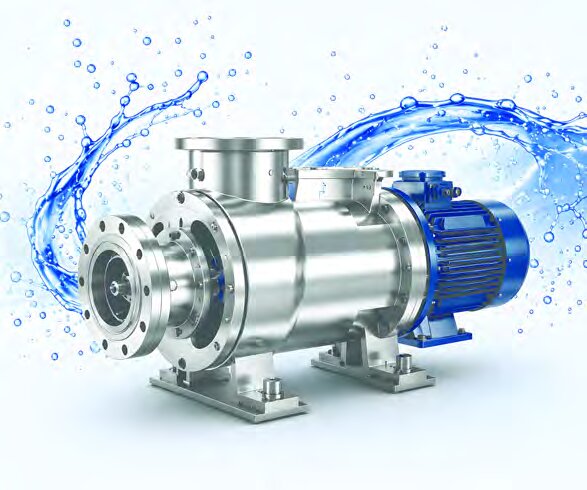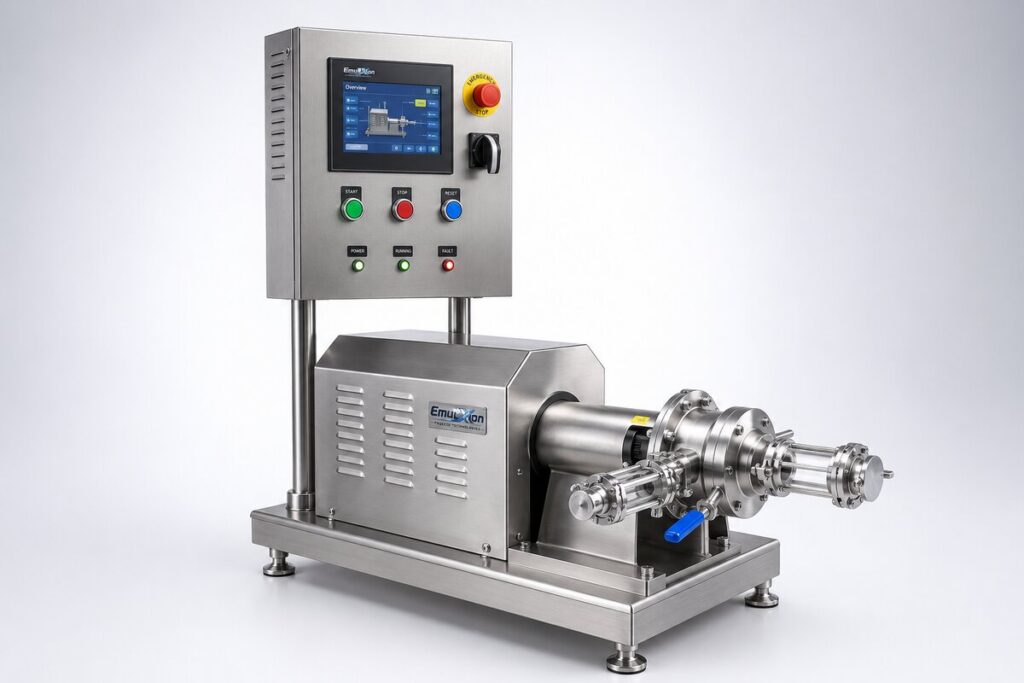
Both machines are rotor-stator devices. Both emulsify, disperse and reduce particle size. So why does one plant swear by its colloid mill while another runs everything through an inline high shear mixer? Because the two geometries apply shear differently — and each has products it is clearly better at.
The geometric difference
A colloid mill passes product through the narrow gap between a high-speed conical rotor and a matching stator. The gap is adjustable — often while running — so the operator directly controls output fineness. The long, converging flow path grinds and smears product between surfaces, which is exactly what tough, viscous, fibrous materials need.
An inline high shear mixer drives product through toothed rotor-stator work heads. Fluid is accelerated and sheared in the slots at very high frequency — intense turbulence, cavitation and mechanical shear optimized for droplet break-up and rapid blending of pumpable liquids. Multi-stage designs stack heads in series for progressive refinement.
| Factor | Colloid Mill | Inline High Shear Mixer |
|---|---|---|
| Best at | Grinding, refining, smearing viscous/fibrous products | Emulsifying, dispersing, blending pumpable liquids |
| Fineness control | Adjustable gap — dial it in per product | Fixed geometry — set by head design and stages |
| Viscosity tolerance | Excellent, including pastes | Good, up to moderately viscous products |
| Fibrous / semi-solid feed | Excellent (nut butters, mustard, meat emulsions, purees) | Limited — prefers pre-conditioned feed |
| Typical result | Smooth, refined pastes and emulsions, ~1–50 µm | Fine emulsions and dispersions, ~1–10 µm |
| Throughput style | Continuous, single pass with gap tuning | Continuous, single or multi-stage, recirculation optional |
Pick the colloid mill when…
- The product is thick, coarse or fibrous: peanut and nut butters, tahini, mustard, tomato paste, fruit purees, meat emulsions, ointments, pigment pastes, bitumen emulsions.
- You run multiple recipes at different fineness targets on one machine — the adjustable gap is your changeover tool.
- Texture is the spec: “smooth, no grit” is colloid mill language.
Pick the high shear mixer when…
- The duty is emulsification or dispersion of pumpable liquids — dressings, beverages, lotions, chemical dispersions.
- You need rapid in-line blending with tight droplet distribution, especially multi-stage single-pass duty.
- The process includes powder incorporation — pair it with powder induction and hydration happens in the same pass.
And sometimes it’s both, in series: a colloid mill to break down coarse or fibrous feed, then a high shear mixer or high-pressure homogenizer to finish the emulsion. Mayonnaise, mustard-based dressings and many pharma semisolids run exactly this way.
Not sure which fits your product?
Describe the product, viscosity before and after, the fineness target and throughput — an EmulXion engineer will recommend the right machine, or the right sequence, with sizing and pricing. Ask an engineer →