
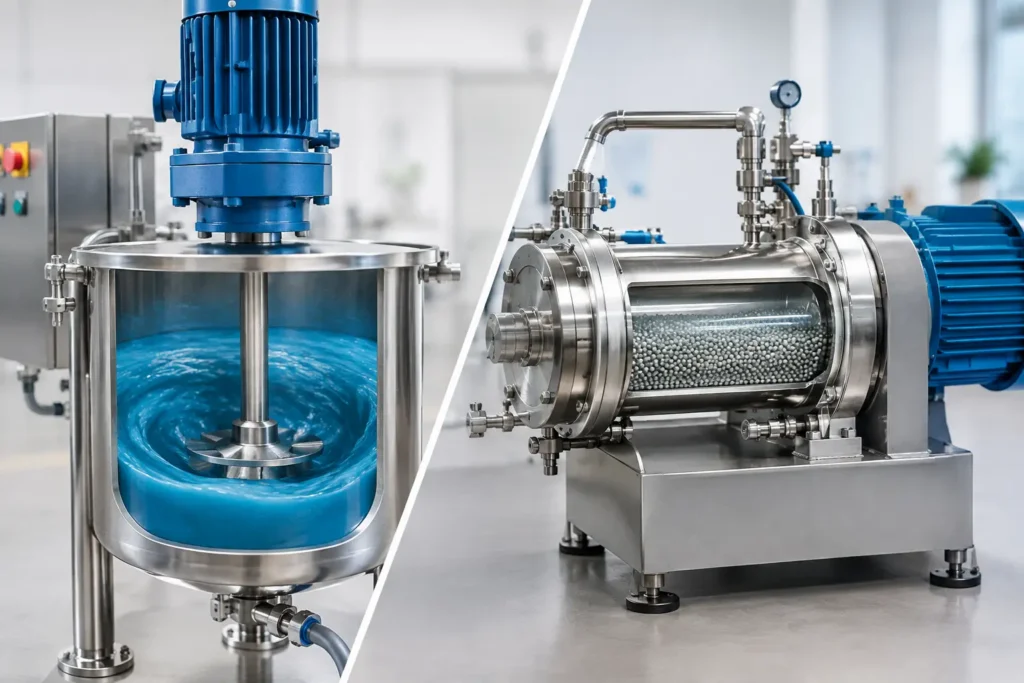
A pigment that looks fully incorporated in a tank can still fail color-strength, gloss, viscosity, or stability targets downstream. The central question in a disperser versus bead mill decision is not which machine creates more visible motion. It is whether the process must wet and separate agglomerates, or whether it must deliver controlled particle-size reduction beyond what hydrodynamic mixing alone can achieve.
For coatings, inks, adhesives, battery slurries, ceramics, cosmetics, and advanced materials, that distinction determines more than final quality. It affects cycle time, energy demand, cooling requirements, cleaning strategy, media contamination risk, and the reliability of scale-up. Equipment should be selected around the required particle-size distribution and material response, not around a generic requirement for high shear.
Disperser Versus Bead Mill: The Core Difference
A high-speed disperser uses a rotating disc, commonly a sawtooth-style blade, to generate flow, turbulence, and localized shear in a batch vessel. At the correct blade speed and immersion depth, the disc establishes a controlled vortex that draws powders into the liquid and circulates material through the high-energy zone near the blade edge. Its primary role is rapid powder wetting, bulk blending, and the breakup of soft agglomerates.
A bead mill processes product through a chamber filled with small grinding media. Product movement, rotor energy, and media-to-media collisions produce intense mechanical attrition. This action can fracture hard agglomerates and, when the formulation permits, reduce the actual particle size of solids. Most production bead mills operate in recirculation mode, repeatedly passing material through the mill until the required fineness is reached.
The difference is consequential. A disperser transfers energy through the liquid and blade-generated flow field. A bead mill transfers energy through grinding media contacting the material. If the particles are only loosely bound and need wetting and separation, a disperser may be sufficient. If they are hard, persistent, or must reach a narrow fine-particle specification, a bead mill is usually the more capable technology.
What a High-Speed Disperser Does Well
A disperser is often the practical first processing step when dry powders must be incorporated quickly into a liquid vehicle. It performs well with many pigments, fillers, gums, thickeners, polymers, and mineral solids when the objective is to eliminate dry pockets, hydrate powders, and create a uniform premix.
Its performance depends heavily on operating conditions. Blade diameter, tip speed, vessel geometry, liquid level, powder addition rate, and product viscosity all influence circulation through the dispersion zone. A blade operating too slowly may simply rotate the batch with limited deagglomeration. One operating too aggressively can entrain air, create excessive heat, or destabilize shear-sensitive ingredients.
Dispersers are attractive because they are relatively simple, accessible, and effective for broad process duties. They can accommodate high-viscosity materials that are difficult to pump through a recirculating mill. They are also useful where batch flexibility matters, such as development work, short production campaigns, and formulas with frequent changeovers.
Their limitation is energy density. A conventional batch disperser does not provide the repeated, high-intensity particle contact available inside a bead mill. It may break down soft clusters and distribute solids evenly, yet leave a wide particle-size distribution or fail to reach the fineness needed for high-gloss coatings, fine inks, electronic materials, or demanding suspension stability.
When a Bead Mill Becomes Necessary
A bead mill is selected when the specification is defined by particle size, not simply visual uniformity. Typical indicators include low micron or submicron targets, demanding color development, improved gloss, high opacity, stable rheology, controlled sedimentation, or the removal of grit from a finished suspension.
The milling chamber concentrates energy within a much smaller volume than a tank disperser. Bead size, bead loading, rotor design, residence time, flow rate, and pass count can be adjusted to control the balance between throughput and fineness. Smaller media generally creates more contact points and supports finer grinding, but it also increases sensitivity to separation design, viscosity, and pressure drop.
Bead milling is not automatically the better choice for every difficult powder. It adds equipment complexity, cooling demand, wear components, and cleaning considerations. The media and chamber materials must also be compatible with the product. In contamination-sensitive applications, trace wear from beads, rotor surfaces, or screens can be unacceptable unless the materials of construction and operating window are carefully engineered.
Heat is another critical variable. Grinding energy becomes heat, and temperature rise can change viscosity, degrade binders, volatilize solvents, damage active ingredients, or alter the very particle interactions being targeted. Effective milling systems require adequate cooling capacity and process monitoring, especially during long recirculation campaigns or when processing temperature-sensitive formulations.
Particle Reduction Is Not the Same as Dispersion
This distinction prevents many equipment-selection errors. Dispersion describes the distribution of one material throughout another. Particle reduction describes a measurable decrease in particle size. A product can appear well dispersed while still containing oversize particles that later produce settling, poor film appearance, nozzle plugging, or inconsistent performance.
Conversely, aggressively reducing particle size can create formulation problems. Finer particles increase surface area, which may raise viscosity, increase demand for dispersants, alter color shade, or reduce filterability. In some systems, overmilling can damage crystal structures or create excessive fines that compromise downstream behavior.
The appropriate process target should therefore be defined with data. Particle-size distribution, not only a single average value, is typically more useful. A D90 target may be essential where oversize particles cause defects, while D50 or D10 values may matter for performance driven by the fine fraction. Hegman gauge readings can support in-process checks for coatings and inks, but they do not replace particle-size analysis when tight specifications are required.
A Two-Stage Process Often Delivers Better Control
For many formulations, the best answer is not a choice between one machine or the other. It is a sequence. A disperser creates a pumpable, homogeneous premix by wetting powders and breaking down the largest soft agglomerates. The premix then moves through a bead mill for controlled fine grinding.
This division of labor improves milling efficiency. Feeding dry powder directly into a bead mill is generally impractical, while sending poorly wetted, inconsistent premix into the mill can cause unstable pressure, screen loading, inefficient energy use, and variable results. A well-designed premix reduces the burden on the milling stage and supports more predictable pass-to-pass performance.
At larger scale, the upstream and downstream systems must be designed as part of the same process. Tank geometry, agitator selection, transfer-pump capability, line velocity, heat-exchanger duty, mill flow rate, and filtration requirements all affect final product quality. A bead mill cannot compensate for a premix tank that produces dead zones or inconsistent solids concentration.
For applications where a conventional disperser does not provide sufficient control but media milling is excessive, an inline rotor-stator mixer may be a useful intermediate option. Its engineered processing zone can deliver repeatable hydraulic shear, rapid recirculation, and closed-loop processing without grinding media. It remains fundamentally different from bead milling, however, and should not be specified when true particle fracture is required.
Selection Variables That Matter in Production
Start with the material, not the equipment category. Hardness, particle morphology, surface chemistry, solids loading, viscosity curve, solvent system, and temperature sensitivity establish the process window. A soft pigment agglomerate in a low-viscosity coating vehicle behaves very differently from a ceramic powder, conductive carbon, or high-solids battery slurry.
Next, define the performance requirement in measurable terms. Required particle-size distribution, batch volume, hourly throughput, allowable temperature rise, allowable contamination, cleaning frequency, and product-changeover requirements are all design inputs. If the plant operates under sanitary, GMP, or validated cleaning requirements, the system must also account for CIP/SIP capability, drainability, surface finish, documentation, and material traceability.
Scale-up should be based on demonstrated process conditions rather than motor horsepower alone. Tip speed can be relevant for a disperser, while bead mill scale-up requires attention to specific energy input, media loading, residence-time distribution, cooling performance, and recirculation volume. A pilot trial should capture these conditions alongside final particle-size and rheology data. That dataset is far more valuable than a nominal equipment size when moving toward commercial production.
EmulXion approaches this decision as a fluid-engineering problem: identify the energy mechanism required by the formulation, then build the processing line around repeatable control of that mechanism. The correct system may be a disperser, a media mill, an inline high-shear stage, or an integrated combination of technologies.
The most productive next step is to test the actual formulation under controlled conditions and establish an operating window that meets quality targets without excessive passes, heat exposure, or energy input. When the process is engineered around what the particles actually require, product performance becomes a controlled outcome rather than a result of trial and error.


